
Victor R. Claveau, MJ
The Book of Mormon describes an extensive culture involving an untold number of people. The book lists thirty-eight specific cities, none of which has been located. Only the Hill Cumorah, has been discovered by archaeologists, and no artifacts which corresponded to those described in Smith’s book have turned up. Every year in July the LDS Churchproduces the Hill Cumorah pageant in Palmyra, New York. This pageant places the final scenes of the Book of Mormon in that location. Today, there is some controversy as to the location of the Hill Cumorah. Some speculate that Hill Cumorah is in Central America. Joseph Smith is on record, definitely declaring the hill, near his home in Western New York, called Cumorah to be the exact hill spoken of in the Book of Mormon.
Ultimately, the Book of Mormon is a tangled work of fiction, which flowed from the fertile mind of a young huckster. Once he convinced his family that he was receiving visions of God, he had a tiger by the tail. His elaborate hoax became something powerful and potentially dangerous, as it took on a life of its own.
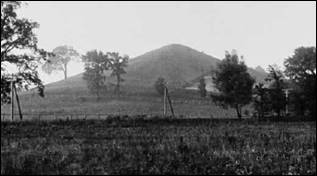
1906 photo of the Hill Cumorah in Palmyra, New York
Almost sixty years ago, Thomas F. O’Dea (1915-1974), professor of sociology at the University of Utah made a in-depth study of Mormonism and wrote a penetrating book entitled The Mormons.[i] In a chapter entitled, The New Scripture and Its Manifest Meaning, he provided an overview of the Book of Mormon:
“The Book of Mormon, which, according to Mormon belief, was miraculously translated from plates of gold by Joseph Smith, claims to be the record of the aboriginal inhabitants of the Western Hemisphere and covers a period of a thousand years, from 600 B.C. to A.D. 400. It is made up of fourteen books and an editorial note and fills 522 pages in the current edition of the Utah church. The first two books, I and II Nephi, cover a period from 600 to 545 B.C. and tell how Lehi, a descendant of Joseph who was sold into Egypt by his brothers, together with his wife Sariah, his four sons—Laman, Lemuel, Sam, and Nephi—and their families and followers, left Jerusalem shortly before the Babylonian captivity and, led by the Lord in a ship which Lehi had built at his command, arrived at a land of promise across the sea. The rebellion of Laman and Lemuel and their people is punished by their being cursed with a dark skin, and from these Lamanites the American Indians are believed to have descended.
“Next follow four short books—Jacob, Enos, Jarom, and Omni—which bring the chronology up to 130 B.C. and tell of the land of Zarahemia, which had been settled by other Hebrews who had left Judah when Zedekiah (II Kings 25:1-7) was carried away captive to Babylon. Then follows the ditorial note called the ‘Words of Mormon,’ which was supposed to have been written in A.D. 385 by the compiler.
“Next are the three main books—Mosiah, Alma, and Helaman—which develop the history of the Nephites, the descendants of Lehi’s faithful son, from 145 to 2 B.C. Here are found the rule and preaching of Benjamin and Mosiah, the wars with the Lamanites, the persecution ot true religion, the founding of Alma’s church, his high priesthood and chief judgeship, the second Alma as high priest and chief judge, the preaching so reminiscent of revival exhortation, the conversion of Lamoni, the appearance of Korihor the Anti-Christ, the threat from secret organizations (which, it has been suggested, represent the Masons), the admonitions of Alma, the prophecy of Samuel the Lamanite, and much else. This record is continued in III and IV Nephi, which describes the coming of Christ to this continent after the Resurrection and the flourishing of the Church of Christ among both Nephites and Lamanites during a period of peace and righteousness, bringing the story up to A.D. 321. The Book of Mormon follows, recounting how sin and apostasy follow the period of virtue and relating the final struggle between the Nephites and Lamanites, in which the former are wiped out in punishment for their sins, and in fulfillment of prophecy. This battle takes place at the Hill Cumorah, where Joseph Smith was later given the gold plates, which had been stored there by Moroni.
“At this point the narrative is interrupted by the Book of Ether, which gives the history of the Jaredites, a people whose discovery by the Nephites was reported in the Book of Omni. Jared and his people had come to the new world in saucer-like submarines at the time of the Tower of Babel and had been destroyed because they would not repent of their iniquity. It is here that the word ‘Deseret’ is used and translated to mean ‘honey bee.’ This word was later proposed by the Mormons as the name for the state of Utah. Finally, there is the Book of Moroni, a kind of postscript in which Moroni, who later is said to have given the plates to Joseph Smith, describes the ritual practices and gives doctrinal instruction.
“This work, which is sacred to the Church of Jesus Christ of Latter-day Saints and which ranks with the Bible as holy scripture in its eyes, has been variously explained by non-Mormons.”[ii]
After listing a number of unsubstantiated hypostasis’ concerning the authorship of Book of Mormon, O’Dea, goes on to say:
“There is a simple common-sense explanation which states that Joseph Smith was a normal person living in an atmosphere of religious excitement that influenced his behavior as it had that of so many thousands of others and, through a unique concomitance of circumstances, influences, and pressures, led him from necromancy into revelation, from revelation to prophecy, and from prophecy to leadership of an important religious movement and to involvement in the bitter and fatal intergroup conflicts that his innovations and success had called forth. To the non-Mormon who does not accept the work as divinely revealed scripture, such an explanation on the basis of the evidence at hand seems far the most likely and safest.”
The first edition of the Book of Mormon had many errors and awkward passages which have been either removed or corrected.
Mormon raised, Fawn M. Brodie, in her highly praised biography of Joseph Smith, No Man Knows My History[iii] wrote:
“Scholars of American literary history have remained persistently uninterested in the Book of Mormon. Their indifference is the more surprising since the book is one of the earliest examples of frontier fiction, the first long Yankee narrative that owes nothing to English literary fashions. Except for the borrowings from the King James Bible, its sources are absolutely American. No sociologist has troubled to draw parallels between the Book of Mormon and other sacred books, like the Koran and Science and Health, though all are ostensibly divinely inspired and all are an obscure compound of folklore, moral platitude, mysticism, and millennialism.
“Every creed perhaps must have its sacred books. And among such books the Mormon Bible is one of the most remarkable for its sheer pretension. It is easy enough to deride its style, and painstaking research can uncover the sources of all its ideas. But nothing can detract from the fact that many people have found it convincing history.”[iv]
[i] Thomas F. O’Dea, The Mormons, (Chicago: The University of Chicago Press) 1957.
[ii] Ibid., pp. 22-23.
[iii] Although No Man Knows My History criticized many foundational Mormon beliefs about Joseph Smith, the LDS Church was slow to condemn the work, even as the book went into a second printing. In 1946, The Improvement Era, an official periodical of the Church, said that many of the book’s citations arose from doubtful sources and that the biography was “of no interest to Latter-day Saints who have correct knowledge of the history of Joseph Smith.” The “Church News” section of the Deseret News had a lengthy critique: it praised the biography’s “fine literary style” and denounced it as “a composite of all anti-Mormon books that have gone before.” In the booklet, “No, Ma’am, That’s Not History”, the BYU professor and LDS historian and apologist Hugh Nibley challenged Brodie. He asserted that she had cited sources supportive only of her conclusions while conveniently ignoring others. Brodie described the Deseret News pamphlet as “a well-written, clever piece of Mormon propaganda,” but she dismissed the more popular “No, Ma’am, That’s Not History” as “a flippant and shallow piece.”
[iv] Fawn M. Brodie, No Man Knows My History: The Life of Joseph Smith (New York: Alfred A. Knopf, 2nd. ed., 1971), p. 67.