
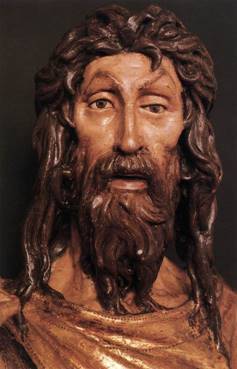
St. John the Baptist (1434) by Donatello
Beyond the simple Gospel story telling of his miraculous birth, brief ministry, and tragic fate, little is known of the life of St. John the Baptist. It is probable, however, that he lived with his parents at Hebron, in what St. Jerome justly calls their ‘plentiful home,’ for his father belonged to the priestly house of Abia, and, as a direct descendant from Aaron, was entitled to take a very high place in Jewish society. The little John may often have gone with his mother St. Elizabeth to visit their humble relations in Nazareth, and he may have played with the child Jesus in the carpenter’s shop, though the games of the boys are not likely to have been of the solemn character the early painters were so fond of giving to them.
It is said that Herod was as anxious to destroy the child John as the infant Jesus, and that he sent his soldiers to Zacharias in the temple to inquire where his son was, to which the father replied: ‘By the God whose priest I am, and whom I serve, I do not know.’ Persisting in this reply, no doubt a true one, in spite of the repeated threats of Herod that he would kill him if he did not produce the child, Zacharias fell a victim to the fury of the baffled tyrant, whose emissaries followed him into the very Holy of Holies and there put him to death.
Whether the absence of John in the wilderness was really the cause of his father’s death or not, it seems certain that the Forerunner was still a mere lad when he withdrew from all the joys of family life to dwell alone in the desert, where, says Origen, writing in the first century, ‘The air was more pure, the heavens more open, and God more familiar; that till the time of his preaching was come he might employ himself in prayer in the company of angels… ‘He had neither scrip nor servant, nor so much as a poor cottage to shelter himself from the inclemency of the weather.’
However fully they may have realized the nobility of the mission of their son before their own deaths, it must have been at first something of a disappointment to Elizabeth and Zacharias when the long-desired heir renounced all claim to his heritage, and elected to spend a life of celibacy away from them. The father, perhaps, had interpreted the promise that the child to be born to him should be great before God, to mean that he would serve the Lord in the Temple or the State, and the profound humility which was the Baptist’s chief characteristic can scarcely have appeared a virtue in the eyes of the high-born Zacharias. However that may be, all worldly ambition for his only son was probably abandoned before his own tragic end, for throughout his strange experiences, the Jewish priest submitted at once to the spirit of the revelations made to him.
Though they give full and significant details of the brief ministry of St. John up to its crowning act, the Baptism of Christ, the Evangelists dwell but slightly on the causes which led to the tragedy of Herod’s birthday feast on the fatal 29th of August, when St. John was thirty-three years old. It is, however, implied by Josepnus and other authorities that the Tetrarch, in spite of his hatred of the Christians, had become greatly attached to the prophet, encouraging his soldiers to attend his preaching, and often himself consulting him on political matters. There seems to be no doubt that, irritated though he was by the warnings and remonstrances of St. John, Herod would never have proceeded to extremities against him but for the influence of Herodias, whom he had married whilst her husband, his brother Philip, was still alive. It was his guilty wife — if wife she could be called — who persuaded him to send St. John to prison, and it is implied that he had hoped to be able to release him privately ere long. Herod’s dismay must therefore have been great indeed when he found that nothing would content his evil genius but the murder of his friend. He was more than grieved: he was terrified, and remorse for the deed haunted him for the rest of his life, as proved by his constant fear, when he heard of the wonderful works of Christ, that St. John had returned from the grave.
It is customary to speak of St. Stephen as the first Christian martyr, but surely that title might with greater justice be given to St. John the Baptist, who paid for his self-sacrificing devotion to the principles of Christ with his life, dying a violent death even before the crucifixion of the Master.
True, the immediate cause of his tragic fate was not the profession of his faith in the divinity of the Lord, but for all that he was in the highest sense a martyr to the zeal with which he taught and put in practice the truth revealed to him.
St. Jerome supplements the Gospel narrative of the death of St. John by saying that when Salome, the daughter of Herodias by her first husband, presented the head of her victim to her mother, the latter pierced the tongue with a bodkin [sewing tool], in a fit of futile rage against the unconscious instrument of the eloquence which had all but succeeded in deterring Herod from marrying her.
With characteristic reticence the Evangelists contented themselves with stating that when John was dead the disciples came and took up the body and burned it; but tradition adds that the place of sepulture was Sebaste or Samaria, and that the revered remains were left in peace until about A.D. 363, when the tomb was broken open, and part of the skeleton was burnt by the heathen. Some few bones were, however, saved by the Christians, who sent them to St. Athanasius, then Bishop of Alexandria. By him they were reverently interred, and twenty years later a beautiful church was built for their reception by the Emperor Theodosius. Tradition further adds that the head of the Baptist, after being lost for 400 years, was found at Emissa in Syria, though how it was identified is not explained. After many wanderings in the custody of various guardians, it was deposited in Rome, in the Church of St. Silvestro in Capite, built on purpose to receive it by Pope Paul I., but it has since been removed to the Pope’s private apartments in the Vatican.
The characteristics by which the parents of St. John the Baptist may be recognized in art are not numerous, but they are quaint and significant. St. Zacharias, who is one of the patrons of Venice, his body having been transported there from the Holy Land in the ninth century, generally stands beside an altar in his priestly robes, wearing a Phrygian helmet on his head, and holding a thurible in his right hand. The Phrygian helmet is of special interest as having been the original form of the mitre adopted first by the Greek and later by the Roman Catholic Church, although it was in antique art the distinguishing mark of a barbarian warrior of Asia; whilst the thurible, the symbol amongst the Jews of the Levitic priesthood, marks the high sacerdotal position of Zacharias.
St. Elizabeth is generally represented as a dignified elderly woman, and her noble character has been finely interpreted in many a beautiful ‘Salutation,’ in which she and her cousin, the Blessed Virgin, are sometimes alone, and sometimes accompanied by St. Zacharias and St. Joseph of Nazareth, or by one or two attendant women. In some subjects St. Elizabeth has an escort of angels, for she is said to have withdrawn to the desert with her son when he was seven years old, and there to have been ministered to by messengers from on high. Now and then a mass of rock is introduced behind the mother and child, in allusion to a Greek legend to the effect that when they were pursued by Herod’s executioners a rock opened to receive them, hiding them till the danger was past.
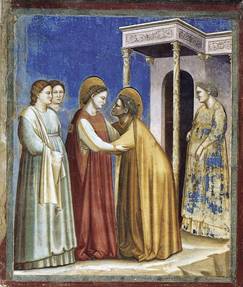
Among the most beautiful Italian representations of the Visitation are the fresco by Giotto in the Arena Chapel at Padua, (above) remarkable for the great beauty of the expression of the Virgin’s face, and the reverential love of the attitude of St. Elizabeth.
The symbols and attributes of St. John the Baptist are, of course, far more numerous than those of his parents, and in the course of centuries they have been frequently modified. The lamb, the cross-hilted staff, and the raiment of camel’s hair are fairly constant, but even they have been subject to slight changes in treatment. The figure of a lamb, in evident allusion to the fact that St. John hailed Jesus as the Lamb of God, was in mediaeval times placed in his hand, as in some of the quaint leaden figures found in the Seine when the river was deepened, and now in the Cluny Museum, or on a book, as in several rood-screens in England, in allusion to the fulfilment of the prophecies in the Old Testament with regard to the messenger who should precede the Messiah; whilst in many old calendars the 24th of June, the day on which the nativity of St. John the Baptist is celebrated in the Greek and Roman Catholic Churches, is marked by a lamb, sometimes with and sometimes without a banderole on which a cross is figured. Later, the child St. John was represented pointing to a lamb beside him, but as time went on this was again changed, the lamb being omitted, to give place to a cross, generally of reeds, about which was twined a scroll bearing the words ‘Agnus Dei.’ The form of the cross held by St. John the Baptist, sometimes as a staff, sometimes on the shoulder, is of special significance, being intended, it is said, to symbolize the fact that the Forerunner was the first to use the cross as a symbol of the self-denial by which heaven must be won, whilst the raiment of camel’s hair and the girdle of skin or leather belt, on account of which belt-makers, furriers, and dealers in skins look on St. John as their patron, were more than a mere literal rendering of the Evangelist’s description.
They were, in fact, the traditional garments worn by the hermits of the East, and mark the belief of the early Church that the Baptist was a true hermit or solitary worshipper of God, in spite of the fact that his later life was spent amongst crowds and in prison.
Less constant attributes of St. John the Baptist are a torch, in allusion to the words of his father, ‘To give light to them that sit in darkness’; a knife, such as that marking in some old calendars the 24th of August, the day of his death; a banner or pennant, really merely a modification of the scroll; a sword, as on a tomb at Bamberg, in which the saint is represented seated with a sword in his right hand, and in the left a medallion bearing a bas-relief of a lamb and a cross; a grated window, in allusion to bis imprisonment, as in various mediaeval drawings, in which he is seen talking to his disciples through the bars; a tree with an axe imbedded in the trunk, recalling the words: ‘the axe is laid unto the root of the tree’; and more rarely a lily, the symbol of purity and chastity. The early artists of the Greek Church also occasionally represented the Baptist with wings, in memory of the prophecy, ‘Behold, I will send My messenger, and he shall prepare the way before Me,’ messenger being taken to mean angel, an interpretation also adopted by the Latin Fathers, though not hitherto embodied in Roman Catholic art.
St. John the Baptist is the patron saint of very many towns and societies, including the Order of St. John of Jerusalem. He is supposed to be the special protector of choristers, because of the use in the Solfeggio system of certain syllables occurring in an old hymn in his honor beginning, ‘Ut queant laxīs resonāre fibrīs;[1] of cutlers, on account of the use of a knife at his execution; of carpenters, because some say it was a hatchet, not a knife, which put an end to his life; and of bird-catchers, on account of his having lived in the desert where the wild birds congregate, or, as seems more probable, because he was shut up in prison for so long.
From a very early date St. John the Baptist was specially honored in England as the guardian of young children and of the poor and oppressed. In Palestine the religious sect of the Mandaeans still claim the Forerunner as their founder, and are popularly known as the St. John Christians, because of their practicing the rite of baptism by immersion; although in pictures of the Baptism of Christ, notably in the fresco by Pinturicchio, in the Appartamenti Borgia of the Vatican, the Forerunner generally pours the water from a shell. Throughout the Continent the Baptist is everywhere honored as one of the greatest saints of the Church, taking rank even before the Evangelists and Apostles, and constantly introduced, as in Van Eyck’s ‘Adoration of the Lamb’ at Ghent, opposite to the Virgin in heaven. In the early Greek Church, he was venerated chiefly as the forerunner of Christ, and no group of saints was considered complete without his well-known figure; while in the West he was perhaps beloved chiefly as the playmate of the infant Savior, the sharer of the happy home-life of Nazareth, the constant friend of the Redeemer, and the divinely-appointed instrument of the inauguration of His work on earth. St. John the Baptist appears as a lovely boy, with a face full of more than human wisdom, in countless Holy Families; be figures as the type of all that was best in early manhood in many a scene from the life of the Master he loved so well; and in the last act of his mission, the Baptism of Christ, he is often scarcely inferior in dignity and virile beauty to Jesus Himself.
To make anything like a representative selection from the immense number of beautiful ‘Holy Families’ in which St. John the Baptist is included is extremely difficult. Scarcely a painter or sculptor of religious subjects, of whatever nationality, has failed to produce one or more renderings of the fascinating theme, but perhaps Raphael, Leonardo da Vinci, Correggio, Andrea del Sarto, Bernardino Luini, and Pinturicchio, have been most successful in interpreting the ideal character of the boy set apart from all others by his constant association with the Divine Child. ‘The Madonna della Sedia’; The Madonna in the Meadow, in which the kneeling St. John offers the cross hiked staff to his cousin; ‘The Sleep of Jesus’; ‘The Madonna with the Diadem’; ‘The Holy Family of Naples,’ in which St. Elizabeth is introduced persuading Jesus to bless her kneeling in ‘The Madonna della Tenda’; and the small ‘Holy Family’ of the Louvre, are amongst the most popular of Raphael’s numerous renderings of the familiar theme, and Leonardo da Vinci’s ‘Vierge aux Rochers,’ now in the Louvre, of which there is a replica in the National Gallery, London, is known throughout the world.
Adapted from: The Saints in Christian Art: The Evangelists, Apostles, and Other Early Saints, By Mrs. Arthur Bell, (London: George Bell & Sons, 1901)
[1] “Ut queant laxis”: a Latin hymn in honor of John the Baptist, written in Horatian Sapphics with text traditionally attributed to Paulus Diaconus, the eighth-century Lombard historian. It is famous for its part in the history of musical notation, in particular solmization. The hymn belongs to the tradition of Gregorian chant. The first stanza is: It may be translated: So that they may, with loosened voices, resound the wonders of your deeds, clean the guilt from our stained lips, O Saint John.