|
Introduction |
Top |
|
Background: |
A violent Marxist
urban guerrilla movement, the Tupamaros, launched in the late
1960s, led Uruguay's president to agree to military control of
his administration in 1973. By yearend, the rebels had been
crushed, but the military continued to expand its hold
throughout the government. Civilian rule was not restored until
1985. Uruguay's political and labor conditions are among the
freest on the continent.
|
|
|
Geography |
Top |
|
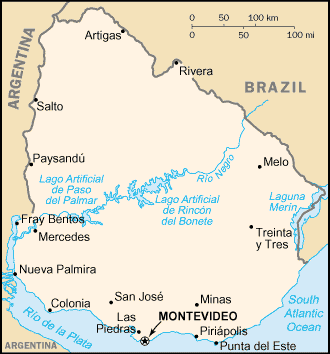
Location: |
Southern South
America, bordering the South Atlantic Ocean, between Argentina
and Brazil
|
|
|
Geographic
coordinates: |
33 00 S, 56 00 W
|
|
|
Map references: |
South America
|
|
|
Area: |
total:
176,220 sq km
land: 173,620 sq km
water: 2,600 sq km
|
|
|
Area -
comparative: |
slightly smaller
than the state of Washington
|
|
|
Land boundaries: |
total: 1,564
km
border countries: Argentina 579 km, Brazil 985 km
|
|
|
Coastline: |
660 km
|
|
|
Maritime claims: |
territorial sea:
12 nm
contiguous zone: 24 nm
exclusive economic zone: 200 nm
continental shelf: 200-m depth or to the depth of
exploitation
|
|
|
Climate: |
warm temperate;
freezing temperatures almost unknown
|
|
|
Terrain: |
mostly rolling
plains and low hills; fertile coastal lowland
|
|
|
Elevation
extremes: |
lowest point:
Atlantic Ocean 0 m
highest point: Cerro Catedral 514 m
|
|
|
Natural
resources: |
arable land,
hydropower, minor minerals, fisheries
|
|
|
Land use: |
arable land:
7.43%
permanent crops: 0.23%
other: 92.34% (2001)
|
|
|
Irrigated land: |
1,800 sq km (1998
est.)
|
|
|
Natural hazards: |
seasonally high
winds (the pampero is a chilly and occasional violent wind which
blows north from the Argentine pampas), droughts, floods;
because of the absence of mountains, which act as weather
barriers, all locations are particularly vulnerable to rapid
changes from weather fronts
|
|
|
Environment -
current issues: |
water pollution
from meat packing/tannery industry; inadequate solid/hazardous
waste disposal
|
|
|
Environment -
international agreements: |
party to:
Antarctic-Environmental Protocol, Antarctic-Marine Living
Resources, Antarctic Treaty, Biodiversity, Climate Change,
Climate Change-Kyoto Protocol, Desertification, Endangered
Species, Environmental Modification, Hazardous Wastes, Law of
the Sea, Ozone Layer Protection, Ship Pollution, Tropical Timber
94, Wetlands
signed, but not ratified: Marine Dumping, Marine Life
Conservation
|
|
|
Geography -
note: |
second-smallest
South American country (after Suriname); most of the low-lying
landscape (three-quarters of the country) is grassland, ideal
for cattle and sheep raising
|
|
|
People |
Top |
|
Population: |
3,415,920 (July
2005 est.)
|
|
|
Age structure: |
0-14 years:
23.2% (male 403,041/female 389,427)
15-64 years: 63.6% (male 1,076,960/female 1,095,833)
65 years and over: 13.2% (male 183,877/female 266,782)
(2005 est.)
|
|
|
Median age: |
total: 32.46
years
male: 31.02 years
female: 33.95 years (2005 est.)
|
|
|
Population
growth rate: |
0.47% (2005 est.)
|
|
|
Birth rate: |
14.09 births/1,000
population (2005 est.)
|
|
|
Death rate: |
9.06 deaths/1,000
population (2005 est.)
|
|
|
Net migration
rate: |
-0.28 migrant(s)/1,000
population (2005 est.)
|
|
|
Sex ratio: |
at birth:
1.04 male(s)/female
under 15 years: 1.04 male(s)/female
15-64 years: 0.98 male(s)/female
65 years and over: 0.69 male(s)/female
total population: 0.95 male(s)/female (2005 est.)
|
|
|
Infant mortality
rate: |
total: 11.95
deaths/1,000 live births
male: 13.27 deaths/1,000 live births
female: 10.58 deaths/1,000 live births (2005 est.)
|
|
|
Life expectancy
at birth: |
total
population: 76.13 years
male: 72.92 years
female: 79.45 years (2005 est.)
|
|
|
Total fertility
rate: |
1.91 children
born/woman (2005 est.)
|
|
|
HIV/AIDS - adult
prevalence rate: |
0.3% (2001 est.)
|
|
|
HIV/AIDS -
people living with HIV/AIDS: |
6,000 (2001 est.)
|
|
|
HIV/AIDS -
deaths: |
less than 500 (2003
est.)
|
|
|
Nationality: |
noun:
Uruguayan(s)
adjective: Uruguayan
|
|
|
Ethnic groups: |
white 88%, mestizo
8%, black 4%, Amerindian (practically nonexistent)
|
|
|
Religions: |
Roman Catholic 66%
(less than half of the adult population attends church
regularly), Protestant 2%, Jewish 1%, nonprofessing or other 31%
|
|
|
Languages: |
Spanish, Portunol,
or Brazilero (Portuguese-Spanish mix on the Brazilian frontier)
|
|
|
Literacy: |
definition:
age 15 and over can read and write
total population: 98%
male: 97.6%
female: 98.4% (2003 est.)
|
|
|
Government |
Top |
|
Country name: |
conventional
long form: Oriental Republic of Uruguay
conventional short form: Uruguay
local long form: Republica Oriental del Uruguay
local short form: Uruguay
former: Banda Oriental, Cisplatine Province
|
|
|
Government type: |
constitutional
republic
|
|
|
Capital: |
Montevideo
|
|
|
Administrative
divisions: |
19 departments (departamentos,
singular - departamento); Artigas, Canelones, Cerro Largo,
Colonia, Durazno, Flores, Florida, Lavalleja, Maldonado,
Montevideo, Paysandu, Rio Negro, Rivera, Rocha, Salto, San Jose,
Soriano, Tacuarembo, Treinta y Tres
|
|
|
Independence: |
25 August 1825
(from Brazil)
|
|
|
National
holiday: |
Independence Day,
25 August (1825)
|
|
|
Constitution: |
27 November 1966,
effective February 1967, suspended 27 June 1973, new
constitution rejected by referendum 30 November 1980; two
constitutional reforms approved by plebiscite 26 November 1989
and 7 January 1997
|
|
|
Legal system: |
based on Spanish
civil law system; accepts compulsory ICJ jurisdiction
|
|
|
Suffrage: |
18 years of age;
universal and compulsory
|
|
|
Executive
branch: |
chief of state:
President Tabare VAZQUEZ (since 1 March 2005) and Vice President
Rodolfo NIN NOVA (since 1 March 2005); note - the president is
both the chief of state and head of government
head of government: President Tabare VAZQUEZ (since 1
March 2005) and Vice President Rodolfo NIN NOVA (since 1 March
2005); note - the president is both the chief of state and head
of government
cabinet: Council of Ministers appointed by the president
with parliamentary approval
elections: president and vice president elected on the
same ticket by popular vote for five-year terms; election last
held 31 October 2004 (next to be held October 2009)
election results: Tabare VAZQUEZ elected president;
percent of vote - Tabare VAZQUEZ 50.5%, Jorge LARRANAGA 35.1%,
Guillermo STIRLING 10.3%
|
|
|
Legislative
branch: |
bicameral General
Assembly or Asamblea General consists of Chamber of Senators or
Camara de Senadores (30 seats; members are elected by popular
vote to serve five-year terms) and Chamber of Representatives or
Camara de Representantes (99 seats; members are elected by
popular vote to serve five-year terms)
elections: Chamber of Senators - last held 31 October
2004 (next to be held October 2009); Chamber of Representatives
- last held 31 October 2004 (next to be held October 2009)
election results: Chamber of Senators - percent of vote
by party - NA%; seats by party - EP-FA 16, Blanco 11, Colorado
Party 3; Chamber of Representatives - percent of vote by party -
NA%; seats by party - EP-FA 52, Blanco 36, Colorado Party 10,
Independent Party 1
|
|
|
Judicial branch: |
Supreme Court
(judges are nominated by the president and elected for 10-year
terms by the General Assembly)
|
|
|
Political
parties and leaders: |
Colorado Party
[Jorge BATLLE Ibanez]; National Party or Blanco [Luis Alberto
LACALLE Herrera]; New Sector/Space Coalition (Nuevo Espacio)
[Rafael MICHELINI]; Progressive Encounter/Broad Front Coalition
(Encuentro Progresista/Frente Amplio) or EP-FA [Tabare VAZQUEZ];
Independent Party (Partido Independiente) [leader NA]
|
|
|
Political
pressure groups and leaders: |
Agrupacion UTE
(powerful state worker's union), Rural Association of Uruguay
(rancher's association), Uruguayan Construction League, Chamber
of Uruguayan Industries (manufacturer's association), Chemist
and Pharmaceutical Association (professional organization),
Architect's Society of Uruguay (professional organization), the
Catholic Church, students
|
|
|
International
organization participation: |
CSN, FAO, G-77,
IADB, IAEA, IBRD, ICAO, ICC, ICCt, ICRM, IFAD, IFC, IFRCS, IHO,
ILO, IMF, IMO, Interpol, IOC, IOM, ISO, ITU, LAES, LAIA,
Mercosur, MIGA, MINURSO, MINUSTAH, MONUC, NAM (observer), OAS,
ONUB, OPANAL, OPCW, PCA, RG, UN, UNAMSIL, UNCTAD, UNESCO,
UNFICYP, UNIDO, UNMEE, UNMOGIP, UNMOT, UNOCI, UNOMIG, UPU, WCL,
WCO, WFTU, WHO, WIPO, WMO, WToO, WTO
|
|
|
Flag
description: |
nine equal
horizontal stripes of white (top and bottom) alternating with
blue; there is a white square in the upper hoist-side corner
with a yellow sun bearing a human face known as the Sun of May
and 16 rays alternately triangular and wavy
|
|
|
Economy |
Top |
|
Economy -
overview: |
Uruguay's
well-to-do economy is characterized by an export-oriented
agricultural sector, a well-educated workforce, and high levels
of social spending. After averaging growth of 5% annually during
1996-98, in 1999-2002 the economy suffered a major downturn,
stemming largely from the spillover effects of the economic
problems of its large neighbors, Argentina and Brazil. For
instance, in 2001-02 massive withdrawals by Argentina of dollars
deposited in Uruguayan banks led to a plunge in the Uruguyan
peso and a massive rise in unemployment. Total GDP in these four
years dropped by nearly 20%, with 2002 the worst year due to the
serious banking crisis. Unemployment rose to nearly 20% in 2002,
inflation surged, and the burden of external debt doubled.
Cooperation with the IMF limited the damage. The debt swap with
private creditors carried out in 2003, which extended the
maturity dates on nearly half of Uruguay's $11.3 billion in
public debt, substantially alleviated the country's amortization
burden in the coming years and restored public confidence. The
economy grew about 10% in 2004 as a result of high commodity
prices for Uruguayan exports, the weakness of the dollar against
the euro, growth in the region, low international interest
rates, and greater export competitiveness.
|
|
|
GDP: |
purchasing power
parity - $49.27 billion (2004 est.)
|
|
|
GDP - real
growth rate: |
10.2% (2004 est.)
|
|
|
GDP - per
capita: |
purchasing power
parity - $14,500 (2004 est.)
|
|
|
GDP -
composition by sector: |
agriculture:
7.9%
industry: 27.4%
services: 64.8% (2004 est.)
|
|
|
Labor force: |
1.56 million (2004
est.)
|
|
|
Labor force - by
occupation: |
agriculture 14%,
industry 16%, services 70%
|
|
|
Unemployment
rate: |
13% (2004 est.)
|
|
|
Population below
poverty line: |
21% of households
(2003)
|
|
|
Household income
or consumption by percentage share: |
lowest 10%:
3.7%
highest 10%: 25.8% (1997)
|
|
|
Distribution of
family income - Gini index: |
44.8 (1999)
|
|
|
Inflation rate
(consumer prices): |
7.6% (2004 est.)
|
|
|
Investment
(gross fixed): |
9.6% of GDP (2004
est.)
|
|
|
Budget: |
revenues:
$3.332 billion
expenditures: $3.787 billion, including capital
expenditures of $193 million (2004 est.)
|
|
|
Agriculture -
products: |
rice, wheat, corn,
barley; livestock; fish
|
|
|
Industries: |
food processing,
electrical machinery, transportation equipment, petroleum
products, textiles, chemicals, beverages
|
|
|
Industrial
production growth rate: |
22% (2004 est.)
|
|
|
Electricity -
production: |
8.536 billion kWh
(2003)
|
|
|
Electricity -
production by source: |
fossil fuel:
0.7%
hydro: 99.1%
nuclear: 0%
other: 0.3% (2001)
|
|
|
Electricity -
consumption: |
5.878 billion kWh
(2003)
|
|
|
Electricity -
exports: |
954 million kWh
(2003)
|
|
|
Electricity -
imports: |
434.2 million kWh
(2003)
|
|
|
Oil -
production: |
0 bbl/day (2001
est.)
|
|
|
Oil -
consumption: |
41,500 bbl/day
(2001 est.)
|
|
|
Oil - exports: |
NA
|
|
|
Oil - imports: |
NA
|
|
|
Natural gas -
production: |
0 cu m (2003 est.)
|
|
|
Natural gas -
consumption: |
64.5 million cu m
(2003 est.)
|
|
|
Natural gas -
exports: |
0 cu m (2003 est.)
|
|
|
Natural gas -
imports: |
65 million cu m
(2003 est.)
|
|
|
Current account
balance: |
$181.8 million
(2004 est.)
|
|
|
Exports: |
$2.2 billion f.o.b.
(2003 est.)
|
|
|
Exports -
commodities: |
meat, rice, leather
products, wool, fish, dairy products
|
|
|
Exports -
partners: |
Brazil 19.4%, US
18%, Germany 6.6%, Argentina 6.4% (2004)
|
|
|
Imports: |
$2.071 billion
f.o.b. (2003)
|
|
|
Imports -
commodities: |
machinery,
chemicals, road vehicles, crude petroleum
|
|
|
Imports -
partners: |
Argentina 21.3%,
Brazil 17.1%, US 12.3%, China 6.9%, Russia 5.1% (2004)
|
|
|
Reserves of
foreign exchange and gold: |
$2.362 billion
(2004 est.)
|
|
|
Debt - external: |
$12.8 billion
(March 2004)
|
|
|
Currency (code): |
Uruguayan peso (UYU)
|
|
|
Currency code: |
UYU
|
|
|
Exchange rates: |
Uruguayan pesos per
US dollar - 28.704 (2004), 28.209 (2003), 21.257 (2002), 13.319
(2001), 12.1 (2000)
|
|
|
Fiscal year: |
calendar year
|
|
|
Communications |
Top |
|
Telephones -
main lines in use: |
946,500 (2002)
|
|
|
Telephones -
mobile cellular: |
652,000 (2002)
|
|
|
Telephone
system: |
general
assessment: fully digitalized
domestic: most modern facilities concentrated in
Montevideo; new nationwide microwave radio relay network
international: country code - 598; satellite earth
stations - 2 Intelsat (Atlantic Ocean) (2002)
|
|
|
Radio broadcast
stations: |
AM 91, FM 149,
shortwave 7 (2001)
|
|
|
Radios: |
1.97 million (1997)
|
|
|
Television
broadcast stations: |
23 (2002)
|
|
|
Televisions: |
782,000 (1997)
|
|
|
Internet country
code: |
.uy
|
|
|
Internet hosts: |
87,630 (2003)
|
|
|
Internet Service
Providers (ISPs): |
14 (2001)
|
|
|
Internet users: |
400,000 (2002)
|
|
|
Transportation |
Top |
|
Railways: |
total: 2,073
km
standard gauge: 2,073 km 1.435-m gauge
note: 461 km have been taken out of service and 460 km
are in partial use (2004)
|
|
|
Highways: |
total: 8,983
km
paved: 8,081 km
unpaved: 902 km (1999 est.)
|
|
|
Waterways: |
1,600 km (2002)
|
|
|
Pipelines: |
gas 192 km (2004)
|
|
|
Ports and
harbors: |
Colonia, Fray
Bentos, Juan La Caze, La Paloma, Montevideo, Nueva Palmira,
Paysandu, Punta del Este, Piriapolis
|
|
|
Merchant marine: |
total: 11
ships (1,000 GRT or over) 10,918 GRT/10,342 DWT
by type: cargo 1, chemical tanker 1, passenger/cargo 6,
petroleum tanker 2, roll on/roll off 1
foreign-owned: 4 (Argentina 3, Greece 1)
registered in other countries: 8 (2005)
|
|
|
Airports: |
64 (2004 est.)
|
|
|
Airports - with
paved runways: |
total: 14
2,438 to 3,047 m: 1
1,524 to 2,437 m: 5
914 to 1,523 m: 6
under 914 m: 2 (2004 est.)
|
|
|
Airports - with
unpaved runways: |
total: 50
1,524 to 2,437 m: 2
914 to 1,523 m: 17
under 914 m: 31 (2004 est.)
|
|
|
Military |
Top |
|
Military
branches: |
Army, Navy
(includes Naval Air Arm, Marines, Maritime Prefecture in
wartime), Air Force
|
|
|
Military
manpower - military age and obligation: |
18 years of age for
voluntary and compulsory military service (2001)
|
|
|
Military
manpower - availability: |
males age 18-49:
764,408 (2005 est.)
|
|
|
Military
manpower - fit for military service: |
males age 18-49:
637,445 (2005 est.)
|
|
|
Military
expenditures - dollar figure: |
$257.5 million
(2004)
|
|
|
Military
expenditures - percent of GDP: |
2% (2004)
|
|
|
Transnational Issues |
Top |
|
Disputes -
international: |
uncontested dispute
with Brazil over certain islands in the Quarai/Cuareim and
Invernada streams and the resulting tripoint with Argentina
|

 100+ Important Documents in United States History