|
Introduction |
|
Background: |
The Trucial States
of the Persian Gulf coast granted the UK control of their
defense and foreign affairs in 19th century treaties. In 1971,
six of these states - Abu Zaby, 'Ajman, Al Fujayrah, Ash
Shariqah, Dubayy, and Umm al Qaywayn - merged to form the United
Arab Emirates (UAE). They were joined in 1972 by Ra's al Khaymah.
The UAE's per capita GDP is on par with those of leading West
European nations. Its generosity with oil revenues and its
moderate foreign policy stance have allowed the UAE to play a
vital role in the affairs of the region.
|
|
Geography |
|
Location: |
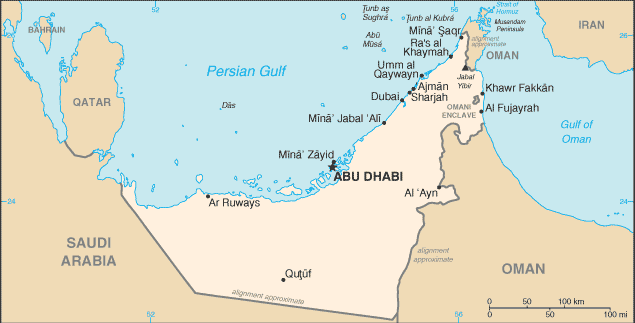
Middle East,
bordering the Gulf of Oman and the Persian Gulf, between Oman
and Saudi Arabia
|
|
Geographic
coordinates: |
24 00 N, 54 00 E
|
|
Map references: |
Middle East
|
|
Area: |
total:
82,880 sq km
land: 82,880 sq km
water: 0 sq km
|
|
Area -
comparative: |
slightly smaller
than Maine
|
|
Land boundaries: |
total: 867
km
border countries: Oman 410 km, Saudi Arabia 457 km
|
|
Coastline: |
1,318 km
|
|
Maritime claims: |
territorial sea:
12 nm
contiguous zone: 24 nm
exclusive economic zone: 200 nm
continental shelf: 200 nm or to the edge of the
continental margin
|
|
Climate: |
desert; cooler in
eastern mountains
|
|
Terrain: |
flat, barren
coastal plain merging into rolling sand dunes of vast desert
wasteland; mountains in east
|
|
Elevation
extremes: |
lowest point:
Persian Gulf 0 m
highest point: Jabal Yibir 1,527 m
|
|
Natural
resources: |
petroleum, natural
gas
|
|
Land use: |
arable land:
0.6%
permanent crops: 2.25%
other: 97.15% (2001)
|
|
Irrigated land: |
720 sq km (1998
est.)
|
|
Natural hazards: |
frequent sand and
dust storms
|
|
Environment -
current issues: |
lack of natural
freshwater resources compensated by desalination plants;
desertification; beach pollution from oil spills
|
|
Environment -
international agreements: |
party to:
Biodiversity, Climate Change, Climate Change-Kyoto Protocol,
Desertification, Endangered Species, Hazardous Wastes, Marine
Dumping, Ozone Layer Protection
signed, but not ratified: Law of the Sea
|
|
Geography -
note: |
strategic location
along southern approaches to Strait of Hormuz, a vital transit
point for world crude oil
|
|
People |
|
Population: |
2,563,212
note: includes an estimated 1,606,079 non-nationals; the
17 December 1995 census presents a total population figure of
2,377,453, and there are estimates of 3.44 million for 2002
(July 2005 est.)
|
|
Age structure: |
0-14 years:
25.3% (male 331,269; female 317,977)
15-64 years: 71.1% (male 1,115,826; female 707,058)
65 years and over: 3.6% (male 66,404; female 24,678)
(2005 est.)
|
|
Median age: |
total: 27.9
years
male: 35.2 years
female: 22.9 years (2005 est.)
|
|
Population
growth rate: |
1.54% (2005 est.)
|
|
Birth rate: |
18.78 births/1,000
population (2005 est.)
|
|
Death rate: |
4.26 deaths/1,000
population (2005 est.)
|
|
Net migration
rate: |
0.84 migrant(s)/1,000
population (2005 est.)
|
|
Sex ratio: |
at birth:
1.05 male(s)/female
under 15 years: 1.04 male(s)/female
15-64 years: 1.58 male(s)/female
65 years and over: 2.691 male(s)/female
total population: 1.442 male(s)/female (2005 est.)
|
|
Infant mortality
rate: |
total: 14.51
deaths/1,000 live births
male: 17.05 deaths/1,000 live births
female: 11.84 deaths/1,000 live births (2005 est.)
|
|
Life expectancy
at birth: |
total
population: 75.24 years
male: 72.73 years
female: 77.87 years (2005 est.)
|
|
Total fertility
rate: |
2.94 children
born/woman (2005 est.)
|
|
HIV/AIDS - adult
prevalence rate: |
0.18% (2001 est.)
|
|
HIV/AIDS -
people living with HIV/AIDS: |
NA
|
|
HIV/AIDS -
deaths: |
NA
|
|
Nationality: |
noun:
Emirati(s)
adjective: Emirati
|
|
Ethnic groups: |
Emirati 19%, other
Arab and Iranian 23%, South Asian 50%, other expatriates
(includes Westerners and East Asians) 8% (1982)
note: less than 20% are UAE citizens (1982)
|
|
Religions: |
Muslim 96% (Shi'a
16%), Christian, Hindu, and other 4%
|
|
Languages: |
Arabic (official),
Persian, English, Hindi, Urdu
|
|
Literacy: |
definition:
age 15 and over can read and write
total population: 77.9%
male: 76.1%
female: 81.7% (2003 est.)
|
|
Government |
|
Country name: |
conventional
long form: United Arab Emirates
conventional short form: none
local long form: Al Imarat al Arabiyah al Muttahidah
local short form: none
former: Trucial Oman, Trucial States
abbreviation: UAE
|
|
Government type: |
federation with
specified powers delegated to the UAE federal government and
other powers reserved to member emirates
|
|
Capital: |
Abu Dhabi
|
|
Administrative
divisions: |
7 emirates (imarat,
singular - imarah); Abu Zaby (Abu Dhabi), 'Ajman, Al Fujayrah,
Ash Shariqah (Sharjah), Dubayy (Dubai), Ra's al Khaymah, Umm al
Qaywayn
|
|
Independence: |
2 December 1971
(from UK)
|
|
National
holiday: |
Independence Day, 2
December (1971)
|
|
Constitution: |
2 December 1971
(made permanent in 1996)
|
|
Legal system: |
federal court
system introduced in 1971; applies to all emirates except Dubayy
(Dubai) and Ra's al Khaymah, which are not fully integrated into
the federal system; all emirates have secular courts to
adjudicate criminal, civil, and commercial matters and Islamic
courts to review family and religious disputes
|
|
Suffrage: |
none
|
|
Executive
branch: |
chief of state:
President Sheikh KHALIFA bin Zayid Al Nuhayyan (since 3 November
2004), ruler of Abu Zaby (Abu Dhabi) (since 4 November 2004) and
Vice President MAKTUM bin Rashid al-Maktum (since 8 October
1990), ruler of Dubayy (Dubai)
head of government: Prime Minister MAKTUM bin Rashid al-Maktum
(since 8 October 1990), ruler of Dubayy (Dubai); Deputy Prime
Minister SULTAN bin Zayid Al Nuhayyan (since 20 November 1990);
Deputy Prime Minister HAMDAN bin Zayid Al Nuhayyan (since 20
October 2003)
cabinet: Council of Ministers appointed by the president
note: there is also a Federal Supreme Council (FSC)
composed of the seven emirate rulers; the FSC is the highest
constitutional authority in the UAE; establishes general
policies and sanctions federal legislation; meets four times a
year; Abu Zaby (Abu Dhabi) and Dubayy (Dubai) rulers have
effective veto power
elections: president and vice president elected by the
Federal Supreme Council (composed of rulers of the seven
emirates) for five-year terms; election last held 3 November
2004 upon the death of the UAE's Founding Father and first
President ZAYID bin Sultan Al Nuhayyan (next to be held 2009);
prime minister and deputy prime minister appointed by the
president
election results: Sheikh KHALIFA bin Zayid Al Nuhayyan
elected president by a unanimous vote of the FSC; MAKTUM bin
Rashid al-Maktum unanimously reaffirmed vice president
|
|
Legislative
branch: |
unicameral Federal
National Council (FNC) or Majlis al-Ittihad al-Watani (40 seats;
members appointed by the rulers of the constituent states to
serve two-year terms)
elections: none
note: reviews legislation, but cannot change or veto
|
|
Judicial branch: |
Union Supreme Court
(judges are appointed by the president)
|
|
Political
parties and leaders: |
none
|
|
Political
pressure groups and leaders: |
NA
|
|
International
organization participation: |
ABEDA, AFESD, AMF,
FAO, G-77, GCC, IAEA, IBRD, ICAO, ICC, ICCt (signatory), ICRM,
IDA, IDB, IFAD, IFC, IFRCS, IHO, ILO, IMF, IMO, Interpol, IOC,
ISO, ITU, LAS, MIGA, NAM, OAPEC, OIC, OPCW, OPEC, UN, UNCTAD,
UNESCO, UNIDO, UPU, WCO, WHO, WIPO, WMO, WTO
|
|
Flag
description: |
three equal
horizontal bands of green (top), white, and black with a wider
vertical red band on the hoist side
|
|
Economy |
|
Economy -
overview: |
The UAE has an open
economy with a high per capita income and a sizable annual trade
surplus. Its wealth is based on oil and gas output (about 30% of
GDP), and the fortunes of the economy fluctuate with the prices
of those commodities. Since the discovery of oil in the UAE more
than 30 years ago, the UAE has undergone a profound
transformation from an impoverished region of small desert
principalities to a modern state with a high standard of living.
At present levels of production, oil and gas reserves should
last for more than 100 years. The government has increased
spending on job creation and infrastructure expansion and is
opening up its utilities to greater private sector involvement.
In April 2004, the UAE signed a Trade and Investment Framework
Agreement (TIFA) with Washington and in November 2004 agreed to
undertake negotiations toward a Free Trade Agreement (FTA) with
the US.
|
|
GDP: |
purchasing power
parity - $63.67 billion (2004 est.)
|
|
GDP - real
growth rate: |
5.7% (2004 est.)
|
|
GDP - per
capita: |
purchasing power
parity - $25,200 (2004 est.)
|
|
GDP -
composition by sector: |
agriculture:
4%
industry: 58.5%
services: 37.5% (2002 est.)
|
|
Labor force: |
2.36 million
note: 73.9% of the population in the 15-64 age group is
non-national (2004 est.)
|
|
Labor force - by
occupation: |
agriculture 7%,
industry 15%, services 78% (2000 est.)
|
|
Unemployment
rate: |
2.4% (2001)
|
|
Population below
poverty line: |
NA
|
|
Household income
or consumption by percentage share: |
lowest 10%:
NA
highest 10%: NA
|
|
Inflation rate
(consumer prices): |
3.2% (2004 est.)
|
|
Investment
(gross fixed): |
20.8% of GDP (2004
est.)
|
|
Budget: |
revenues:
$23.68 billion
expenditures: $25.45 billion, including capital
expenditures of $3.4 billion (2004 est.)
|
|
Public debt: |
17.6% of GDP (2004
est.)
|
|
Agriculture -
products: |
dates, vegetables,
watermelons; poultry, eggs, dairy products; fish
|
|
Industries: |
petroleum, fishing,
aluminum, cement, fertilizers, commercial ship repair,
petrochemicals, construction materials, some boat building,
handicrafts, textiles
|
|
Industrial
production growth rate: |
4% (2000)
|
|
Electricity -
production: |
45.12 billion kWh
(2004)
|
|
Electricity -
production by source: |
fossil fuel:
100%
hydro: 0%
nuclear: 0%
other: 0% (2001)
|
|
Electricity -
consumption: |
36.51 billion kWh
(2002)
|
|
Electricity -
exports: |
0 kWh (2004)
|
|
Electricity -
imports: |
0 kWh (2004)
|
|
Oil -
production: |
2.335 million
bbl/day (2004 est.)
|
|
Oil -
consumption: |
310,000 bbl/day
(2004 est.)
|
|
Oil - exports: |
2.5 million bbl/day
(2004 est.)
|
|
Oil - imports: |
0 bbl/day (2004)
|
|
Oil - proved
reserves: |
97.8 billion bbl
(2004 est.)
|
|
Natural gas -
production: |
44.4 billion cu m
(2003 est.)
|
|
Natural gas -
consumption: |
33.7 billion cu m
(2003 est.)
|
|
Natural gas -
exports: |
7.19 billion cu m
(2003 est.)
|
|
Natural gas -
imports: |
0 cu m (2003 est.)
|
|
Natural gas -
proved reserves: |
6.06 trillion cu m
(2004)
|
|
Current account
balance: |
$6.3 billion (2004
est.)
|
|
Exports: |
$69.48 billion
f.o.b. (2004 est.)
|
|
Exports -
commodities: |
crude oil 45%,
natural gas, reexports, dried fish, dates
|
|
Exports -
partners: |
Japan 28.5%, South
Korea 9.5%, Thailand 5.9% (2004)
|
|
Imports: |
$45.66 billion
f.o.b. (2004 est.)
|
|
Imports -
commodities: |
machinery and
transport equipment, chemicals, food
|
|
Imports -
partners: |
China 10.4%, India
8.3%, Japan 7.2%, Germany 6.6%, France 6.4%, UK 6.2%, US 6%,
Italy 4.1% (2004)
|
|
Reserves of
foreign exchange and gold: |
$18.64 billion
(2004 est.)
|
|
Debt - external: |
$5.9 billion (2004
est.)
|
|
Economic aid -
donor: |
since its founding
in 1971, the Abu Dhabi Fund for Development has given about $5.2
billion in aid to 56 countries (2004)
|
|
Currency (code): |
Emirati dirham (AED)
|
|
Currency code: |
AED
|
|
Exchange rates: |
Emirati dirhams per
US dollar - 3.6725 (2004), 3.6725 (2003), 3.6725 (2002), 3.6725
(2001), 3.6725 (2000)
note: officially pegged to the US dollar since February
2002
|
|
Fiscal year: |
calendar year
|
|
Communications |
|
Telephones -
main lines in use: |
1,135,800 (2003)
|
|
Telephones -
mobile cellular: |
2,972,300 (2003)
|
|
Telephone
system: |
general
assessment: modern fiber-optic integrated services; digital
network with rapidly growing use of mobile cellular telephones;
key centers are Abu Dhabi and Dubai
domestic: microwave radio relay, fiber optic and coaxial
cable
international: country code - 971; satellite earth
stations - 3 Intelsat (1 Atlantic Ocean and 2 Indian Ocean) and
1 Arabsat; submarine cables to Qatar, Bahrain, India, and
Pakistan; tropospheric scatter to Bahrain; microwave radio relay
to Saudi Arabia
|
|
Radio broadcast
stations: |
AM 13, FM 8,
shortwave 2 (2004)
|
|
Radios: |
820,000 (1997)
|
|
Television
broadcast stations: |
15 (2004)
|
|
Televisions: |
310,000 (1997)
|
|
Internet country
code: |
.ae
|
|
Internet hosts: |
56,283 (2004)
|
|
Internet Service
Providers (ISPs): |
1 (2000)
|
|
Internet users: |
1,110,200 (2003)
|
|
Transportation |
|
Highways: |
total: 1,088
km
paved: 1,088 km (including 253 km of expressways)
unpaved: 0 km (1999 est.)
|
|
Pipelines: |
condensate 469 km;
gas 2,655 km; liquid petroleum gas 300 km; oil 2,936 km;
oil/gas/water 5 km (2004)
|
|
Ports and
harbors: |
'Ajman, Al Fujayrah,
Das Island, Khawr Fakkan, Mina' Jabal 'Ali, Mina' Khalid, Mina'
Rashid, Mina' Saqr, Mina' Zayid, Umm al Qaywayn
|
|
Merchant marine: |
total: 56
ships (1,000 GRT or over) 578,477 GRT/739,823 DWT
by type: bulk carrier 1, cargo 11, chemical tanker 5,
container 6, liquefied gas 1, passenger/cargo 4, petroleum
tanker 21, roll on/roll off 7
foreign-owned: 14 (Greece 2, Kuwait 6)
registered in other countries: 200 (2005)
|
|
Airports: |
35 (2004 est.)
|
|
Airports - with
paved runways: |
total: 22
over 3,047 m: 8
2,438 to 3,047 m: 3
1,524 to 2,437 m: 4
914 to 1,523 m: 4
under 914 m: 3 (2004 est.)
|
|
Airports - with
unpaved runways: |
total: 13
over 3,047 m: 1
2,438 to 3,047 m: 2
1,524 to 2,437 m: 3
914 to 1,523 m: 3
under 914 m: 4 (2004 est.)
|
|
Heliports: |
2 (2004 est.)
|
|
Military |
|
Military
branches: |
Army, Navy
(includes Marines and Coast Guard), Air and Air Defense Force,
paramilitary forces (includes Federal Police Force)
|
|
Military
manpower - military age and obligation: |
18 years of age
(est.); no conscription (2001)
|
|
Military
manpower - availability: |
males age 18-49:
653,181
note: includes non-nationals (2005 est.)
|
|
Military
manpower - fit for military service: |
males age 18-49:
526,671 (2005 est.)
|
|
Military
manpower - reaching military age annually: |
males:
30,706 (2005 est.)
|
|
Military
expenditures - dollar figure: |
$1.6 billion (FY00)
|
|
Military
expenditures - percent of GDP: |
3.1% (FY00)
|
|
Transnational Issues |
|
Disputes -
international: |
because the
treaties have not been made public, the exact alignment of the
boundary with Saudi Arabia is still unknown; boundary agreement
was signed and ratified with Oman in 2003 for entire border,
including Oman's Musandam Peninsula and Al Madhah enclaves, but
contents of the agreement and maps showing the alignment have
not been published; UAE engage in direct talks and solicit Arab
League support to resolve disputes over Iran's occupation of
Lesser and Greater Tunb Islands and Abu Musa Island
|
|
Illicit drugs: |
the UAE is a drug
transshipment point for traffickers given its proximity to
southwest Asian drug producing countries; the UAE's position as
a major financial center makes it vulnerable to money
laundering; anti-money-laundering controls improving
|

 100+ Important Documents in United States History