
Pray for Pope Francis
Scroll down for topics
 100+ Important Documents in United States History
Apostolic Fathers of the Church
Biographies & Writings of Notable Catholics
Catholic News Commentary by Michael Voris, S.T.B.

(Death, Heaven, Purgatory, Hell)
Links to Churches and Religions
Links to Newspapers, Radio and Television
Links to specialized Catholic News services
General Instruction of the Roman Missal
****
****
****
****
Rite of Christian Initiation for Adults

Visits to this site
Various Colours of One Church
|
|
|
|
|
Cardinal Huzar and Fr Ireneusz Skubis |
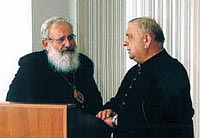
On 25 August 2004 in the aula of 'Niedziela', there was a meeting with Cardinal Lubomyr Huzar, Head of the Ukrainian Greek-Catholic Church and Major Archbishop of Lviv, who came to Czestochowa with a group of Ukrainian pilgrims within the framework of the so-called Pilgrimage of Reconciliation. We took the opportunity of the visit to ask Cardinal Huzar about the Patriarchate of Kiev, which the Ukrainian Greek-Catholic Church had sought to be declared for many years. We present some fragments of the interview with Cardinal Huzar.
Fr. Ireneusz Skubis: - What is the main idea to have the Patriarchate of Kiev recognized?
Cardinal Lubomyr Huzar: - The issue of the Patriarchate of Kiev is not as
sensational as the media has made it. A patriarchate is nothing extraordinary.
In the first millennium there were five great Patriarchates: Rome, Alexandria,
Antioch, Constantinople and Jerusalem. The West did not accept the form of
patriarchate. Only the Patriarchate of Rome has survived, others are only
honorary patriarchates, for example the Patriarchate of Portugal or the
Patriarchate of Venice. However, in the East the form of patriarchate was well
established and in the second millennium it became quite common. There are six
Catholic Patriarchates and several Orthodox ones. This is a normal form of the
Orthodox Church in the East. How does it come into being and where does it come
from?
Well, Christ established universal Church existing in local Churches, i.e.
embracing certain territory under the leadership of a bishop. But - according to
the Dogmatic Constitution on the Church Lumen gentium - with time there was
another form of the Church's existence, in which a certain group of dioceses,
having the same liturgical rite, the same theology, spirituality, usually, but
not always, the same language, the same hierarchy and episcopate, creates the
Church sui iuris - of her law. And this is the basis for what we call a
patriarchate. Therefore, it is an ordinary form of the Church's existence in the
Byzantine tradition and in the traditions of the Near East as well. When we
speak about a patriarchate we understand that our Church, our Greek-Catholic
Church, should have this structure because she meets all its conditions. When we
visited the Holy Father in June he confirmed the fact of our complete
preparation but he said that the right moment of formal recognition - to declare
this structure - had not come yet.
- Your Eminence, the idea of patriarchate is defined by two important elements: history and culture. In what sense are these two elements the basis for the Kiev Patriarchate?
- As
far as history is concerned, Christianity was already introduced in the
territory of the present Ukraine in the first century because the Crimea was the
Siberia of the Roman Empire. Pope Clement I was sent into exile in the Crimea
and he died there. Like other exiles he brought Christianity. The second
important vehicle of Christianity was Greek merchants. But in those days
Christianity was not powerful in these territories. It was in the 10th century,
after the baptism of Poland, in the year 988 that Prince Volodymyr established
Christianity as the national religion of his country. This is the historical
millennium. And the tradition is that Christianity came to us through
Constantinople. It spread quite quickly; the head of this Church had the title
of Metropolitan, which was the equivalent to Major Archbishop, which almost, but
not exactly, means Patriarch. Therefore, in those times, one thousand years ago,
Kiev was the cradle of Christianity in Eastern Europe. There was a Metropolitan,
who was officially confirmed. There was also the trade route from the North to
the South there. The East-West course was of certain importance as well.
Politically speaking, it was some kind of an empire. But there was another
significant matter: Prince Volodymyr's son Jaroslav, known as Jaroslav the Wise,
because, speaking jokingly, instead of fighting he begot twelve children and had
a specific matrimonial diplomacy: his children were in the entire Europe and
through them he had close relationships with Western countries. Today it is very
important to us because it confirms the Christian character of this territory.
It would not have been possible for a father in Kiev to arrange a marriage of
his daughter, for example in Paris, if the marriage had not been within one
Christianity. There was a different culture, different language and customs, but
there was one religion. Thus Jaroslav could be called the father-in-law of
Europe.
The Byzantine culture came to Europe through Kiev, which was the capital and
cradle of Christianity and also of Christian culture, especially for the East.
In a way it was a passage to Western Europe because later direct contacts were
not so strong, due to all sorts of misunderstanding, as they used to be. And
today Kiev in its Catholicism remains the greatest Orthodox Church - not in the
confessional meaning, but in the meaning of the Eastern tradition. We are one of
the representatives of these two great traditions, which came to Europe - one
through the West, through Rome, and the second one in its Byzantine version or
perhaps better: Greek or Hellenistic version, through Constantinople. This
culture spread from Kiev into the entire Eastern Europe. However, the base is
here and one can say that today we are building our whole vision of the Church
in the East on this base.
- One would like to ask you another question. When can we expect a patriarchate?
-
Everyone would like to know when. Today I have also been asked when a covenant,
a union between Ukraine and Poland happens. But I do not know when. We are in
the course of a process. It seems to me that recently the Holy Father gave a
very interesting answer, which was not noticed by journalists. The Pope said
everything had been prepared as far as the canonical aspect was concerned and he
himself wanted very much to declare the Kiev Patriarchate. We do not have doubts
about it although in Ukraine people often think that everything depends on the
good will of the Pope. But the Pope put it on a different, very important level.
He said, 'God willing, and I would like to be his message.' The Pope transferred
this problem from the purely political and human sphere onto another sphere,
which we all must respect. And it was a very inspirational way of speaking and
presenting the matter for us.
In a few days our Episcopate will publish a special letter concerning this
issue, which will answer the people's question - when. We want to stress this
element of the Holy Father's speech. It does not define the exact human time but
gives a religious interpretation of the problem, which is extremely important to
us. A patriarchate is not an ecclesiastical-political matter. It is an
ecclesiastical matter and we must be very cautious to have God's blessing for
this structure. Otherwise it will be only a structure and nothing more.
- Thank you, Your Eminence, for your visit and your precious time for us, editors of the weekly 'Niedziela'. We wish you continuous God's help to fulfill your mission, which is so important to Christ's Church.