|
Introduction |
|
Background: |
A unified Thai
kingdom was established in the mid-14th century. Known as Siam
until 1939, Thailand is the only Southeast Asian country never
to have been taken over by a European power. A bloodless
revolution in 1932 led to a constitutional monarchy. In alliance
with Japan during World War II, Thailand became a US ally
following the conflict. Thailand is currently facing armed
violence in its three Muslim-majority southernmost provinces.
|
|
Geography |
|
Location: |
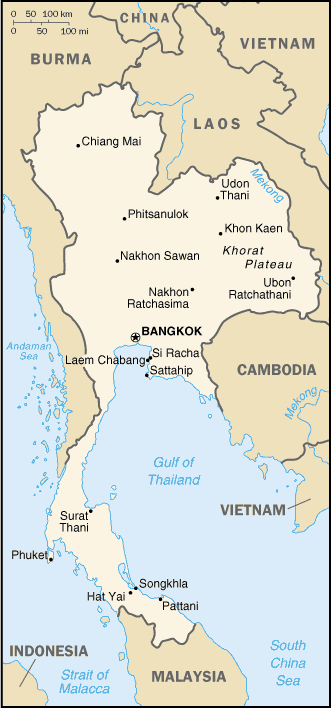
Southeastern Asia,
bordering the Andaman Sea and the Gulf of Thailand, southeast of
Burma
|
|
Geographic
coordinates: |
15 00 N, 100 00 E
|
|
Map references: |
Southeast Asia
|
|
Area: |
total:
514,000 sq km
land: 511,770 sq km
water: 2,230 sq km
|
|
Area -
comparative: |
slightly more than
twice the size of Wyoming
|
|
Land boundaries: |
total: 4,863
km
border countries: Burma 1,800 km, Cambodia 803 km, Laos
1,754 km, Malaysia 506 km
|
|
Coastline: |
3,219 km
|
|
Maritime claims: |
territorial sea:
12 nm
exclusive economic zone: 200 nm
continental shelf: 200-m depth or to the depth of
exploitation
|
|
Climate: |
tropical; rainy,
warm, cloudy southwest monsoon (mid-May to September); dry, cool
northeast monsoon (November to mid-March); southern isthmus
always hot and humid
|
|
Terrain: |
central plain;
Khorat Plateau in the east; mountains elsewhere
|
|
Elevation
extremes: |
lowest point:
Gulf of Thailand 0 m
highest point: Doi Inthanon 2,576 m
|
|
Natural
resources: |
tin, rubber,
natural gas, tungsten, tantalum, timber, lead, fish, gypsum,
lignite, fluorite, arable land
|
|
Land use: |
arable land:
29.36%
permanent crops: 6.46%
other: 64.18% (2001)
|
|
Irrigated land: |
47,490 sq km (1998
est.)
|
|
Natural hazards: |
land subsidence in
Bangkok area resulting from the depletion of the water table;
droughts
|
|
Environment -
current issues: |
air pollution from
vehicle emissions; water pollution from organic and factory
wastes; deforestation; soil erosion; wildlife populations
threatened by illegal hunting
|
|
Environment -
international agreements: |
party to:
Biodiversity, Climate Change, Climate Change-Kyoto Protocol,
Desertification, Endangered Species, Hazardous Wastes, Marine
Life Conservation, Ozone Layer Protection, Tropical Timber 83,
Tropical Timber 94, Wetlands
signed, but not ratified: Law of the Sea
|
|
Geography -
note: |
controls only land
route from Asia to Malaysia and Singapore
|
|
People |
|
Population: |
65,444,371
note: estimates for this country explicitly take into
account the effects of excess mortality due to AIDS; this can
result in lower life expectancy, higher infant mortality and
death rates, lower population and growth rates, and changes in
the distribution of population by age and sex than would
otherwise be expected (July 2005 est.)
|
|
Age structure: |
0-14 years:
23.9% (male 7,988,529/female 7,633,405)
15-64 years: 68.6% (male 22,195,625/female 22,731,767)
65 years and over: 7.5% (male 2,251,112/female 2,643,933)
(2005 est.)
|
|
Median age: |
total: 30.88
years
male: 30.11 years
female: 31.66 years (2005 est.)
|
|
Population
growth rate: |
0.87% (2005 est.)
|
|
Birth rate: |
15.7 births/1,000
population (2005 est.)
|
|
Death rate: |
7.02 deaths/1,000
population (2005 est.)
|
|
Net migration
rate: |
0 migrant(s)/1,000
population (2005 est.)
|
|
Sex ratio: |
at birth:
1.05 male(s)/female
under 15 years: 1.05 male(s)/female
15-64 years: 0.98 male(s)/female
65 years and over: 0.85 male(s)/female
total population: 0.98 male(s)/female (2005 est.)
|
|
Infant mortality
rate: |
total: 20.48
deaths/1,000 live births
male: 21.83 deaths/1,000 live births
female: 19.06 deaths/1,000 live births (2005 est.)
|
|
Life expectancy
at birth: |
total
population: 71.57 years
male: 69.39 years
female: 73.88 years (2005 est.)
|
|
Total fertility
rate: |
1.88 children
born/woman (2005 est.)
|
|
HIV/AIDS - adult
prevalence rate: |
1.5% (2003 est.)
|
|
HIV/AIDS -
people living with HIV/AIDS: |
570,000 (2003 est.)
|
|
HIV/AIDS -
deaths: |
58,000 (2003 est.)
|
|
Nationality: |
noun: Thai
(singular and plural)
adjective: Thai
|
|
Ethnic groups: |
Thai 75%, Chinese
14%, other 11%
|
|
Religions: |
Buddhist 94.6%,
Muslim 4.6%, Christian 0.7%, other 0.1% (2000 census)
|
|
Languages: |
Thai, English
(secondary language of the elite), ethnic and regional dialects
|
|
Literacy: |
definition:
age 15 and over can read and write
total population: 92.6%
male: 94.9%
female: 90.5% (2002)
|
|
Government |
|
Country name: |
conventional
long form: Kingdom of Thailand
conventional short form: Thailand
former: Siam
|
|
Government type: |
constitutional
monarchy
|
|
Capital: |
Bangkok
|
|
Administrative
divisions: |
76 provinces (changwat,
singular and plural); Amnat Charoen, Ang Thong, Buriram,
Chachoengsao, Chai Nat, Chaiyaphum, Chanthaburi, Chiang Mai,
Chiang Rai, Chon Buri, Chumphon, Kalasin, Kamphaeng Phet,
Kanchanaburi, Khon Kaen, Krabi, Krung Thep Mahanakhon (Bangkok),
Lampang, Lamphun, Loei, Lop Buri, Mae Hong Son, Maha Sarakham,
Mukdahan, Nakhon Nayok, Nakhon Pathom, Nakhon Phanom, Nakhon
Ratchasima, Nakhon Sawan, Nakhon Si Thammarat, Nan, Narathiwat,
Nong Bua Lamphu, Nong Khai, Nonthaburi, Pathum Thani, Pattani,
Phangnga, Phatthalung, Phayao, Phetchabun, Phetchaburi, Phichit,
Phitsanulok, Phra Nakhon Si Ayutthaya, Phrae, Phuket, Prachin
Buri, Prachuap Khiri Khan, Ranong, Ratchaburi, Rayong, Roi Et,
Sa Kaeo, Sakon Nakhon, Samut Prakan, Samut Sakhon, Samut
Songkhram, Sara Buri, Satun, Sing Buri, Sisaket, Songkhla,
Sukhothai, Suphan Buri, Surat Thani, Surin, Tak, Trang, Trat,
Ubon Ratchathani, Udon Thani, Uthai Thani, Uttaradit, Yala,
Yasothon
|
|
Independence: |
1238 (traditional
founding date; never colonized)
|
|
National
holiday: |
Birthday of King
PHUMIPHON, 5 December (1927)
|
|
Constitution: |
new constitution
signed by King PHUMIPHON on 11 October 1997
|
|
Legal system: |
based on civil law
system, with influences of common law; has not accepted
compulsory ICJ jurisdiction
|
|
Suffrage: |
18 years of age;
universal and compulsory
|
|
Executive
branch: |
chief of state:
King PHUMIPHON Adunyadet (since 9 June 1946)
head of government: Prime Minister THAKSIN Chinnawat
(since 9 February 2001) and Deputy Prime Ministers CHATURON
Chaisaeng (since 3 October 2002), CHITCHAI Wannasathi (since 11
March 2005), PHINIT Charusombat (since 6 October 2004), SOMKIT
Chatusiphithak (since 11 March 2005), SURAKIAT Sathianthai
(since 11 March 2005); VISHANU Krua-ngam (since 8 November 2003)
cabinet: Council of Ministers
note: there is also a Privy Council
elections: none; the monarch is hereditary; prime
minister is designated from among the members of the House of
Representatives; following national elections for the House of
Representatives, the leader of the party that can organize a
majority coalition usually is appointed prime minister by the
king
|
|
Legislative
branch: |
bicameral National
Assembly or Rathasapha consists of the Senate or Wuthisapha (200
seats; members elected by popular vote to serve six-year terms)
and the House of Representatives or Sapha Phuthaen Ratsadon (500
seats; members elected by popular vote to serve four-year terms)
elections: Senate - last held 4 March, 29 April, 4 June,
9 July, and 22 July 2000 (next to be held by March 2006); House
of Representatives - last held 6 February 2005 (next to be held
in February 2009)
election results: Senate - percent of vote by party - NA;
seats by party - NA; House of Representatives - percent of vote
by party - NA; seats by party - TRT 376, DP 97, TNP 25, PP 2
|
|
Judicial branch: |
Supreme Court or
Sandika (judges appointed by the monarch)
|
|
Political
parties and leaders: |
Democrat Party or
DP (Prachathipat Party) [ABHISIT Wetchachiwa]; People's Party or
PP (Mahachon Party) [ANEK Laothamatas]; Thai Nation Party or TNP
(Chat Thai Party) [BARNHARN SILPA-ARCHA]; Thai Rak Thai Party or
TRT [THAKSIN Chinnawat]
|
|
Political
pressure groups and leaders: |
NA
|
|
International
organization participation: |
APEC, APT, ARF,
AsDB, ASEAN, BIS, CP, FAO, G-77, IAEA, IBRD, ICAO, ICC, ICCt
(signatory), ICFTU, ICRM, IDA, IFAD, IFC, IFRCS, IHO, ILO, IMF,
IMO, Interpol, IOC, IOM, ISO, ITU, MIGA, NAM, OAS (observer),
OIC (observer), OPCW, OSCE (partner), PCA, UN, UNAMSIL, UNCTAD,
UNESCO, UNHCR, UNIDO, UPU, WCL, WCO, WFTU, WHO, WIPO, WMO, WToO,
WTO
|
|
Flag
description: |
five horizontal
bands of red (top), white, blue (double width), white, and red
|
|
Economy |
|
Economy -
overview: |
Thailand has a well
developed infrastructure, a free-enterprise economy, and
welcomes foreign investment. Thailand has fully recovered from
the 1997-98 Asian Financial Crisis and was one of East Asia's
best performers in 2002-04. Increased consumption and investment
spending and strong export growth pushed GDP growth up to 6.9%
in 2003 and 6.1% in 2004 despite a sluggish global economy. The
highly popular government's expansionist policy, including major
support of village economic development, has raised concerns
about fiscal discipline and the health of financial
institutions. Bangkok has pursued preferential trade agreements
with a variety of partners in an effort to boost exports and
maintain high growth, and in 2004 began negotiations on a Free
Trade Agreement with the US. In late December 2004, a major
tsunami took 8,500 lives in Thailand and caused massive
destruction of property in the southern provinces of Krabi,
Phangnga, and Phuket.
|
|
GDP: |
purchasing power
parity - $524.8 billion (2004 est.)
|
|
GDP - real
growth rate: |
6.1% (2004 est.)
|
|
GDP - per
capita: |
purchasing power
parity - $8,100 (2004 est.)
|
|
GDP -
composition by sector: |
agriculture:
9%
industry: 44.3%
services: 46.7% (2004 est.)
|
|
Labor force: |
36.43 million
(November 2004 est.)
|
|
Labor force - by
occupation: |
agriculture 49%,
industry 14%, services 37% (2000 est.)
|
|
Unemployment
rate: |
1.5% (November 2004
est.)
|
|
Population below
poverty line: |
10% (2004 est.)
|
|
Household income
or consumption by percentage share: |
lowest 10%:
2.8%
highest 10%: 32.4% (1998)
|
|
Distribution of
family income - Gini index: |
51.1 (2002)
|
|
Inflation rate
(consumer prices): |
2.8% (2004 est.)
|
|
Investment
(gross fixed): |
22.5% of GDP (Jan -
Sep 2004 est.)
|
|
Budget: |
revenues:
$30.86 billion
expenditures: $31.94 billion, including capital
expenditures of $5 billion (2004 est.)
|
|
Public debt: |
47.6% of GDP
(November 2004 est.)
|
|
Agriculture -
products: |
rice, cassava
(tapioca), rubber, corn, sugarcane, coconuts, soybeans
|
|
Industries: |
tourism, textiles
and garments, agricultural processing, beverages, tobacco,
cement, light manufacturing such as jewelry, electric appliances
and components, computers and parts, integrated circuits,
furniture, plastics, world's second-largest tungsten producer,
and third-largest tin producer
|
|
Industrial
production growth rate: |
8.5% (2004 est.)
|
|
Electricity -
production: |
118.9 billion kWh
(2003)
|
|
Electricity -
production by source: |
fossil fuel:
91.3%
hydro: 6.4%
nuclear: 0%
other: 2.4% (2001)
|
|
Electricity -
consumption: |
106.1 billion kWh
(2003)
|
|
Electricity -
exports: |
188 million kWh
(2002)
|
|
Electricity -
imports: |
600 million kWh
(2002)
|
|
Oil -
production: |
225,000 bbl/day
(2004 est.)
|
|
Oil -
consumption: |
785,000 bbl/day
(2001 est.)
|
|
Oil - exports: |
NA
|
|
Oil - imports: |
NA
|
|
Oil - proved
reserves: |
600 million bbl (1
January 2003)
|
|
Natural gas -
production: |
18.73 billion cu m
(2001 est.)
|
|
Natural gas -
consumption: |
23.93 billion cu m
(2001 est.)
|
|
Natural gas -
exports: |
0 cu m (2001 est.)
|
|
Natural gas -
imports: |
5.2 billion cu m
(2001 est.)
|
|
Natural gas -
proved reserves: |
368.2 billion cu m
(1 January 2003)
|
|
Current account
balance: |
$6.736 billion
(2004 est.)
|
|
Exports: |
$87.91 billion
f.o.b. (2004 est.)
|
|
Exports -
commodities: |
textiles and
footwear, fishery products, rice, rubber, jewelry, automobiles,
computers and electrical appliances
|
|
Exports -
partners: |
US 15.9%, Japan
13.9%, China 7.3%, Singapore 7.2%, Malaysia 5.4%, Hong Kong 5.1%
(2004)
|
|
Imports: |
$80.84 billion
f.o.b. (2004 est.)
|
|
Imports -
commodities: |
capital goods,
intermediate goods and raw materials, consumer goods, fuels
|
|
Imports -
partners: |
Japan 23.6%, China
8.6%, US 7.6%, Malaysia 5.8%, Singapore 4.4%, Taiwan 4.1% (2004)
|
|
Reserves of
foreign exchange and gold: |
$48.3 billion
(2004)
|
|
Debt - external: |
$50.59 billion
(2004 est.)
|
|
Currency (code): |
baht (THB)
|
|
Currency code: |
THB
|
|
Exchange rates: |
baht per US dollar
- 40.222 (2004), 41.485 (2003), 42.96 (2002), 44.432 (2001),
40.112 (2000)
|
|
Fiscal year: |
1 October - 30
September
|
|
Communications |
|
Telephones -
main lines in use: |
6,617,400 (2003)
|
|
Telephones -
mobile cellular: |
26.5 million (2005)
|
|
Telephone
system: |
general
assessment: high quality system, especially in urban areas
like Bangkok; WTO requirement for privatization of telecom
sector is planned to be complete by 2006
domestic: fixed line system provided by both a government
owned and commercial provider; wireless service expanding
rapidly and outpacing fixed lines
international: country code - 66; satellite earth
stations - 2 Intelsat (1 Indian Ocean and 1 Pacific Ocean);
landing country for APCN submarine cable
|
|
Radio broadcast
stations: |
AM 204, FM 334,
shortwave 6 (1999)
|
|
Radios: |
13.96 million
(1997)
|
|
Television
broadcast stations: |
5 (all in Bangkok;
plus 131 repeaters) (1997)
|
|
Televisions: |
15.19 million
(1997)
|
|
Internet country
code: |
.th
|
|
Internet hosts: |
103,700 (2003)
|
|
Internet Service
Providers (ISPs): |
15 (2000)
|
|
Internet users: |
6,971,500 (2003)
|
|
Transportation |
|
Railways: |
total: 4,071
km
narrow gauge: 4,071 km 1.000-m gauge (2004)
|
|
Highways: |
total:
57,403 km
paved: 56,542 km
unpaved: 861 km (2000 est.)
|
|
Waterways: |
4,000 km
note: 3,701 km navigable by boats with drafts up to 0.9 m
(2003)
|
|
Pipelines: |
gas 3,112 km;
refined products 265 km (2004)
|
|
Ports and
harbors: |
Bangkok, Laem
Chabang, Pattani, Phuket, Sattahip, Si Racha, Songkhla
|
|
Merchant marine: |
total: 386
ships (1,000 GRT or over) 2,038,597 GRT/3,104,712 DWT
by type: bulk carrier 57, cargo 142, chemical tanker 12,
combination ore/oil 1, container 21, liquefied gas 25, passenger
3, passenger/cargo 4, petroleum tanker 89, refrigerated cargo
30, roll on/roll off 1, specialized tanker 1
foreign-owned: 55 (Indonesia 1, Japan 3, Norway 45,
Singapore 6)
registered in other countries: 35 (2005)
|
|
Airports: |
109 (2004 est.)
|
|
Airports - with
paved runways: |
total: 65
over 3,047 m: 7
2,438 to 3,047 m: 10
1,524 to 2,437 m: 23
914 to 1,523 m: 19
under 914 m: 6 (2004 est.)
|
|
Airports - with
unpaved runways: |
total: 44
1,524 to 2,437 m: 1
914 to 1,523 m: 15
under 914 m: 28 (2004 est.)
|
|
Heliports: |
3 (2004 est.)
|
|
Military |
|
Military
branches: |
Royal Thai Army,
Royal Thai Navy (includes Royal Thai Marine Corps), Royal Thai
Air Force
|
|
Military
manpower - military age and obligation: |
21 years of age for
compulsory military service; males are registered at 18 years of
age; conscript service obliation - 2 years; 18 years of age for
voluntary military service (2004)
|
|
Military
manpower - availability: |
males age 21-49:
14.984 million (2005 est.)
|
|
Military
manpower - fit for military service: |
males age 21-49:
10,342,337 (2005 est.)
|
|
Military
manpower - reaching military age annually: |
males:
530,493 (2005 est.)
|
|
Military
expenditures - dollar figure: |
$1.775 billion
(FY00)
|
|
Military
expenditures - percent of GDP: |
1.8% (2003)
|
|
Transnational Issues |
|
Disputes -
international: |
separatist violence
in Thailand's predominantly Muslim southern provinces prompt
border closures and controls with Malaysia to stem terrorist
activities; southeast Asian states have enhanced border
surveillance to check the spread of avian flu; Laos and Thailand
pledge to complete demarcation of their boundary in 2005;
despite continuing border committee talks, significant
differences remain with Burma over boundary alignment and the
handling of ethnic rebels, refugees, and illegal cross-border
activities; Cambodia and Thailand dispute sections of boundary
with missing boundary markers; Cambodia claims Thai
encroachments into Cambodian territory and obstructing access to
Preah Vihear temple ruins awarded to Cambodia by ICJ decision in
1962; ethnic Karens from Burma flee into Thailand to escape
fighting between Karen rebels and Burmese troops resulting in
Thailand sheltering about 118,000 Burmese refugees in 2004;
Karens also protest Thai support for a Burmese hydroelectric dam
construction on the Salween River near the border;
environmentalists in Burma and Thailand remain concerned about
China's construction of hydroelectric dams upstream on the
Nujiang/Salween River in Yunnan Province
|
|
Refugees and
internally displaced persons:: |
refugees
(country of origin): 118,407 (Burma) (2004)
|
|
Illicit drugs: |
a minor producer of
opium, heroin, and marijuana; illicit transit point for heroin
en route to the international drug market from Burma and Laos;
eradication efforts have reduced the area of cannabis
cultivation and shifted some production to neighboring
countries; opium poppy cultivation has been reduced by
eradication efforts; also a drug money-laundering center; minor
role in amphetamine production for regional consumption;
increasing indigenous abuse of methamphetamine
|

 100+ Important Documents in United States History