
Pray for Pope Francis
Scroll down for topics
 100+ Important Documents in United States History
Apostolic Fathers of the Church
Biographies & Writings of Notable Catholics
Catholic News Commentary by Michael Voris, S.T.B.

(Death, Heaven, Purgatory, Hell)
Links to Churches and Religions
Links to Newspapers, Radio and Television
Links to specialized Catholic News services
General Instruction of the Roman Missal
****
****
****
****
Rite of Christian Initiation for Adults

Visits to this site
Cardinal quashes gay priesthood protests
Jan 07, 2006
South African
men with "deep-seated" homosexual tendencies, who were barred from becoming
priests in the Catholic church, had no reason to take the issue to the
Constitutional Court, according to Catholic leader Cardinal Wilfred Napier.
(Saturday Star, December 31 2005) "Nobody has a right to be a priest. You can't
claim the right. On what basis would they take it to the constitutional court if
they don't have a right?" he questioned.
Napier said religious freedom gave any institution the right to set its own
standards.
His comments follow a recent instruction from Rome that only men with
"transitory" homosexual tendencies who had overcome it three years previously
could enter the priesthood. Practising homosexuals and those who supported "gay
culture" were banned.
Napier said "transitory" homosexual tendencies referred to someone who had
"flirted" or "experimented" or had "been in a relationship and maybe not wanting
one."
"My interpretation of this is that it was a passing phase." He said the
instruction only had bearing on those who wanted to enter the priesthood not
those already ordained.
According to Napier the suitability of all prospective priests was evaluated
through interviews and a psychological assessment as well as seven years of
"training and formation" before they could put in an application for ordination.
This assessment also gave an indication how the candidate would function in the
four "focal points" required of a priest which included the human, spiritual,
intellectual and pastoral levels.
The candidates were also screened to determine if they needed help in dealing
with homosexuality, celibacy or even past personal trauma.
"Clearly if a heterosexual man thinks its okay to sleep around with girls and he
has not stopped, he will not be a good priest."
The church appealed to the sense of integrity and honesty of potential
candidates, said Napier.
"If a person has a major defect in his personality how will he function as a
priest?" Napier asked.
"Homosexuality is seen as a defect. Both homosexual and heterosexual men must
practice celibacy if they want to become priests. Engaging in sexual activity is
not allowed."
Napier stressed that the instruction did not say "very much that is new" and
that those who wanted to enter the priesthood should remember that there were
rules to becoming a priest.
He said society lived in a time when "objective moral norms" were rejected in
favour of "subjective personal preferences".
The latest "instruction" by the Catholic church resonated strongly with openly
gay Anglican clergyman, Dean Rowan Smith.
Smith who is in charge of St George's cathedral in Cape Town believed those who
were gay brought another sort of experience to the ministry and there must be
respect for the integrity of the individual.
His message to other homosexual priests: "The calling comes from God and
sometimes it comes despite our sense of unworthiness. God says I'm calling you
because of that."
Although he was hesitant to comment on the rules of another church he believed
the Catholic "instruction" was intrusive and would create a "nightmare" for
those gay men who wanted to enter the priesthood.
"It may cause people to be dishonest with themselves and to others with whom
they discuss their convocation," he said.
The Anglican Church requires gay and lesbian priests to remain celibate.
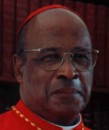
| Wilfrid Fox Cardinal Napier, O.F.M. |
 |
 |
|
|
|
|||
|
Function: Archbishop of Durban, South Africa |
|||
|
|
|||
| Title: Cardinal Priest of S Francesco d'Assisi ad Acilia |
|||
|
|
|||
| Birthdate: Mar 08, 1941 |
Country: South Africa |
||
|
|
|||
| Elevated: Feb 21, 2001 |
More
information: www.catholic-hierarchy.org |
||