|
Introduction |
|
Background: |
Settled as early as
1000 B.C., Samoa was "discovered" by European explorers in the
18th century. International rivalries in the latter half of the
19th century were settled by an 1899 treaty in which Germany and
the US divided the Samoan archipelago. The US formally occupied
its portion - a smaller group of eastern islands with the
excellent harbor of Pago Pago - the following year.
|
|
Geography |
|
Location: |
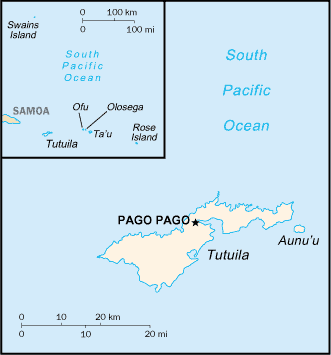
Oceania, group of
islands in the South Pacific Ocean, about half way between
Hawaii and New Zealand
|
|
Geographic
coordinates: |
14 20 S, 170 00 W
|
|
Map references: |
Oceania
|
|
Area: |
total: 199
sq km
land: 199 sq km
water: 0 sq km
note: includes Rose Island and Swains Island
|
|
Area -
comparative: |
slightly larger
than Washington, DC
|
|
Land boundaries: |
0 km
|
|
Coastline: |
116 km
|
|
Maritime claims: |
territorial sea:
12 nm
exclusive economic zone: 200 nm
|
|
Climate: |
tropical marine,
moderated by southeast trade winds; annual rainfall averages
about 3 m; rainy season from November to April, dry season from
May to October; little seasonal temperature variation
|
|
Terrain: |
five volcanic
islands with rugged peaks and limited coastal plains, two coral
atolls (Rose Island, Swains Island)
|
|
Elevation
extremes: |
lowest point:
Pacific Ocean 0 m
highest point: Lata 966 m
|
|
Natural
resources: |
pumice, pumicite
|
|
Land use: |
arable land:
10%
permanent crops: 15%
other: 75% (2001)
|
|
Irrigated land: |
NA sq km
|
|
Natural hazards: |
typhoons common
from December to March
|
|
Environment -
current issues: |
limited natural
fresh water resources; the water division of the government has
spent substantial funds in the past few years to improve water
catchments and pipelines
|
|
Geography -
note: |
Pago Pago has one
of the best natural deepwater harbors in the South Pacific
Ocean, sheltered by shape from rough seas and protected by
peripheral mountains from high winds; strategic location in the
South Pacific Ocean
|
|
People |
|
Population: |
57,881 (July 2005
est.)
|
|
Age structure: |
0-14 years:
35.7% (male 10,705/female 9,956)
15-64 years: 61.3% (male 18,351/female 17,125)
65 years and over: 3% (male 664/female 1,080) (2005 est.)
|
|
Median age: |
total: 22.76
years
male: 22.5 years
female: 23.05 years (2005 est.)
|
|
Population
growth rate: |
-0.11% (2005 est.)
|
|
Birth rate: |
23.13 births/1,000
population (2005 est.)
|
|
Death rate: |
3.33 deaths/1,000
population (2005 est.)
|
|
Net migration
rate: |
-20.89 migrant(s)/1,000
population (2005 est.)
|
|
Sex ratio: |
at birth:
1.06 male(s)/female
under 15 years: 1.08 male(s)/female
15-64 years: 1.07 male(s)/female
65 years and over: 0.62 male(s)/female
total population: 1.06 male(s)/female (2005 est.)
|
|
Infant mortality
rate: |
total: 9.27
deaths/1,000 live births
male: 9.85 deaths/1,000 live births
female: 8.65 deaths/1,000 live births (2005 est.)
|
|
Life expectancy
at birth: |
total
population: 75.84 years
male: 72.27 years
female: 79.62 years (2005 est.)
|
|
Total fertility
rate: |
3.25 children
born/woman (2005 est.)
|
|
HIV/AIDS - adult
prevalence rate: |
NA
|
|
HIV/AIDS -
people living with HIV/AIDS: |
NA
|
|
HIV/AIDS -
deaths: |
NA
|
|
Nationality: |
noun:
American Samoan(s)
adjective: American Samoan
|
|
Ethnic groups: |
native Pacific
islander 92.9%, Asian 2.9%, white 1.2%, mixed 2.8%, other 0.2%
(2000 census)
|
|
Religions: |
Christian
Congregationalist 50%, Roman Catholic 20%, Protestant and other
30%
|
|
Languages: |
Samoan 90.6%
(closely related to Hawaiian and other Polynesian languages),
English 2.9%, Tongan 2.4%, other Pacific islander 2.1%, other 2%
note: most people are bilingual (2000 census)
|
|
Literacy: |
definition:
age 15 and over can read and write
total population: 97%
male: 98%
female: 97% (1980 est.)
|
|
Government |
|
Country name: |
conventional
long form: Territory of American Samoa
conventional short form: American Samoa
abbreviation: AS
|
|
Government type: |
NA
|
|
Capital: |
Pago Pago
|
|
Administrative
divisions: |
none (territory of
the US); there are no first-order administrative divisions as
defined by the US Government, but there are three districts and
two islands* at the second order; Eastern, Manu'a, Rose Island*,
Swains Island*, Western
|
|
Independence: |
none (territory of
the US)
|
|
National
holiday: |
Flag Day, 17 April
(1900)
|
|
Constitution: |
ratified 2 June
1966, in effect 1 July 1967
|
|
Legal system: |
NA
|
|
Suffrage: |
18 years of age;
universal
|
|
Executive
branch: |
chief of state:
President George W. BUSH of the US (since 20 January 2001) and
Vice President Richard B. CHENEY (since 20 January 2001)
head of government: Governor Togiola TULAFONO (since 7
April 2003)
cabinet: cabinet made up of 12 department directors
elections: US president and vice president elected on the
same ticket for four-year terms; governor and lieutenant
governor elected on the same ticket by popular vote for
four-year terms; election last held 2 and 16 November 2004 (next
to be held November 2008)
election results: Togiola TULAFONO elected governor;
percent of vote - Togiola TULAFONO 55.7%, Afoa Moega LUTU 44.3%
|
|
Legislative
branch: |
bicameral Fono or
Legislative Assembly consists of the House of Representatives
(21 seats - 20 of which are elected by popular vote and 1 is an
appointed, nonvoting delegate from Swains Island; members serve
two-year terms) and the Senate (18 seats; members are elected
from local chiefs and serve four-year terms)
elections: House of Representatives - last held 2
November 2004 (next to be held November 2006); Senate - last
held 2 November 2004 (next to be held November 2008)
election results: House of Representatives - percent of
vote by party - NA%; seats by party - NA; Senate - percent of
vote by party - NA%; seats by party - independents 18
note: American Samoa elects one nonvoting representative
to the US House of Representatives; election last held 2
November 2004 (next to be held November 2006); results - Eni F.
H. FALEOMAVAEGA (Democrat) reelected as delegate
|
|
Judicial branch: |
High Court (chief
justice and associate justices are appointed by the US Secretary
of the Interior)
|
|
Political
parties and leaders: |
Democratic Party [Oreta
M. TOGAFAU]; Republican Party [Tautai A. F. FAALEVAO]
|
|
Political
pressure groups and leaders: |
NA
|
|
International
organization participation: |
Interpol (subbureau),
IOC, UPU
|
|
Flag
description: |
blue, with a white
triangle edged in red that is based on the outer side and
extends to the hoist side; a brown and white American bald eagle
flying toward the hoist side is carrying two traditional Samoan
symbols of authority, a staff and a war club
|
|
Economy |
|
Economy -
overview: |
This is a
traditional Polynesian economy in which more than 90% of the
land is communally owned. Economic activity is strongly linked
to the US, with which American Samoa conducts most of its
foreign trade. Tuna fishing and tuna processing plants are the
backbone of the private sector, with canned tuna the primary
export. Transfers from the US Government add substantially to
American Samoa's economic well-being. Attempts by the government
to develop a larger and broader economy are restrained by
Samoa's remote location, its limited transportation, and its
devastating hurricanes. Tourism is a promising developing
sector.
|
|
GDP: |
purchasing power
parity - $500 million (2000 est.)
|
|
GDP - real
growth rate: |
NA
|
|
GDP - per
capita: |
purchasing power
parity - $8,000 (2000 est.)
|
|
GDP -
composition by sector: |
agriculture:
NA%
industry: NA%
services: NA%
|
|
Labor force: |
14,000 (1996)
|
|
Labor force - by
occupation: |
tuna canneries 34%,
government 33%, other 33% (1990)
|
|
Unemployment
rate: |
6% (2000)
|
|
Population below
poverty line: |
NA
|
|
Household income
or consumption by percentage share: |
lowest 10%:
NA%
highest 10%: NA%
|
|
Inflation rate
(consumer prices): |
NA%
|
|
Budget: |
revenues:
$121 million (37% in local revenue and 63% in US grants)
expenditures: $127 million, including capital
expenditures of NA (FY96/97)
|
|
Agriculture -
products: |
bananas, coconuts,
vegetables, taro, breadfruit, yams, copra, pineapples, papayas;
dairy products, livestock
|
|
Industries: |
tuna canneries
(largely supplied by foreign fishing vessels), handicrafts
|
|
Industrial
production growth rate: |
NA%
|
|
Electricity -
production: |
130 million kWh
(2002)
|
|
Electricity -
production by source: |
fossil fuel:
100%
hydro: 0%
nuclear: 0%
other: 0% (2001)
|
|
Electricity -
consumption: |
120.9 million kWh
(2002)
|
|
Electricity -
exports: |
0 kWh (2002)
|
|
Electricity -
imports: |
0 kWh (2002)
|
|
Oil -
production: |
0 bbl/day (2001
est.)
|
|
Oil -
consumption: |
3,800 bbl/day (2001
est.)
|
|
Oil - exports: |
NA
|
|
Oil - imports: |
NA
|
|
Exports: |
$30 million (2002)
|
|
Exports -
commodities: |
canned tuna 93%
|
|
Exports -
partners: |
Samoa 41.6%,
Australia 21.8%, Japan 16.6%, New Zealand 7.7%, Canada 4.2%
(2004)
|
|
Imports: |
$123 million (2002)
|
|
Imports -
commodities: |
materials for
canneries 56%, food 8%, petroleum products 7%, machinery and
parts 6%
|
|
Imports -
partners: |
Japan 32.3%, New
Zealand 30.4%, Germany 14.6%, Australia 9.2% (2004)
|
|
Debt - external: |
$NA
|
|
Currency (code): |
US dollar (USD)
|
|
Currency code: |
USD
|
|
Exchange rates: |
the US dollar is
used
|
|
Fiscal year: |
1 October - 30
September
|
|
Communications |
|
Telephones -
main lines in use: |
15,000 (2001)
|
|
Telephones -
mobile cellular: |
2,377 (1999)
|
|
Telephone
system: |
general
assessment: NA
domestic: good telex, telegraph, facsimile and cellular
telephone services; domestic satellite system with 1 Comsat
earth station
international: country code - 1-684; satellite earth
station - 1 Intelsat (Pacific Ocean)
|
|
Radio broadcast
stations: |
AM 3, FM 4,
shortwave 1 (2004)
|
|
Radios: |
57,000 (1997)
|
|
Television
broadcast stations: |
1; note - one cable
TV station (2004)
|
|
Televisions: |
14,000 (1997)
|
|
Internet country
code: |
.as
|
|
Internet Service
Providers (ISPs): |
1 (2000)
|
|
Internet users: |
NA
|
|
Transportation |
|
Highways: |
total: 185
km
paved: 185 km
unpaved: 0 km (2004)
|
|
Ports and
harbors: |
Pago Pago
|
|
Airports: |
3 (2004 est.)
|
|
Airports - with
paved runways: |
total: 2
2,438 to 3,047 m: 1
under 914 m: 1 (2004 est.)
|
|
Airports - with
unpaved runways: |
total: 1
under 914 m: 1 (2004 est.)
|
|
Military |
|
Military note: |
defense is the
responsibility of the US
|
|
Transnational Issues |
|
Disputes -
international: |
none
|

 100+ Important Documents in United States History