|
Introduction |
Top |
|
Background: |
The Kingdom of
Serbs, Croats, and Slovenes was formed in 1918; its name was
changed to Yugoslavia in 1929. Occupation by Nazi Germany in
1941 was resisted by various paramilitary bands that fought each
other as well as the invaders. The group headed by Marshal TITO
took full control upon German expulsion in 1945. Although
Communist, his new government and its successors (he died in
1980) managed to steer their own path between the Warsaw Pact
nations and the West for the next four and a half decades. In
the early 1990s, post-TITO Yugoslavia began to unravel along
ethnic lines: Slovenia, Croatia, Macedonia, and Bosnia and
Herzegovina were recognized as independent states in 1992. The
remaining republics of Serbia and Montenegro declared a new
"Federal Republic of Yugoslavia" (FRY) in April 1992 and, under
President Slobodan MILOSEVIC, Serbia led various military
intervention efforts to unite ethnic Serbs in neighboring
republics into a "Greater Serbia." All of these efforts were
ultimately unsuccessful and led to Yugoslavia being ousted from
the UN in 1992. In 1998-99, massive expulsions by FRY forces and
Serb paramilitaries of ethnic Albanians living in Kosovo
provoked an international response, including the NATO bombing
of Serbia and the stationing of a NATO-led force (KFOR), in
Kosovo. Federal elections in the fall of 2000, brought about the
ouster of MILOSEVIC and installed Vojislav KOSTUNICA as
president. The arrest of MILOSEVIC in 2001 allowed for his
subsequent transfer to the International Criminal Tribunal for
the Former Yugoslavia in The Hague to be tried for crimes
against humanity. In 2001, the country's suspension from the UN
was lifted, and it was once more accepted into UN organizations
under the name of the Federal Republic of Yugoslavia. Kosovo has
been governed by the UN Interim Administration Mission in Kosovo
(UNMIK) since June 1999, under the authority of UN Security
Council Resolution 1244, pending a determination by the
international community of its future status. In 2002, the
Serbian and Montenegrin components of Yugoslavia began
negotiations to forge a looser relationship. These talks became
a reality in February 2003 when lawmakers restructured the
country into a loose federation of two republics called Serbia
and Montenegro. The Constitutional Charter of Serbia and
Montenegro includes a provision that allows either republic to
hold a referendum after three years that would allow for their
independence from the state union.
|
|
|
Geography |
Top |
|
Location: |
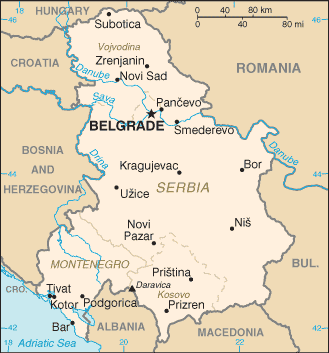
Southeastern
Europe, bordering the Adriatic Sea, between Albania and Bosnia
and Herzegovina
|
|
|
Geographic
coordinates: |
44 00 N, 21 00 E
|
|
|
Map references: |
Europe
|
|
|
Area: |
total:
102,350 sq km
land: 102,136 sq km
water: 214 sq km
|
|
|
Area -
comparative: |
slightly smaller
than Kentucky
|
|
|
Land boundaries: |
total: 2,246
km
border countries: Albania 287 km, Bosnia and Herzegovina
527 km, Bulgaria 318 km, Croatia (north) 241 km, Croatia (south)
25 km, Hungary 151 km, Macedonia 221 km, Romania 476 km
|
|
|
Coastline: |
199 km
|
|
|
Maritime claims: |
NA
|
|
|
Climate: |
in the north,
continental climate (cold winters and hot, humid summers with
well distributed rainfall); central portion, continental and
Mediterranean climate; to the south, Adriatic climate along the
coast, hot, dry summers and autumns and relatively cold winters
with heavy snowfall inland
|
|
|
Terrain: |
extremely varied;
to the north, rich fertile plains; to the east, limestone ranges
and basins; to the southeast, ancient mountains and hills; to
the southwest, extremely high shoreline with no islands off the
coast
|
|
|
Elevation
extremes: |
lowest point:
Adriatic Sea 0 m
highest point: Daravica 2,656 m
|
|
|
Natural
resources: |
oil, gas, coal,
iron ore, bauxite, copper, lead, zinc, antimony, chromite,
nickel, gold, silver, magnesium, pyrite, limestone, marble,
salt, hydropower, arable land
|
|
|
Land use: |
arable land:
33.35%
permanent crops: 3.2%
other: 63.45% (2001)
|
|
|
Irrigated land: |
570 sq km
|
|
|
Natural hazards: |
destructive
earthquakes
|
|
|
Environment -
current issues: |
pollution of
coastal waters from sewage outlets, especially in
tourist-related areas such as Kotor; air pollution around
Belgrade and other industrial cities; water pollution from
industrial wastes dumped into the Sava which flows into the
Danube
|
|
|
Environment -
international agreements: |
party to:
Air Pollution, Biodiversity, Climate Change, Endangered Species,
Hazardous Wastes, Law of the Sea, Marine Dumping, Marine Life
Conservation, Ozone Layer Protection, Ship Pollution, Wetlands
signed, but not ratified: none of the selected agreements
|
|
|
Geography -
note: |
controls one of the
major land routes from Western Europe to Turkey and the Near
East; strategic location along the Adriatic coast
|
|
|
People |
Top |
|
Population: |
10,829,175 (July
2005 est.)
|
|
|
Age structure: |
0-14 years:
18.1% (male 1,014,443/female 943,702)
15-64 years: 66.9% (male 3,610,646/female 3,632,365)
65 years and over: 15% (male 699,446/female 928,573)
(2005 est.)
|
|
|
Median age: |
total: 36.79
years
male: 35.3 years
female: 38.29 years (2005 est.)
|
|
|
Population
growth rate: |
0.03% (2005 est.)
|
|
|
Birth rate: |
12.12 births/1,000
population (2005 est.)
|
|
|
Death rate: |
10.49 deaths/1,000
population (2005 est.)
|
|
|
Net migration
rate: |
-1.3 migrant(s)/1,000
population (2005 est.)
|
|
|
Sex ratio: |
at birth:
1.08 male(s)/female
under 15 years: 1.08 male(s)/female
15-64 years: 0.99 male(s)/female
65 years and over: 0.75 male(s)/female
total population: 0.97 male(s)/female (2005 est.)
|
|
|
Infant mortality
rate: |
total: 12.89
deaths/1,000 live births
male: 14.54 deaths/1,000 live births
female: 11.1 deaths/1,000 live births (2005 est.)
|
|
|
Life expectancy
at birth: |
total
population: 74.73 years
male: 72.15 years
female: 77.51 years (2005 est.)
|
|
|
Total fertility
rate: |
1.67 children
born/woman (2005 est.)
|
|
|
HIV/AIDS - adult
prevalence rate: |
0.2% (2001 est.)
|
|
|
HIV/AIDS -
people living with HIV/AIDS: |
10,000 (2001 est.)
|
|
|
HIV/AIDS -
deaths: |
less than 100 (2003
est.)
|
|
|
Nationality: |
noun: Serb(s);
Montenegrin(s)
adjective: Serbian; Montenegrin
|
|
|
Ethnic groups: |
Serb 62.6%,
Albanian 16.5%, Montenegrin 5%, Hungarian 3.3%, other 12.6%
(1991)
|
|
|
Religions: |
Orthodox 65%,
Muslim 19%, Roman Catholic 4%, Protestant 1%, other 11%
|
|
|
Languages: |
Serbian 95%,
Albanian 5%
|
|
|
Literacy: |
definition:
age 15 and over can read and write
total population: 93%
male: 97.2%
female: 88.9% (1991)
|
|
|
Government |
Top |
|
Country name: |
conventional
long form: Serbia and Montenegro
conventional short form: none
local long form: Srbija i Crna Gora
local short form: none
former: Federal Republic of Yugoslavia
abbreviation: SCG
|
|
|
Government type: |
republic
|
|
|
Capital: |
Belgrade
|
|
|
Administrative
divisions: |
2 republics (republike,
singular - republika); and 2 nominally autonomous provinces* (autonomn
pokrajine, singular - autonomna pokrajina); Kosovo* (temporarily
under UN administration, per UN Security Council Resolution
1244), Montenegro, Serbia, Vojvodina*
|
|
|
Independence: |
27 April 1992
(Federal Republic of Yugoslavia or FRY - now Serbia and
Montenegro - formed as self-proclaimed successor to the
Socialist Federal Republic of Yugoslavia or SFRY)
|
|
|
National
holiday: |
National Day, 27
April
|
|
|
Constitution: |
4 February 2003
|
|
|
Legal system: |
based on civil law
system
|
|
|
Suffrage: |
16 years of age, if
employed; 18 years of age, universal
|
|
|
Executive
branch: |
chief of state:
President Svetozar MAROVIC (since 7 March 2003); note - the
president is both the chief of state and head of government
head of government: President Svetozar MAROVIC (since 7
March 2003); note - the president is both the chief of state and
head of government
cabinet: Federal Ministries act as Cabinet
elections: president elected by the parliament for a
four-year term; election last held 7 March 2003 (next to be held
2007)
election results: Svetozar MAROVIC elected president by
the parliament; vote was Svetozar MAROVIC 65, other 47
|
|
|
Legislative
branch: |
unicameral
Parliament (126 seats - 91 Serbian, 35 Montenegrin - filled by
nominees of the two state parliaments for the first two years,
after which the Constitutional Charter calls for direct
elections
elections: last held 25 February 2003 (next to be held
2005)
election results: percent of vote by party - NA%; seats
by party - Serbian parties: SRS 30, DSS 20, DS 13, G17 Plus 12,
SPO-NS 8, SPS 8; Montenegrin parties: DPS 15, SNP 9, SDP 4, DSS
3, NS 2, LSCG 2
|
|
|
Judicial branch: |
The Court of Serbia
and Montenegro; judges are elected by the Serbia and Montenegro
Parliament for six-year terms
note: since the promulgation of the 2003 Constitution,
the Federal Court has constitutional and administrative
functions; it has an equal number of judges from each republic
|
|
|
Political
parties and leaders: |
Democratic Party or
DS [Boris TADIC]; Democratic Party of Serbia or DSS [Vojislav
KOSTUNICA]; Democratic Party of Socialists of Montenegro or DPS
[Milo DJUKANOVIC]; Democratic Serbian Party of Montenegro or DSS
[Bozidar BOJOVIC]; G17 Plus [Miroljub LABUS]; New Serbia or NS [Velimir
ILIC]; Liberal Party of Montenegro or LSCG [Miodrag ZIVKOVIC];
People's Party of Montenegro or NS [Dragan SOC]; Power of Serbia
Movement or PSS [Bogoljub KARIC]; Serbian Radical Party or SRS [Tomislav
NIKOLIC]; Serbian Renewal Movement or SPO [Vuk DRASKOVIC];
Serbian Socialist Party or SPS (former Communist Party and party
of Slobodan MILOSEVIC) [Ivica DACIC, president of Main Board];
Social Democratic Party of Montenegro or SDP [Ranko KRIVOKAPIC];
Socialist People's Party of Montenegro or SNP [Predrag BULATOVIC]
note: the following political parties participate in
elections and institutions only in Kosovo, which has been
governed by the UN under UNSCR 1244 since 1999: Albanian
Christian Democratic Party or PSHDK [Mark KRASNIQI]; Alliance
for the Future of Kosovo or AAK [Ramush HARADINAJ]; Citizens'
Initiative of Serbia or GIS [Slavisa PETKOVIC]; Democratic
Ashkali Party of Kosovo or PDAK [Sabit RRAHMANI]; Democratic
League of Kosovo or LDK [Ibrahim RUGOVA]; Democratic Party of
Kosovo or PDK [Hashim THACI]; Justice Party of PD [Sylejman
CERKEZI]; Kosovo Democratic Turkish Party of KDTP [Mahir
YAGCILAR]; Liberal Party of Kosovo or PLK [Gjergj DEDAJ]; Ora [Veton
SURROI]; New Democratic Initiative of Kosovo or IRDK [Bislim
HOTI]; Party of Democratic Action or SDA [Numan BALIC]; Popular
Movement of Kosovo or LPK [Emrush XHEMAJLI]; Prizren-Dragas
Initiative or PDI [Ismajl KARADOLAMI]; Serb List for Kosovo and
Metohija or SLKM [Oliver IVANOVIC]; United Roma Party of Kosovo
or PREBK [Haxhi Zylfi MERXHA]; Vakat [leader NA]
|
|
|
Political
pressure groups and leaders: |
Political Council
for Presevo, Medvedja and Bujanovac or PCPMB [leader NA]; Group
for Changes of Montenegro or GZP [Nebojsa MEDOJEVIC]
|
|
|
International
organization participation: |
BSEC, CE, CEI, EBRD,
FAO, IAEA, IBRD, ICAO, ICC, ICCt, ICFTU, ICRM, IDA, IFAD, IFC,
IFRCS, IHO, ILO, IMF, IMO, Interpol, IOC, IOM, ISO, ITU, MIGA,
MONUC, NAM, OAS (observer), ONUB, OPCW, OSCE, PCA, UN, UNCTAD,
UNESCO, UNHCR, UNIDO, UNMIL, UNOCI, UPU, WCL, WCO, WHO, WIPO,
WMO, WToO, WTO (observer)
|
|
|
Flag
description: |
three equal
horizontal bands of blue (top), white, and red
|
|
|
Economy |
Top |
|
Economy -
overview: |
MILOSEVIC-era
mismanagement of the economy, an extended period of economic
sanctions, and the damage to Yugoslavia's infrastructure and
industry during the NATO airstrikes in 1999 left the economy
only half the size it was in 1990. After the ousting of former
Federal Yugoslav President MILOSEVIC in October 2000, the
Democratic Opposition of Serbia (DOS) coalition government
implemented stabilization measures and embarked on an aggressive
market reform program. After renewing its membership in the IMF
in December 2000, a down-sized Yugoslavia continued to
reintegrate into the international community by rejoining the
World Bank (IBRD) and the European Bank for Reconstruction and
Development (EBRD). A World Bank-European Commission sponsored
Donors' Conference held in June 2001 raised $1.3 billion for
economic restructuring. An agreement rescheduling the country's
$4.5 billion Paris Club government debts was concluded in
November 2001 - it wrote off 66% of the debt - and the London
Club of private creditors forgave $1.7 billion of debt, just
over half the total owed, in July 2004. The smaller republic of
Montenegro severed its economy from federal control and from
Serbia during the MILOSEVIC era and continues to maintain its
own central bank, uses the euro instead of the Yugoslav dinar as
official currency, collects customs tariffs, and manages its own
budget. Kosovo's economy continues to transition to a
market-based system, and is largely dependent on the
international community and the diaspora for financial and
technical assistance. The euro and the Yugoslav dinar are both
accepted currencies in Kosovo. While maintaining ultimate
oversight, UNMIK continues to work with the European Union and
Kosovo's local provisional government to accelerate economic
growth, lower unemployment, and attract foreign investment to
help Kosovo integrate into regional economic structures. The
complexity of Serbia and Montenegro political relationships,
slow progress in privatization, legal uncertainty over property
rights, scarcity of foreign-investment and a substantial foreign
trade deficit are holding back the economy. Arrangements with
the IMF, especially requirements for fiscal discipline, are an
important element in policy formation. Severe unemployment
remains a key political economic problem for this entire region.
|
|
|
GDP: |
purchasing power
parity - $26.27 billion (2004 est.)
|
|
|
GDP - real
growth rate: |
6.5% (2004 est.)
|
|
|
GDP - per
capita: |
purchasing power
parity - $2,400 (2004 est.)
|
|
|
GDP -
composition by sector: |
agriculture:
15.5%
industry: 27.6%
services: 56.8% (2004 est.)
|
|
|
Labor force: |
3.2 million (2004
est.)
|
|
|
Labor force - by
occupation: |
agriculture NA,
industry NA, services NA
|
|
|
Unemployment
rate: |
30%
note: unemployment is approximately 50% in Kosovo (2004
est.)
|
|
|
Population below
poverty line: |
30% (1999 est.)
|
|
|
Household income
or consumption by percentage share: |
lowest 10%:
NA%
highest 10%: NA%
|
|
|
Inflation rate
(consumer prices): |
8.8% (2004 est.)
|
|
|
Investment
(gross fixed): |
14.4% of GDP (2004
est.)
|
|
|
Budget: |
revenues:
$9.773 billion
expenditures: $10.46 billion, including capital
expenditures of NA (2004 est.)
|
|
|
Public debt: |
80% of GDP (2004
est.)
|
|
|
Agriculture -
products: |
cereals, fruits,
vegetables, tobacco, olives; cattle, sheep, goats
|
|
|
Industries: |
machine building
(aircraft, trucks, and automobiles; tanks and weapons;
electrical equipment; agricultural machinery); metallurgy
(steel, aluminum, copper, lead, zinc, chromium, antimony,
bismuth, cadmium); mining (coal, bauxite, nonferrous ore, iron
ore, limestone); consumer goods (textiles, footwear, foodstuffs,
appliances); electronics, petroleum products, chemicals, and
pharmaceuticals
|
|
|
Industrial
production growth rate: |
1.7% (2002 est.)
|
|
|
Electricity -
production: |
31.64 billion kWh
(2002)
|
|
|
Electricity -
production by source: |
fossil fuel:
62.9%
hydro: 37.1%
nuclear: 0%
other: 0% (2001)
|
|
|
Electricity -
consumption: |
32.33 billion kWh
(2002)
|
|
|
Electricity -
exports: |
400 million kWh
(2002)
|
|
|
Electricity -
imports: |
3.3 billion kWh
(2002)
|
|
|
Oil -
production: |
15,000 bbl/day
(2001 est.)
|
|
|
Oil -
consumption: |
64,000 bbl/day
(2001 est.)
|
|
|
Oil - exports: |
NA
|
|
|
Oil - imports: |
NA
|
|
|
Oil - proved
reserves: |
38.75 million bbl
(1 January 2002)
|
|
|
Natural gas -
production: |
602 million cu m
(2001 est.)
|
|
|
Natural gas -
consumption: |
602 million cu m
(2001 est.)
|
|
|
Natural gas -
exports: |
0 cu m (2001 est.)
|
|
|
Natural gas -
imports: |
0 cu m (2001 est.)
|
|
|
Natural gas -
proved reserves: |
24.07 billion cu m
(1 January 2002)
|
|
|
Current account
balance: |
$-3.008 billion
(2004 est.)
|
|
|
Exports: |
$3.245 billion
f.o.b. (2004 est.)
|
|
|
Exports -
commodities: |
manufactured goods,
food and live animals, raw materials
|
|
|
Exports -
partners: |
Italy 30.1%,
Germany 16.6%, Austria 7.4%, Greece 7.1%, France 5.3%, Slovenia
4.2%, US 4.1% (2004)
|
|
|
Imports: |
$9.538 billion
f.o.b. (2004 est.)
|
|
|
Imports -
commodities: |
machinery and
transport equipment, fuels and lubricants, manufactured goods,
chemicals, food and live animals, raw materials
|
|
|
Imports -
partners: |
Germany 20.2%,
Italy 18.1%, Austria 9%, Slovenia 6.1%, France 5.1%, Netherlands
4.4%, Bulgaria 4.3%, Greece 4.2% (2004)
|
|
|
Reserves of
foreign exchange and gold: |
$3.55 billion (2004
est.)
|
|
|
Debt - external: |
$12.97 billion
(2004 est.)
|
|
|
Currency (code): |
new Yugoslav dinar
(YUM); note - in Montenegro the euro is legal tender; in Kosovo
both the euro and the Yugoslav dinar are legal
|
|
|
Currency code: |
CSD, EUR
|
|
|
Exchange rates: |
new Yugoslav dinars
per US dollar - 64.1915 (official rate: 65) (2002)
|
|
|
Fiscal year: |
calendar year
|
|
|
Communications |
Top |
|
Telephones -
main lines in use: |
2,611,700 (2003)
|
|
|
Telephones -
mobile cellular: |
3,634,600 (2003)
|
|
|
Telephone
system: |
general
assessment: NA
domestic: NA
international: country code - 381; satellite earth
station - 1 Intelsat (Atlantic Ocean)
|
|
|
Radio broadcast
stations: |
AM 113, FM 194,
shortwave 2 (1998)
|
|
|
Radios: |
3.15 million (1997)
|
|
|
Television
broadcast stations: |
more than 771
(including 86 strong stations and 685 low-power stations, plus
20 repeaters in the principal networks; also numerous local or
private stations in Serbia and Vojvodina) (1997)
|
|
|
Televisions: |
2.75 million (1997)
|
|
|
Internet country
code: |
.cs
|
|
|
Internet hosts: |
20,207 (2004)
|
|
|
Internet Service
Providers (ISPs): |
9 (2000)
|
|
|
Internet users: |
847,000 (2003)
|
|
|
Transportation |
Top |
|
Railways: |
total: 4,380
km
standard gauge: 4,380 km 1.435-m gauge (1,364 km
electrified) (2004)
|
|
|
Highways: |
total:
45,290 km
paved: 28,261 km (including 374 km of expressways)
unpaved: 17,029 km (2002)
|
|
|
Waterways: |
587 km
note: Danube River traffic delayed by pontoon bridge at
Novi Sad; plan to replace by summer of 2005 (2004)
|
|
|
Pipelines: |
gas 3,177 km; oil
393 km (2004)
|
|
|
Ports and
harbors: |
Bar, Belgrade,
Kotor, Novi Sad, Pancevo, Tivat, Zelenika
|
|
|
Merchant marine: |
total: 2
by type: cargo 1, chemical tanker 1
foreign-owned: 2 (Finland 1, Turkey 1)
registered in other countries: 3 (2005)
|
|
|
Airports: |
44 (2004 est.)
|
|
|
Airports - with
paved runways: |
total: 19
over 3,047 m: 2
2,438 to 3,047 m: 5
1,524 to 2,437 m: 6
914 to 1,523 m: 2
under 914 m: 4 (2004 est.)
|
|
|
Airports - with
unpaved runways: |
total: 25
1,524 to 2,437 m: 2
914 to 1,523 m: 10
under 914 m: 13 (2004 est.)
|
|
|
Heliports: |
4 (2004 est.)
|
|
|
Military |
Top |
|
Military
branches: |
Serbian and
Montenegrin Armed Forces (Vojska Srbije i Crne Gore, VSCG):
Ground Forces, Air and Air Defense Forces, Naval Forces (2005)
|
|
|
Military
manpower - military age and obligation: |
19 years of age
(nine months compulsory service) (2004)
|
|
|
Military
manpower - availability: |
males age 19-49:
2,389,729 (2005 est.)
|
|
|
Military
manpower - fit for military service: |
males age 19-49:
1,959,166 (2005 est.)
|
|
|
Military
manpower - reaching military age annually: |
males:
81,033 (2005 est.)
|
|
|
Military
expenditures - dollar figure: |
$654 million (2002)
|
|
|
Military
expenditures - percent of GDP: |
NA
|
|
|
Transnational Issues |
Top |
|
Disputes -
international: |
Kosovo remains
unresolved administered by several thousand peacekeepers from
the UN Interim Administration Mission in Kosovo (UNMIK) since
1999, with Kosovar Albanians overwhelmingly supporting and
Serbian officials opposing Kosovo independence; the
international community had agreed to begin a process to
determine final status but contingency of solidifying
multi-ethnic democracy in Kosovo has not been satisfied; ethnic
Albanians in Kosovo refuse demarcation of the boundary with
Macedonia in accordance with the 2000 Macedonia-Serbia and
Montenegro delimitation agreement; Serbia and Montenegro have
delimited about half of the boundary with Bosnia and
Herzegovina, but sections along the Drina River remain in
dispute
|
|
|
Refugees and
internally displaced persons:: |
refugees
(country of origin): 99,170 (Bosnia) 188,656 (Croatia)
IDPs: 225,000 (mostly ethnic Serbs and Roma who fled
Kosovo in 1999) (2004)
|
|
|
Illicit drugs: |
transshipment point
for Southwest Asian heroin moving to Western Europe on the
Balkan route; economy vulnerable to money laundering
|

 100+ Important Documents in United States History