|
Introduction |
Top |
|
Background: |
Ancient Peru was
the seat of several prominent Andean civilizations, most notably
that of the Incas whose empire was captured by the Spanish
conquistadors in 1533. Peruvian independence was declared in
1821, and remaining Spanish forces defeated in 1824. After a
dozen years of military rule, Peru returned to democratic
leadership in 1980, but experienced economic problems and the
growth of a violent insurgency. President Alberto FUJIMORI's
election in 1990 ushered in a decade that saw a dramatic
turnaround in the economy and significant progress in curtailing
guerrilla activity. Nevertheless, the president's increasing
reliance on authoritarian measures and an economic slump in the
late 1990s generated mounting dissatisfaction with his regime.
FUJIMORI won reelection to a third term in the spring of 2000,
but international pressure and corruption scandals led to his
ouster by Congress in November of that year. A caretaker
government oversaw new elections in the spring of 2001, which
ushered in Alejandro TOLEDO as the new head of government; his
presidency has been hampered by allegations of corruption.
|
|
|
Geography |
Top |
|
Location: |
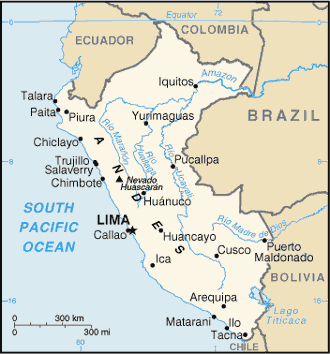
Western South
America, bordering the South Pacific Ocean, between Chile and
Ecuador
|
|
|
Geographic
coordinates: |
10 00 S, 76 00 W
|
|
|
Map references: |
South America
|
|
|
Area: |
total:
1,285,220 sq km
land: 1.28 million sq km
water: 5,220 sq km
|
|
|
Area -
comparative: |
slightly smaller
than Alaska
|
|
|
Land boundaries: |
total: 5,536
km
border countries: Bolivia 900 km, Brazil 1,560 km, Chile
160 km, Colombia 1,496 km (est.), Ecuador 1,420 km
|
|
|
Coastline: |
2,414 km
|
|
|
Maritime claims: |
territorial sea:
200 nm
continental shelf: 200 nm
|
|
|
Climate: |
varies from
tropical in east to dry desert in west; temperate to frigid in
Andes
|
|
|
Terrain: |
western coastal
plain (costa), high and rugged Andes in center (sierra), eastern
lowland jungle of Amazon Basin (selva)
|
|
|
Elevation
extremes: |
lowest point:
Pacific Ocean 0 m
highest point: Nevado Huascaran 6,768 m
|
|
|
Natural
resources: |
copper, silver,
gold, petroleum, timber, fish, iron ore, coal, phosphate,
potash, hydropower, natural gas
|
|
|
Land use: |
arable land:
2.89%
permanent crops: 0.4%
other: 96.71% (2001)
|
|
|
Irrigated land: |
11,950 sq km (1998
est.)
|
|
|
Natural hazards: |
earthquakes,
tsunamis, flooding, landslides, mild volcanic activity
|
|
|
Environment -
current issues: |
deforestation (some
the result of illegal logging); overgrazing of the slopes of the
costa and sierra leading to soil erosion; desertification; air
pollution in Lima; pollution of rivers and coastal waters from
municipal and mining wastes
|
|
|
Environment -
international agreements: |
party to:
Antarctic-Environmental Protocol, Antarctic-Marine Living
Resources, Antarctic Treaty, Biodiversity, Climate Change,
Climate Change-Kyoto Protocol, Desertification, Endangered
Species, Hazardous Wastes, Marine Dumping, Ozone Layer
Protection, Ship Pollution, Tropical Timber 83, Tropical Timber
94, Wetlands, Whaling
signed, but not ratified: none of the selected agreements
|
|
|
Geography -
note: |
shares control of
Lago Titicaca, world's highest navigable lake, with Bolivia; a
remote slope of Nevado Mismi, a 5,316 m peak, is the ultimate
source of the Amazon River
|
|
|
People |
Top |
|
Population: |
27,925,628 (July
2005 est.)
|
|
|
Age structure: |
0-14 years:
31.5% (male 4,479,278/female 4,323,356)
15-64 years: 63.3% (male 8,891,785/female 8,776,343)
65 years and over: 5.2% (male 685,179/female 769,687)
(2005 est.)
|
|
|
Median age: |
total: 24.95
years
male: 24.69 years
female: 25.21 years (2005 est.)
|
|
|
Population
growth rate: |
1.36% (2005 est.)
|
|
|
Birth rate: |
20.87 births/1,000
population (2005 est.)
|
|
|
Death rate: |
6.26 deaths/1,000
population (2005 est.)
|
|
|
Net migration
rate: |
-1.03 migrant(s)/1,000
population (2005 est.)
|
|
|
Sex ratio: |
at birth:
1.05 male(s)/female
under 15 years: 1.04 male(s)/female
15-64 years: 1.01 male(s)/female
65 years and over: 0.89 male(s)/female
total population: 1.01 male(s)/female (2005 est.)
|
|
|
Infant mortality
rate: |
total: 31.94
deaths/1,000 live births
male: 34.53 deaths/1,000 live births
female: 29.24 deaths/1,000 live births (2005 est.)
|
|
|
Life expectancy
at birth: |
total
population: 69.53 years
male: 67.77 years
female: 71.37 years (2005 est.)
|
|
|
Total fertility
rate: |
2.56 children
born/woman (2005 est.)
|
|
|
HIV/AIDS - adult
prevalence rate: |
0.5% (2003 est.)
|
|
|
HIV/AIDS -
people living with HIV/AIDS: |
82,000 (2003 est.)
|
|
|
HIV/AIDS -
deaths: |
4,200 (2003 est.)
|
|
|
Nationality: |
noun:
Peruvian(s)
adjective: Peruvian
|
|
|
Ethnic groups: |
Amerindian 45%,
mestizo (mixed Amerindian and white) 37%, white 15%, black,
Japanese, Chinese, and other 3%
|
|
|
Religions: |
Roman Catholic 81%,
Seventh Day Adventist 1.4%, other Christian 0.7%, other 0.6%,
unspecified or none 16.3% (2003 est.)
|
|
|
Languages: |
Spanish (official),
Quechua (official), Aymara, and a large number of minor
Amazonian languages
|
|
|
Literacy: |
definition:
age 15 and over can read and write
total population: 90.9%
male: 95.2%
female: 86.8% (2003 est.)
|
|
|
Government |
Top |
|
Country name: |
conventional
long form: Republic of Peru
conventional short form: Peru
local long form: Republica del Peru
local short form: Peru
|
|
|
Government type: |
constitutional
republic
|
|
|
Capital: |
Lima
|
|
|
Administrative
divisions: |
24 departments (departamentos,
singular - departamento) and 1 constitutional province* (provincia
constitucional); Amazonas, Ancash, Apurimac, Arequipa, Ayacucho,
Cajamarca, Callao*, Cusco, Huancavelica, Huanuco, Ica, Junin, La
Libertad, Lambayeque, Lima, Loreto, Madre de Dios, Moquegua,
Pasco, Piura, Puno, San Martin, Tacna, Tumbes, Ucayali
note: some reports indicate that the 24 departments and 1
constitutional province are now being referred to as regions;
Peru is implementing a decentralization program whereby these 25
administrative divisions will begin to exercise greater
governmental authority over their territories; in November 2002,
voters chose their new regional presidents and other regional
leaders; the authority that the regional governments will
exercise has not yet been clearly defined, but it will be
devolved to the regions over the course of several years
|
|
|
Independence: |
28 July 1821 (from
Spain)
|
|
|
National
holiday: |
Independence Day,
28 July (1821)
|
|
|
Constitution: |
31 December 1993
|
|
|
Legal system: |
based on civil law
system; has not accepted compulsory ICJ jurisdiction
|
|
|
Suffrage: |
18 years of age;
universal and compulsory until the age of 70; note - members of
the military and national police may not vote
|
|
|
Executive
branch: |
chief of state:
President Alejandro TOLEDO Manrique (since 28 July 2001); note -
the president is both the chief of state and head of government;
additionally, the constitution provides for two vice presidents,
First Vice President (vacant) and Second Vice President David
WAISMAN Rjavinsthi (since 28 July 2001)
head of government: President Alejandro TOLEDO Manrique
(since 28 July 2001); note - the president is both the chief of
state and head of government; additionally, the constitution
provides for two vice presidents, First Vice President (vacant)
and Second Vice President David WAISMAN Rjavinsthi (since 28
July 2001)
note: Prime Minister Carlos FERRERO Costa (since 15
December 2003) does not exercise executive power; this power is
in the hands of the president
cabinet: Council of Ministers appointed by the president
elections: president elected by popular vote for a
five-year term; special presidential and congressional elections
held 8 April 2001, with runoff election held 3 June 2001; next
to be held 9 April 2006
election results: President Alejandro TOLEDO Manrique
elected president in runoff election; percent of vote -
Alejandro TOLEDO Manrique 53.1%, Alan GARCIA 46.9%
|
|
|
Legislative
branch: |
unicameral Congress
of the Republic of Peru or Congreso de la Republica del Peru
(120 seats; members are elected by popular vote to serve
five-year terms)
elections: last held 8 April 2001 (next to be held 9
April 2006)
election results: percent of vote by party - PP 26.3%,
APRA 19.7%, UN 13.8%, FIM 11.0%, others 29.2%; seats by party -
PP 47, APRA 28, UN 17, FIM 11, others 17
|
|
|
Judicial branch: |
Supreme Court of
Justice or Corte Suprema de Justicia (judges are appointed by
the National Council of the Judiciary)
|
|
|
Political
parties and leaders: |
Independent
Moralizing Front or FIM [Fernando OLIVERA Vega]; National Unity
(Unidad Nacional) or UN [Lourdes FLORES Nano]; Peru Posible or
PP [David WAISMAN]; Peruvian Aprista Party or PAP (also referred
to by its original name Alianza Popular Revolucionaria Americana
or APRA) [Alan GARCIA]; Popular Action or AP [Javier DIAZ
Orihuela]; Solucion Popular [Carlos BOLANA]; Somos Peru or SP
[Alberto ANDRADE]; Union for Peru or UPP [Roger GUERRA Garcia]
|
|
|
Political
pressure groups and leaders: |
leftist guerrilla
groups include Shining Path [Abimael GUZMAN Reynoso
(imprisoned), Gabriel MACARIO (top leader at-large)]; Tupac
Amaru Revolutionary Movement or MRTA [Victor POLAY (imprisoned),
Hugo AVALLENEDA Valdez (top leader at-large)]
|
|
|
International
organization participation: |
APEC, CAN, CSN, FAO,
G-15, G-24, G-77, IADB, IAEA, IBRD, ICAO, ICC, ICCt, ICFTU, ICRM,
IDA, IFAD, IFC, IFRCS, IHO, ILO, IMF, IMO, Interpol, IOC, IOM,
ISO (correspondent), ITU, LAES, LAIA, Mercosur (associate), MIGA,
MINUSTAH, MONUC, NAM, OAS, ONUB, OPANAL, OPCW, PCA, RG, UN,
UNCTAD, UNESCO, UNIDO, UNMEE, UNMIL, UNOCI, UPU, WCL, WCO, WFTU,
WHO, WIPO, WMO, WToO, WTO
|
|
|
Flag
description: |
three equal,
vertical bands of red (hoist side), white, and red with the coat
of arms centered in the white band; the coat of arms features a
shield bearing a vicuna, cinchona tree (the source of quinine),
and a yellow cornucopia spilling out gold coins, all framed by a
green wreath
|
|
|
Economy |
Top |
|
Economy -
overview: |
Peru's economy
reflects its varied geography - an arid coastal region, the
Andes further inland, and tropical lands bordering Colombia and
Brazil. Abundant mineral resources are found in the mountainous
areas, and Peru's coastal waters provide excellent fishing
grounds. However, overdependence on minerals and metals subjects
the economy to fluctuations in world prices, and a lack of
infrastructure deters trade and investment. After several years
of inconsistent economic performance, the Peruvian economy grew
by an average 4 percent per year during the period 2002-2004,
with a stable exchange rate and low inflation. Risk premiums on
Peruvian bonds on secondary markets reached historically low
levels in late 2004, reflecting investor optimism regarding the
government's prudent fiscal policies and openness to trade and
investment. Despite the strong macroeconomic performance, the
TOLEDO administration remained unpopular in 2004, and
unemployment and poverty have stayed persistently high.
|
|
|
GDP: |
purchasing power
parity - $155.3 billion (2004 est.)
|
|
|
GDP - real
growth rate: |
4.5% (2004 est.)
|
|
|
GDP - per
capita: |
purchasing power
parity - $5,600 (2004 est.)
|
|
|
GDP -
composition by sector: |
agriculture:
8%
industry: 27%
services: 65% (2003 est.)
|
|
|
Labor force: |
11 million (2004
est.)
|
|
|
Labor force - by
occupation: |
agriculture 9%,
industry 18%, services 73% (2001)
|
|
|
Unemployment
rate: |
9.6% in
metropolitan Lima; widespread underemployment (2004 est.)
|
|
|
Population below
poverty line: |
54% (2003 est.)
|
|
|
Household income
or consumption by percentage share: |
lowest 10%:
0.8%
highest 10%: 37.2% (2000)
|
|
|
Distribution of
family income - Gini index: |
49.8 (2000)
|
|
|
Inflation rate
(consumer prices): |
3.8% (2004 est.)
|
|
|
Investment
(gross fixed): |
17.8% of GDP (2004
est.)
|
|
|
Budget: |
revenues:
$13.6 billion
expenditures: $14.6 billion, including capital
expenditures of $1.8 billion, for general government, excluding
private enterprises (2004 est.)
|
|
|
Public debt: |
44.1% of GDP (2004
est.)
|
|
|
Agriculture -
products: |
coffee, cotton,
sugarcane, rice, potatoes, corn, plantains, grapes, oranges,
coca; poultry, beef, dairy products; fish
|
|
|
Industries: |
mining and refining
of minerals and metals, petroleum extraction and refining,
natural gas, fishing and fish processing, textiles, clothing,
food processing, steel, metal fabrication
|
|
|
Industrial
production growth rate: |
5.2% (2004 est.)
|
|
|
Electricity -
production: |
22.88 billion kWh
(2004 est.)
|
|
|
Electricity -
production by source: |
fossil fuel:
14.5%
hydro: 84.7%
nuclear: 0%
other: 0.8% (2001)
|
|
|
Electricity -
consumption: |
20.22 billion kWh
(2002)
|
|
|
Electricity -
exports: |
0 kWh (2003)
|
|
|
Electricity -
imports: |
0 kWh (2003)
|
|
|
Oil -
production: |
95,500 bbl/day
(2004 est.)
|
|
|
Oil -
consumption: |
161,000 bbl/day
(2001 est.)
|
|
|
Oil - exports: |
49,000 bbl/day
(2004 est.)
|
|
|
Oil - imports: |
NA
|
|
|
Oil - proved
reserves: |
408.8 million bbl
(2004 est.)
|
|
|
Natural gas -
production: |
910 million cu m
(2004 est.)
|
|
|
Natural gas -
consumption: |
910 million cu m
(2004 est.)
|
|
|
Natural gas -
exports: |
0 cu m (2004 est.)
|
|
|
Natural gas -
imports: |
0 cu m (2004 est.)
|
|
|
Natural gas -
proved reserves: |
245.1 billion cu m
(2004)
|
|
|
Current account
balance: |
$-30 million (2004
est.)
|
|
|
Exports: |
$12.3 billion
f.o.b. (2004 est.)
|
|
|
Exports -
commodities: |
copper, gold, zinc,
crude petroleum and petroleum products, coffee
|
|
|
Exports -
partners: |
US 29.5%, China
9.8%, UK 8%, Chile 5.3%, Japan 4.7%, Switzerland 4.4% (2004)
|
|
|
Imports: |
$9.6 billion f.o.b.
(2004 est.)
|
|
|
Imports -
commodities: |
petroleum and
petroleum products, plastics, machinery, vehicles, iron and
steel, wheat, paper
|
|
|
Imports -
partners: |
US 29.2%, Spain
8.5%, Chile 6.9%, Brazil 5.6%, Colombia 5.2%, China 4% (2004)
|
|
|
Reserves of
foreign exchange and gold: |
$12.7 billion (2004
est.)
|
|
|
Debt - external: |
$29.79 billion
(2004 est.)
|
|
|
Currency (code): |
nuevo sol (PEN)
|
|
|
Currency code: |
PEN
|
|
|
Exchange rates: |
nuevo sol per US
dollar - 3.4132 (2004), 3.4785 (2003), 3.5165 (2002), 3.5068
(2001), 3.49 (2000)
|
|
|
Fiscal year: |
calendar year
|
|
|
Communications |
Top |
|
Telephones -
main lines in use: |
1,839,200 (2003)
|
|
|
Telephones -
mobile cellular: |
2,908,800 (2003)
|
|
|
Telephone
system: |
general
assessment: adequate for most requirements
domestic: nationwide microwave radio relay system and a
domestic satellite system with 12 earth stations
international: country code - 51; satellite earth
stations - 2 Intelsat (Atlantic Ocean); Pan American submarine
cable
|
|
|
Radio broadcast
stations: |
AM 472, FM 198,
shortwave 189 (1999)
|
|
|
Radios: |
6.65 million (1997)
|
|
|
Television
broadcast stations: |
13 (plus 112
repeaters) (1997)
|
|
|
Televisions: |
3.06 million (1997)
|
|
|
Internet country
code: |
.pe
|
|
|
Internet hosts: |
65,868 (2003)
|
|
|
Internet Service
Providers (ISPs): |
10 (2000)
|
|
|
Internet users: |
2.85 million (2003)
|
|
|
Transportation |
Top |
|
Railways: |
total: 3,462
km
standard gauge: 2,962 km 1.435-m gauge
narrow gauge: 500 km 0.914-m gauge (2004)
|
|
|
Highways: |
total:
78,230 km
paved: 10,452 km
unpaved: 67,778 km (2001)
|
|
|
Waterways: |
8,808 km
note: 8,600 km of navigable tributaries of Amazon system
and 208 km of Lago Titicaca (2004)
|
|
|
Pipelines: |
gas 388 km; oil
1,557 km; refined products 13 km (2004)
|
|
|
Ports and
harbors: |
Callao, Chimbote,
Ilo, Matarani, Paita, Puerto Maldonado, Salaverry, San Martin,
Talara, Iquitos, Pucallpa, Yurimaguas
note: Iquitos, Pucallpa, and Yurimaguas are all on the
upper reaches of the Amazon and its tributaries
|
|
|
Merchant marine: |
total: 4
ships (1,000 GRT or over) 13,666 GRT/17,611 DWT
by type: cargo 3, petroleum tanker 1
foreign-owned: 1 (United States 1)
registered in other countries: 14 (2005)
|
|
|
Airports: |
234 (2004 est.)
|
|
|
Airports - with
paved runways: |
total: 52
over 3,047 m: 5
2,438 to 3,047 m: 20
1,524 to 2,437 m: 16
914 to 1,523 m: 9
under 914 m: 2 (2004 est.)
|
|
|
Airports - with
unpaved runways: |
total: 182
1,524 to 2,437 m: 21
914 to 1,523 m: 62
under 914 m: 99 (2004 est.)
|
|
|
Heliports: |
1 (2004 est.)
|
|
|
Military |
Top |
|
Military
branches: |
Army (Ejercito
Peruano), Navy (Marina de Guerra del Peru; includes Naval Air,
Naval Infantry, and Coast Guard), Air Force (Fuerza Aerea del
Peru; FAP)
|
|
|
Military
manpower - military age and obligation: |
18 years of age for
compulsory military service (1999)
|
|
|
Military
manpower - availability: |
males age 18-49:
6,647,874 (2005 est.)
|
|
|
Military
manpower - fit for military service: |
males age 18-49:
4,938,417 (2005 est.)
|
|
|
Military
manpower - reaching military age annually: |
males:
277,105 (2005 est.)
|
|
|
Military
expenditures - dollar figure: |
$829.3 million
(2003)
|
|
|
Military
expenditures - percent of GDP: |
1.4% (2004)
|
|
|
Transnational Issues |
Top |
|
Disputes -
international: |
Peru proposes
changing its latitudinal maritime boundary with Chile to an
equidistance line with a southwestern axis; organized illegal
narcotics operations in Colombia have penetrated Peru's shared
border; Peru does not support Bolivia's claim to restore
maritime access through a sovereign corridor through Chile along
the Peruvian border
|
|
|
Refugees and
internally displaced persons:: |
IDPs: 60,000
(civil war from 1980-2000; most IDPs are indigenous peasants in
Andean and Amazonian regions) (2004)
|
|
|
Illicit drugs: |
until 1996 the
world's largest coca leaf producer; emerging opium producer;
cultivation of coca in Peru fell 15 percent to 31,150 hectares
between 2002 and the end of 2003; much of the cocaine base is
shipped to neighboring Colombia for processing into cocaine,
while finished cocaine is shipped out from Pacific ports to the
international drug market; increasing amounts of base and
finished cocaine, however, are being moved to Brazil and Bolivia
for use in the Southern Cone or transshipped to Europe and
Africa
|
|

 100+ Important Documents in United States History