|
Introduction |
|
Background: |
With US backing,
Panama seceded from Colombia in 1903 and promptly signed a
treaty with the US allowing for the construction of a canal and
US sovereignty over a strip of land on either side of the
structure (the Panama Canal Zone). The Panama Canal was built by
the US Army Corps of Engineers between 1904 and 1914. On 7
September 1977, an agreement was signed for the complete
transfer of the Canal from the US to Panama by the end of 1999.
Certain portions of the Zone and increasing responsibility over
the Canal were turned over in the intervening years. With US
help, dictator Manuel NORIEGA was deposed in 1989. The entire
Panama Canal, the area supporting the Canal, and remaining US
military bases were turned over to Panama by or on 31 December
1999.
|
|
Geography |
|
Location: |
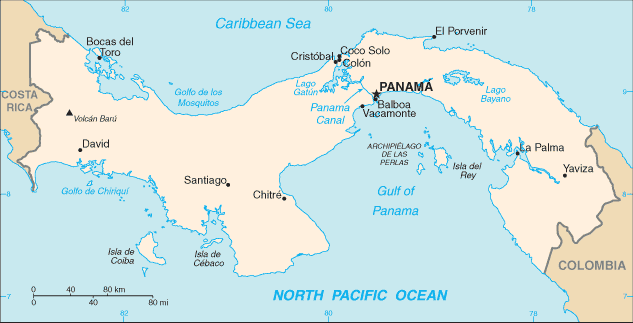
Central America,
bordering both the Caribbean Sea and the North Pacific Ocean,
between Colombia and Costa Rica
|
|
Geographic
coordinates: |
9 00 N, 80 00 W
|
|
Map references: |
Central America and
the Caribbean
|
|
Area: |
total:
78,200 sq km
land: 75,990 sq km
water: 2,210 sq km
|
|
Area -
comparative: |
slightly smaller
than South Carolina
|
|
Land boundaries: |
total: 555
km
border countries: Colombia 225 km, Costa Rica 330 km
|
|
Coastline: |
2,490 km
|
|
Maritime claims: |
territorial sea:
12 nm
contiguous zone: 24 nm
exclusive economic zone: 200 nm
|
|
Climate: |
tropical maritime;
hot, humid, cloudy; prolonged rainy season (May to January),
short dry season (January to May)
|
|
Terrain: |
interior mostly
steep, rugged mountains and dissected, upland plains; coastal
areas largely plains and rolling hills
|
|
Elevation
extremes: |
lowest point:
Pacific Ocean 0 m
highest point: Volcan de Chiriqui 3,475 m
|
|
Natural
resources: |
copper, mahogany
forests, shrimp, hydropower
|
|
Land use: |
arable land:
7.36%
permanent crops: 1.98%
other: 90.66% (2001)
|
|
Irrigated land: |
320 sq km (1998
est.)
|
|
Natural hazards: |
occasional severe
storms and forest fires in the Darien area
|
|
Environment -
current issues: |
water pollution
from agricultural runoff threatens fishery resources;
deforestation of tropical rain forest; land degradation and soil
erosion threatens siltation of Panama Canal; air pollution in
urban areas; mining threatens natural resources
|
|
Environment -
international agreements: |
party to:
Biodiversity, Climate Change, Climate Change-Kyoto Protocol,
Desertification, Endangered Species, Hazardous Wastes, Law of
the Sea, Marine Dumping, Ozone Layer Protection, Ship Pollution,
Tropical Timber 83, Tropical Timber 94, Wetlands, Whaling
signed, but not ratified: Marine Life Conservation
|
|
Geography -
note: |
strategic location
on eastern end of isthmus forming land bridge connecting North
and South America; controls Panama Canal that links North
Atlantic Ocean via Caribbean Sea with North Pacific Ocean
|
|
People |
|
Population: |
3,039,150 (July
2005 est.)
|
|
Age structure: |
0-14 years:
29.8% (male 460,840/female 443,359)
15-64 years: 63.9% (male 984,558/female 956,748)
65 years and over: 6.4% (male 91,383/female 102,262)
(2005 est.)
|
|
Median age: |
total: 26.18
years
male: 25.89 years
female: 26.48 years (2005 est.)
|
|
Population
growth rate: |
1.26% (2005 est.)
|
|
Birth rate: |
19.96 births/1,000
population (2005 est.)
|
|
Death rate: |
6.54 deaths/1,000
population (2005 est.)
|
|
Net migration
rate: |
-0.86 migrant(s)/1,000
population (2005 est.)
|
|
Sex ratio: |
at birth:
1.04 male(s)/female
under 15 years: 1.04 male(s)/female
15-64 years: 1.03 male(s)/female
65 years and over: 0.89 male(s)/female
total population: 1.02 male(s)/female (2005 est.)
|
|
Infant mortality
rate: |
total: 20.47
deaths/1,000 live births
male: 22.59 deaths/1,000 live births
female: 18.26 deaths/1,000 live births (2005 est.)
|
|
Life expectancy
at birth: |
total
population: 71.94 years
male: 69.67 years
female: 74.31 years (2005 est.)
|
|
Total fertility
rate: |
2.45 children
born/woman (2005 est.)
|
|
HIV/AIDS - adult
prevalence rate: |
0.9% (2003 est.)
|
|
HIV/AIDS -
people living with HIV/AIDS: |
16,000 (2003 est.)
|
|
HIV/AIDS -
deaths: |
less than 500 (2003
est.)
|
|
Nationality: |
noun:
Panamanian(s)
adjective: Panamanian
|
|
Ethnic groups: |
mestizo (mixed
Amerindian and white) 70%, Amerindian and mixed (West Indian)
14%, white 10%, Amerindian 6%
|
|
Religions: |
Roman Catholic 85%,
Protestant 15%
|
|
Languages: |
Spanish (official),
English 14%; note - many Panamanians bilingual
|
|
Literacy: |
definition:
age 15 and over can read and write
total population: 92.6%
male: 93.2%
female: 91.9% (2003 est.)
|
|
Government |
|
Country name: |
conventional
long form: Republic of Panama
conventional short form: Panama
local long form: Republica de Panama
local short form: Panama
|
|
Government type: |
constitutional
democracy
|
|
Capital: |
Panama
|
|
Administrative
divisions: |
9 provinces (provincias,
singular - provincia) and 1 territory* (comarca); Bocas del
Toro, Chiriqui, Cocle, Colon, Darien, Herrera, Los Santos,
Panama, San Blas*(Kuna Yala), and Veraguas
|
|
Independence: |
3 November 1903
(from Colombia; became independent from Spain 28 November 1821)
|
|
National
holiday: |
Independence Day, 3
November (1903)
|
|
Constitution: |
11 October 1972;
major reforms adopted 1978, 1983, 1994, and 2004
|
|
Legal system: |
based on civil law
system; judicial review of legislative acts in the Supreme Court
of Justice; accepts compulsory ICJ jurisdiction, with
reservations
|
|
Suffrage: |
18 years of age;
universal and compulsory
|
|
Executive
branch: |
chief of state:
President Martin TORRIJOS Espino (since 1 September 2004); First
Vice President Samuel LEWIS Navarro (since 1 September 2004);
Second Vice President Ruben AROSEMENA Valdes (since 1 September
2004); note - the president is both the chief of state and head
of government
head of government: President Martin TORRIJOS Espino
(since 1 September 2004); First Vice President Samuel LEWIS
Navarro (since 1 September 2004); Second Vice President Ruben
AROSEMENA Valdes (since 1 September 2004); note - the president
is both the chief of state and head of government
cabinet: Cabinet appointed by the president
elections: president and vice presidents elected on the
same ticket by popular vote for five-year terms; election last
held 2 May 2004 (next to be held 3 May 2009); note - beginning
in 2009, Panama will have only one vice president.
election results: Martin TORRIJOS Espino elected
president; percent of vote - Martin TORRIJOS Espino 47.5%,
Guillermo ENDARA Galimany 30.6%, Jose Miguel ALEMAN 17%, Ricardo
MARTINELLI 4.9%
note: government coalition - PRD (Democratic
Revolutionary Party), PP (Popular Party)
|
|
Legislative
branch: |
unicameral National
Assembly (formerly called Legislative Assembly) or Asamblea
Nacional (78 seats; members are elected by popular vote to serve
five-year terms; note - in 2009, the number of seats will change
to 71)
elections: last held 2 May 2004 (next to be held 3 May
2009)
election results: percent of vote by party - NA%; seats
by party - PRD 40, PA 17, PS 8, MOLIRENA 3, CD 2, PP 2, PLN 1,
other 5
note: legislators from outlying rural districts are
chosen on a plurality basis while districts located in more
populous towns and cities elect multiple legislators by means of
a proportion-based formula
|
|
Judicial branch: |
Supreme Court of
Justice or Corte Suprema de Justicia (nine judges appointed for
10-year terms); five superior courts; three courts of appeal
|
|
Political
parties and leaders: |
Democratic Change
or CD [Ricardo MARTINELLI]; Democratic Revolutionary Party or
PRD [Martin TORRIJOS]; National Liberal Party or PLN [Anibal
GALINDO]; Nationalist Republican Liberal Movement or MOLIRENA
[Jesus ROSAS]; Panamenista Party or PA (formerly the Arnulfista
Party) [Mireya Elisa MOSCOSO Rodriguez]; Popular Party or PP
(formerly Christian Democratic Party or PDC) [Ruben AROSEMENA];
Solidarity Party or PS [Jose Raul MULINO]
|
|
Political
pressure groups and leaders: |
Chamber of
Commerce; National Civic Crusade; National Council of Organized
Workers or CONATO; National Council of Private Enterprise or
CONEP; National Union of Construction and Similar Workers (SUNTRACS);
Panamanian Association of Business Executives or APEDE;
Panamanian Industrialists Society or SIP; Workers Confederation
of the Republic of Panama or CTRP
|
|
International
organization participation: |
FAO, G-77, IADB,
IAEA, IBRD, ICAO, ICC, ICCt, ICFTU, ICRM, IDA, IFAD, IFC, IFRCS,
ILO, IMF, IMO, Interpol, IOC, IOM, ISO, ITU, LAES, LAIA
(observer), MIGA, NAM, OAS, OPANAL, OPCW, PCA, RG, UN, UNCTAD,
UNESCO, UNIDO, UPU, WCL, WCO, WFTU, WHO, WIPO, WMO, WToO, WTO
|
|
Flag
description: |
divided into four,
equal rectangles; the top quadrants are white (hoist side) with
a blue five-pointed star in the center and plain red; the bottom
quadrants are plain blue (hoist side) and white with a red
five-pointed star in the center
|
|
Economy |
|
Economy -
overview: |
Panama's dollarised
economy rests primarily on a well-developed services sector that
accounts for four-fifths of GDP. Services include operating the
Panama Canal, banking, the Colon Free Zone, insurance, container
ports, flagship registry, and tourism. A slump in Colon Free
Zone and agricultural exports, the global slowdown, and the
withdrawal of US military forces held back economic growth in
2000-03; growth picked up in 2004 led by export-oriented
services and a construction boom stimulated by tax incentives.
The government has been backing tax reforms, reform of the
social security program, new regional trade agreements, and
development of tourism. Unemployment remains high.
|
|
GDP: |
purchasing power
parity - $20.57 billion (2004 est.)
|
|
GDP - real
growth rate: |
6% (2004 est.)
|
|
GDP - per
capita: |
purchasing power
parity - $6,900 (2004 est.)
|
|
GDP -
composition by sector: |
agriculture:
7.2%
industry: 13%
services: 79.8% (2004 est.)
|
|
Labor force: |
1.32 million
note: shortage of skilled labor, but an oversupply of
unskilled labor (2004 est.)
|
|
Labor force - by
occupation: |
agriculture 20.8%,
industry 18%, services 61.2% (1995 est.)
|
|
Unemployment
rate: |
12.6% (2004 est.)
|
|
Population below
poverty line: |
37% (1999 est.)
|
|
Household income
or consumption by percentage share: |
lowest 10%:
1.2%
highest 10%: 35.7% (1997)
|
|
Distribution of
family income - Gini index: |
48.5 (1997)
|
|
Inflation rate
(consumer prices): |
2% (2004 est.)
|
|
Investment
(gross fixed): |
25% of GDP (2004
est.)
|
|
Budget: |
revenues:
$3.095 billion
expenditures: $3.737 billion, including capital
expenditures of $471 million (2004 est.)
|
|
Public debt: |
69.2% of GDP (2004
est.)
|
|
Agriculture -
products: |
bananas, rice,
corn, coffee, sugarcane, vegetables; livestock; shrimp
|
|
Industries: |
construction,
brewing, cement and other construction materials, sugar milling
|
|
Industrial
production growth rate: |
5.4% (2004 est.)
|
|
Electricity -
production: |
4.873 billion kWh
(2002)
|
|
Electricity -
production by source: |
fossil fuel:
37%
hydro: 61.3%
nuclear: 0%
other: 1.7% (2001)
|
|
Electricity -
consumption: |
4.473 billion kWh
(2002)
|
|
Electricity -
exports: |
120 million kWh
(2002)
|
|
Electricity -
imports: |
61 million kWh
(2002)
|
|
Oil -
production: |
0 bbl/day (2004
est.)
|
|
Oil -
consumption: |
40,520 bbl/day
(2003 est.)
|
|
Oil - exports: |
NA
|
|
Oil - imports: |
NA
|
|
Current account
balance: |
$-469.6 million
(2004 est.)
|
|
Exports: |
$5.699 billion
f.o.b. (includes the Colon Free Zone) (2004 est.)
|
|
Exports -
commodities: |
bananas, shrimp,
sugar, coffee, clothing (1999)
|
|
Exports -
partners: |
US 12.2%, Nigeria
9.4%, Germany 8.4%, South Korea 8.2%, El Salvador 5.7%, Peru
5.1%, Costa Rica 5.1%, Japan 4.1% (2004)
|
|
Imports: |
$7.164 billion
f.o.b. (includes the Colon Free Zone) (2004 est.)
|
|
Imports -
commodities: |
capital goods,
foodstuffs, consumer goods, chemicals
|
|
Imports -
partners: |
Japan 32.9%, China
10.6%, US 9.8%, South Korea 7.2%, Singapore 7.1%, Italy 4.5%
(2004)
|
|
Reserves of
foreign exchange and gold: |
$1.076 billion
(2004 est.)
|
|
Debt - external: |
$8.78 billion (2004
est.)
|
|
Currency (code): |
balboa (PAB); US
dollar (USD)
|
|
Currency code: |
PAB; USD
|
|
Exchange rates: |
balboas per US
dollar - 1 (2004), 1 (2003), 1 (2002), 1 (2001), 1 (2000)
|
|
Fiscal year: |
calendar year
|
|
Communications |
|
Telephones -
main lines in use: |
386,900 (2002)
|
|
Telephones -
mobile cellular: |
834,000 (2003)
|
|
Telephone
system: |
general
assessment: domestic and international facilities well
developed
domestic: NA
international: country code - 507; 1 coaxial submarine
cable; satellite earth stations - 2 Intelsat (Atlantic Ocean);
connected to the Central American Microwave System
|
|
Radio broadcast
stations: |
AM 101, FM 134,
shortwave 0 (1998)
|
|
Radios: |
815,000 (1997)
|
|
Television
broadcast stations: |
38 (including
repeaters) (1998)
|
|
Televisions: |
510,000 (1997)
|
|
Internet country
code: |
.pa
|
|
Internet hosts: |
7,129 (2003)
|
|
Internet Service
Providers (ISPs): |
6 (2000)
|
|
Internet users: |
120,000 (2002)
|
|
Transportation |
|
Railways: |
total: 355
km
standard gauge: 76 km 1.435-m gauge
narrow gauge: 279 km 0.914-m gauge (2004)
|
|
Highways: |
total:
11,643 km
paved: 4,028 km (including 30 km of expressways)
unpaved: 7,615 km (2000 est.)
|
|
Waterways: |
800 km (includes 82
km Panama Canal) (2004)
|
|
Ports and
harbors: |
Balboa, Cristobal,
Coco Solo, Manzanillo (part of Colon area), Vacamonte
|
|
Merchant marine: |
total: 5,005
ships (1,000 GRT or over) 122,960,929 GRT/183,615,337 DWT
by type: barge carrier 1, bulk carrier 1,548, cargo 886,
chemical tanker 465, combination ore/oil 13, container 605,
liquefied gas 183, livestock carrier 8, passenger 42,
passenger/cargo 77, petroleum tanker 521, refrigerated cargo
298, roll on/roll off 97, specialized tanker 5, vehicle carrier
256
foreign-owned: 4,388 (Andorra 1, Argentina 9, Australia
3, Bahamas 1, Belgium 14, Brazil 1, Canada 1, Chile 14, China
310, Colombia 5, Croatia 1, Cuba 9, Cyprus 7, Denmark 13, Egypt
15, France 7, Germany 23, Greece 546, Hong Kong 159, India 8,
Indonesia 46, Ireland 1, Isle of Man 2, Israel 3, Italy 8, Japan
1814, Jordan 9, Latvia 2, Lithuania 5, Malaysia 11, Maldives 1,
Malta 1, Mexico 4, Monaco 8, Netherlands 22, New Zealand 1,
Nigeria 6, Norway 66, Pakistan 1, Peru 13, Philippines 15,
Poland 19, Portugal 8, Romania 13, Russia 4, Saudi Arabia 4,
Singapore 54, South Africa 3, South Korea 292, Spain 41, Sri
Lanka 1, Sudan 1, Sweden 4, Switzerland 188, Syria 7, Taiwan
301, Thailand 10, Trinidad & Tobago 1, Tunisia 1, Turkey 18,
Ukraine 9, UAE 83, United Kingdom 29, United States 88,
Venezuela 20, Vietnam 2, Yemen 1) (2005)
|
|
Airports: |
105 (2004 est.)
|
|
Airports - with
paved runways: |
total: 44
over 3,047 m: 1
2,438 to 3,047 m: 1
1,524 to 2,437 m: 5
914 to 1,523 m: 15
under 914 m: 22 (2004 est.)
|
|
Airports - with
unpaved runways: |
total: 61
914 to 1,523 m: 12
under 914 m: 49 (2004 est.)
|
|
Military |
|
Military
branches: |
an amendment to the
Constitution abolished the armed forces, but there are security
forces (Panamanian Public Forces or PPF includes the Panamanian
National Police, National Maritime Service, and National Air
Service)
|
|
Military
manpower - availability: |
males age 18-49:
733,031 (2005 est.)
|
|
Military
manpower - fit for military service: |
males age 18-49:
511,905 (2005 est.)
|
|
Military
expenditures - dollar figure: |
$147 million (2004)
|
|
Military
expenditures - percent of GDP: |
1.1% (2004)
|
|
Military note: |
on 10 February
1990, the government of then President ENDARA abolished Panama's
military and reformed the security apparatus by creating the
Panamanian Public Forces; in October 1994, Panama's Legislative
Assembly approved a constitutional amendment prohibiting the
creation of a standing military force, but allowing the
temporary establishment of special police units to counter acts
of "external aggression"
|
|
Transnational Issues |
|
Disputes -
international: |
organized illegal
narcotics operations in Colombia operate within the border
region with Panama
|
|
Illicit drugs: |
major cocaine
transshipment point and primary money-laundering center for
narcotics revenue; money-laundering activity is especially heavy
in the Colon Free Zone; offshore financial center; negligible
signs of coca cultivation; monitoring of financial transactions
is improving; official corruption remains a major problem
|

 100+ Important Documents in United States History