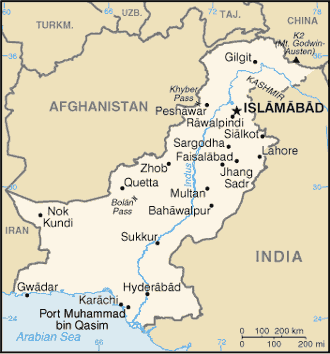
The separation in
1947 of British India into the Muslim state of Pakistan (with
two sections West and East) and largely Hindu India was never
satisfactorily resolved, and India and Pakistan have fought two
wars - in 1947-48 and 1965 - over the disputed Kashmir
territory. A third war between these countries in 1971 - in
which India capitalized on Islamabad's marginalization of
Bengalis in Pakistani politics - resulted in East Pakistan
becoming the separate nation of Bangladesh. In response to
Indian nuclear weapons testing, Pakistan conducted its own tests
in 1998. The dispute over the state of Kashmir is ongoing, but
recent discussions and confidence-building measures may be a
start toward lessened tensions.
Geography
Location:
Southern Asia,
bordering the Arabian Sea, between India on the east and Iran
and Afghanistan on the west and China in the north
Geographic
coordinates:
30 00 N, 70 00 E
Map references:
Asia
Area:
total:
803,940 sq km land: 778,720 sq km water: 25,220 sq km
Area -
comparative:
slightly less than
twice the size of California
Land boundaries:
total: 6,774
km border countries: Afghanistan 2,430 km, China 523 km,
India 2,912 km, Iran 909 km
Coastline:
1,046 km
Maritime claims:
territorial sea:
12 nm contiguous zone: 24 nm exclusive economic zone: 200 nm continental shelf: 200 nm or to the edge of the
continental margin
Climate:
mostly hot, dry
desert; temperate in northwest; arctic in north
Terrain:
flat Indus plain in
east; mountains in north and northwest; Balochistan plateau in
west
Elevation
extremes:
lowest point:
Indian Ocean 0 m highest point: K2 (Mt. Godwin-Austen) 8,611 m
Natural
resources:
land, extensive
natural gas reserves, limited petroleum, poor quality coal, iron
ore, copper, salt, limestone
frequent
earthquakes, occasionally severe especially in north and west;
flooding along the Indus after heavy rains (July and August)
Environment -
current issues:
water pollution
from raw sewage, industrial wastes, and agricultural runoff;
limited natural fresh water resources; a majority of the
population does not have access to potable water; deforestation;
soil erosion; desertification
Environment -
international agreements:
party to:
Biodiversity, Climate Change, Climate Change-Kyoto Protocol,
Desertification, Endangered Species, Environmental Modification,
Hazardous Wastes, Law of the Sea, Marine Dumping, Ozone Layer
Protection, Ship Pollution, Wetlands signed, but not ratified: Marine Life Conservation
Geography -
note:
controls Khyber
Pass and Bolan Pass, traditional invasion routes between Central
Asia and the Indian Subcontinent
total: 19.58
years male: 19.44 years female: 19.74 years (2005 est.)
Population
growth rate:
2.03% (2005 est.)
Birth rate:
30.42 births/1,000
population (2005 est.)
Death rate:
8.45 deaths/1,000
population (2005 est.)
Net migration
rate:
-1.67 migrant(s)/1,000
population (2005 est.)
Sex ratio:
at birth:
1.05 male(s)/female under 15 years: 1.06 male(s)/female 15-64 years: 1.05 male(s)/female 65 years and over: 0.93 male(s)/female total population: 1.05 male(s)/female (2005 est.)
Infant mortality
rate:
total: 72.44
deaths/1,000 live births male: 72.84 deaths/1,000 live births female: 72.03 deaths/1,000 live births (2005 est.)
Life expectancy
at birth:
total
population: 63 years male: 62.04 years female: 64.01 years (2005 est.)
Total fertility
rate:
4.14 children
born/woman (2005 est.)
HIV/AIDS - adult
prevalence rate:
0.1% (2001 est.)
HIV/AIDS -
people living with HIV/AIDS:
74,000 (2001 est.)
HIV/AIDS -
deaths:
4,900 (2003 est.)
Nationality:
noun:
Pakistani(s) adjective: Pakistani
Ethnic groups:
Punjabi, Sindhi,
Pashtun (Pathan), Baloch, Muhajir (immigrants from India at the
time of partition and their descendants)
Religions:
Muslim 97% (Sunni
77%, Shi'a 20%), Christian, Hindu, and other 3%
Languages:
Punjabi 48%, Sindhi
12%, Siraiki (a Punjabi variant) 10%, Pashtu 8%, Urdu (official)
8%, Balochi 3%, Hindko 2%, Brahui 1%, English (official and
lingua franca of Pakistani elite and most government
ministries), Burushaski, and other 8%
Literacy:
definition:
age 15 and over can read and write total population: 45.7% male: 59.8% female: 30.6% (2003 est.)
Government
Country name:
conventional
long form: Islamic Republic of Pakistan conventional short form: Pakistan former: West Pakistan
Government type:
federal republic
Capital:
Islamabad
Administrative
divisions:
4 provinces, 1
territory*, and 1 capital territory**; Balochistan, Federally
Administered Tribal Areas*, Islamabad Capital Territory**,
North-West Frontier Province, Punjab, Sindh note: the Pakistani-administered portion of the disputed
Jammu and Kashmir region includes Azad Kashmir and the Northern
Areas
Independence:
14 August 1947
(from UK)
National
holiday:
Republic Day, 23
March (1956)
Constitution:
12 April 1973,
suspended 5 July 1977, restored with amendments 30 December
1985; suspended 15 October 1999, restored 31 December 2002;
amended 31 December 2003
Legal system:
based on English
common law with provisions to accommodate Pakistan's status as
an Islamic state; accepts compulsory ICJ jurisdiction, with
reservations
Suffrage:
18 years of age;
universal; joint electorates and reserved parliamentary seats
for women and non-Muslims
Executive
branch:
note:
following a military takeover on 12 October 1999, Chief of Army
Staff and Chairman of the Joint Chiefs of Staff Committee,
General Pervez MUSHARRAF, suspended Pakistan's constitution and
assumed the additional title of Chief Executive; on 12 May 2000,
Pakistan's Supreme Court unanimously validated the October 1999
coup and granted MUSHARRAF executive and legislative authority
for three years from the coup date; on 20 June 2001, MUSHARRAF
named himself as president and was sworn in, replacing Mohammad
Rafiq TARAR; in a referendum held on 30 April 2002, MUSHARRAF's
presidency was extended by five more years; on 1 January 2004,
MUSHARRAF won a vote of confidence in the Senate, National
Assembly, and four provincial assemblies chief of state: President General Pervez MUSHARRAF (since
20 June 2001) head of government: Prime Minister Shaukat AZIZ (since 28
August 2004) cabinet: Cabinet appointed by the prime minister elections: the president is elected by Parliament for a
five-year term; note - in a referendum held on 30 April 2002,
MUSHARRAF's presidency was extended by five more years (next to
be held NA 2007); the prime minister is selected by the National
Assembly for a five-year term (next to be held NA 2007) election results: AZIZ elected by the National Assembly
on 27 August 2004 with 191 of the votes
Legislative
branch:
bicameral
Parliament or Majlis-e-Shoora consists of the Senate (100 seats
- formerly 87; members indirectly elected by provincial
assemblies to serve four-year terms; and the National Assembly
(342 seats - formerly 217; 60 seats represent women; 10 seats
represent minorities; members elected by popular vote to serve
four-year terms) elections: Senate - last held 24 and 27 February 2003
(next to be held by February 2007); National Assembly - last
held 10 October 2002 (next to be held by October 2006) election results: Senate results - percent of vote by
party - NA%; seats by party - PML/Q 40, PPPP 11, MMA 21, MQM/A
6, PML/N 4, NA 3, PML/F 1, PkMAP 2, ANP 2, PPP/S 2, JWP 1,
BNP-Awami 1, BNP-Mengal 1, BNM/H 1, independents 4; National
Assembly results - percent of votes by party - NA%; seats by
party - PML/Q 126, PPPP 81, MMA 63, PML/N 19, MQM/A 17, NA 16,
PML/F 5, PML/J 3, PPP/S 2, BNP 1, JWP 1, PAT 1, PML/Z 1, PTI 1,
MQM/H 1, PkMAP 1, independents 3
Judicial branch:
Supreme Court
(justices appointed by the president); Federal Islamic or
Shari'a Court
Political
parties and leaders:
Awami National
Party or ANP [Wali KHAN]; Balochistan National Movement/Hayee
Group or BNM/H [Dr. Hayee BALUCH]; Baluch National Party/Awami
or BNP/Awami [Moheem Khan BALOCH]; Baluch National Party-Mengal
or BNP/M [Sardar Ataullah MENGAL]; Jamhoori Watan Party or JWP [Akbar
Khan BUGTI]; Jamiat-al-Hadith or JAH [Sajid MIR];
Jamiat-i-Islami or JI [Qazi Hussain AHMED]; Jamiat Ulema-i-Islam,
Fazlur Rehman faction or JUI/F [Fazlur REHMAN]; Jamiat Ulema-i-Islam,
Sami ul-HAQ faction or JUI/S [Sami ul-HAQ]; Jamiat Ulema-i-Pakistan
or JUP [Shah Faridul HAQ]; Millat Party or MP [Farooq LEGHARI];
Muttahida Majlis-e-Amal Pakistan or MMA [Qazi Hussain AHMED];
Muttahida Qaumi Movement, Altaf faction or MQM/A [Altaf HUSSAIN];
Muttahida Quami Movement, Haqiqi faction or MQM/H [Afaq AHMAD];
National People's Party or NPP [Ghulam Mustapha JATOI]; Pakhtun
Khwa Milli Awami Party or PkMAP [Mahmood Khan ACHAKZAI]; Pakhtun
Quami Party or PQP [Mohammed Afzal KHAN]; Pakistan Awami Tehrik
or PAT [Tahir ul QADRI]; Pakistan Democratic Party or PDP [Mehbooba
Mufti SAYEED]; Pakistan Muslim League, Functional Group or PML/F
[Pir PAGARO]; Pakistan Muslim League, Nawaz Sharif faction or
PML/N [Nawaz SHARIF]; Pakistan Muslim League or PML [Chaudhry
Shujaat HUSSAIN]; note - as of May 2004, the PML/Q changed its
name to PML and absorbed the PML/J, PML/Z, and NA; Pakistan
National Party or PNP [Hasil BIZENJO]; Pakistan People's Party
or PPP [Aftab Ahmed Khan SHERPAO]; Pakistan People's Party
Parliamentarians or PPPP [Benazir BHUTTO]; Pakistan
Tehrik-e-Insaaf or PTI [Imran KHAN]; Tehrik-i-Islami [Allama
Sajid NAQVI] note: political alliances in Pakistan can shift
frequently
Political
pressure groups and leaders:
military remains
most important political force; ulema (clergy), landowners,
industrialists, and small merchants also influential
green with a
vertical white band (symbolizing the role of religious
minorities) on the hoist side; a large white crescent and star
are centered in the green field; the crescent, star, and color
green are traditional symbols of Islam
Economy
Economy -
overview:
Pakistan, an
impoverished and underdeveloped country, has suffered from
decades of internal political disputes, low levels of foreign
investment, and a costly, ongoing confrontation with neighboring
India. However, IMF-approved government policies, bolstered by
generous foreign assistance and renewed access to global markets
since 2001, have generated solid macroeconomic recovery the last
three years. The government has made substantial macroeconomic
reforms since 2000, although progress on more politically
sensitive reforms has slowed. For example, in the third and
final year of its $1.3 billion IMF Poverty Reduction and Growth
Facility, Islamabad has continued to require waivers for energy
sector reforms. While long-term prospects remain uncertain,
given Pakistan's low level of development, medium-term prospects
for job creation and poverty reduction are the best in nearly a
decade. Islamabad has raised development spending from about 2%
of GDP in the 1990s to 4% in 2003, a necessary step towards
reversing the broad underdevelopment of its social sector. GDP
growth, spurred by double-digit gains in industrial production
over the past year, has become less dependent on agriculture.
Foreign exchange reserves continued to reach new levels in 2004,
supported by robust export growth and steady worker remittances.
GDP:
purchasing power
parity - $347.3 billion (2004 est.)
textiles (garments,
bed linen, cotton cloth, and yarn), rice, leather goods, sports
goods, chemicals, manufactures, carpets and rugs
Exports -
partners:
US 21.3%, UAE 9.8%,
UK 7.1%, Germany 5.2%, Hong Kong 4.2%, Saudi Arabia 4.1% (2004)
Imports:
$14.01 billion
f.o.b. (2004 est.)
Imports -
commodities:
petroleum,
petroleum products, machinery, plastics, transportation
equipment, edible oils, paper and paperboard, iron and steel,
tea
Imports -
partners:
China 10.8%, US
10.2%, UAE 9.3%, Saudi Arabia 9%, Japan 7%, Kuwait 5.3%, Germany
4.2% (2004)
Reserves of
foreign exchange and gold:
$12.58 billion
(2004 est.)
Debt - external:
$33.97 billion
(2004 est.)
Currency (code):
Pakistani rupee (PKR)
Currency code:
PKR
Exchange rates:
Pakistani rupees
per US dollar - 58.258 (2004), 57.752 (2003), 59.724 (2002),
61.927 (2001), 53.648 (2000)
Fiscal year:
1 July - 30 June
Communications
Telephones -
main lines in use:
3,982,800 (2003)
Telephones -
mobile cellular:
2,624,800 (2003)
Telephone
system:
general
assessment: the domestic system is mediocre, but improving;
service is adequate for government and business use, in part
because major businesses have established their own private
systems; since 1988, the government has promoted investment in
the national telecommunications system on a priority basis,
significantly increasing network capacity; despite major
improvements in trunk and urban systems, telecommunication
services are still not readily available to the majority of the
rural population domestic: microwave radio relay, coaxial cable,
fiber-optic cable, cellular, and satellite networks international: country code - 92; satellite earth
stations - 3 Intelsat (1 Atlantic Ocean and 2 Indian Ocean); 3
operational international gateway exchanges (1 at Karachi and 2
at Islamabad); microwave radio relay to neighboring countries
(1999)
Radio broadcast
stations:
AM 27, FM 1,
shortwave 21 (1998)
Radios:
13.5 million (1997)
Television
broadcast stations:
22 (plus seven
low-power repeaters) (1997)
Televisions:
3.1 million (1997)
Internet country
code:
.pk
Internet hosts:
15,124 (2003)
Internet Service
Providers (ISPs):
30 (2000)
Internet users:
1.5 million (2002)
Transportation
Railways:
total: 8,163
km broad gauge: 7,718 km 1.676-m gauge (293 km electrified)
narrow gauge: 445 km 1.000-m gauge (2004)
Highways:
total:
257,683 km paved: 152,033 km (including 339 km of expressways) unpaved: 105,650 km (2001)
Pipelines:
gas 9,945 km; oil
1,821 km (2004)
Ports and
harbors:
Karachi, Port
Muhammad bin Qasim
Merchant marine:
total: 13
ships (1,000 GRT or over) 329,486 GRT/512,506 DWT by type: cargo 10, petroleum tanker 3 registered in other countries: 14 (2005)
Airports:
131 (2004 est.)
Airports - with
paved runways:
total: 92
over 3,047 m: 14 2,438 to 3,047 m: 22 1,524 to 2,437 m: 32 914 to 1,523 m: 18 under 914 m: 6 (2004 est.)
Airports - with
unpaved runways:
total: 39
over 3,047 m: 1 1,524 to 2,437 m: 8 914 to 1,523 m: 9 under 914 m: 21 (2004 est.)
Heliports:
15 (2004 est.)
Military
Military
branches:
Army, Navy, Air
Force
Military
manpower - military age and obligation:
16 years of age for
voluntary military service; soldiers cannot be deployed for
combat until age of 18 (2001)
Military
manpower - availability:
males age 16-49:
39,028,014 (2005 est.)
Military
manpower - fit for military service:
males age 16-49:
29,428,747 (2005 est.)
Military
manpower - reaching military age annually:
males:
1,969,055 (2005 est.)
Military
expenditures - dollar figure:
$3.848 billion
(2004)
Military
expenditures - percent of GDP:
4.9% (2004)
Transnational Issues
Disputes -
international:
recent talks and
confidence-building measures have begun to defuse tensions over
Kashmir, site of the world's largest and most militarized
territorial dispute with portions under the de facto
administration of China (Aksai Chin), India (Jammu and Kashmir),
and Pakistan (Azad Kashmir and Northern Areas); UN Military
Observer Group in India and Pakistan (UNMOGIP) has maintained a
small group of peacekeepers since 1949; India does not recognize
Pakistan's ceding historic Kashmir lands to China in 1964; in
2004, India and Pakistan instituted a cease fire in the Kashmir,
and in 2005 restored bus service across the highly militarized
Line of Control; Pakistan has taken its dispute on the impact
and benefits of India's building the Baglihar dam on the Chenab
River in Jammu and Kashmir to the World Bank for arbitration and
in general the two states still dispute Indus River water
sharing; to defuse tensions and prepare for discussions on a
maritime boundary, India and Pakistan resurveyed a portion of
the disputed Sir Creek estuary at the mouth of the Rann of Kutch
in 2004; Pakistani maps continue to show Junagadh in India's
Gujarat State; by 2005, Pakistan with UN assistance had
repatriated 2.3 million Afghan refugees and has undertaken a
census to count the remaining million or more, many of whom
remain at their own choosing; Pakistan maintains troops in
remote tribal areas to control the border with Afghanistan and
root out organized terrorist and other illegal cross-border
activities; regular meetings with Afghan and Coalition allies
aim to resolve periodic claims of boundary encroachments
Refugees and
internally displaced persons::
refugees
(country of origin): 1,064,230 (Afghanistan) IDPs: undetermined (government strikes on Islamic
militants in South Waziristan) (2004)
Illicit drugs:
opium poppy in
Federally Administered Tribal Areas, North-West Frontier
Province, and Balochistan Province has rebounded since it was
nearly eliminated in 2001; key transit point for Afghan drugs,
including heroin, opium, morphine, and hashish, bound for
Western markets, the Gulf States, and Africa; financial crimes
related to drug trafficking, terrorism, corruption, and
smuggling remain problems

 100+ Important Documents in United States History