


CRS Reaches More Than 150,000 People in Pakistan, India — Response Among Most Timely, Far-Reaching
On October 8, a 7.6 magnitude earthquake jolted Pakistan, India and Afghanistan, causing entire villages to disappear under a pile of rubble and earth. The death toll is now estimated at 73,000 in Pakistan and 1,400 in India, with more than 3 million affected overall. With temperatures dipping and snowfall reported in the hills, CRS is working around the clock to ensure relief supplies reach people as quickly as possible.
CRS Implements $20 Million Response
Within hours of the earthquake, CRS was conducting vital needs
assessments in some of the most devastated areas. Within days, CRS had
set up three field offices and was distributing immediate relief items,
including plastic sheeting, water cans, kitchen sets and heavy blankets.
In December, CRS expanded its operation, opening a new office in
Muzzaferabad in order to reach underserved populations in Kashmir.
CRS has been implementing a response valued at over $20 million to respond to the immediate needs of the earthquake survivors and ensure that appropriate shelter is available for the winter. Shelter and materials suitable for the harsh mountain winter remain a priority, along with water and sanitation, given the destruction of sanitation facilities and piped water sources.
In Pakistan, CRS has field offices in Manshera, Muzzaferabad and Besham. In India, CRS and its partner Caritas India set up a field office in Baramulla.
Withstanding the Winter
Rain and snow fell across Pakistan's earthquake zone for two straight
days beginning on January 1, blocking access into some of the areas in
which CRS is operating. Other roads were expected to be cut off for a
number of days due to severe landslides outside Muzaffarabad. Operations
did restart in Manshera and Besham after 3 days, with field teams
registering new households to receive shelter materials in villages
buried in up to two feet of snow.
Nonetheless, in lower altitude areas around Manshera, and in some of the most vulnerable high-altitude villages, CRS continued its large-scale programming and is making significant strides in on-going relief efforts to provide winterized shelter to tens of thousands who lost their homes.
Pakistan Response Update
CRS Targets Remote Villages for Shelter Assistance
January 6, 2006, Islamabad, Pakistan - In the weeks immediately
following the earthquake, CRS has distributed much needed emergency
relief items and is working with local partners to conduct in-depth
assessments to determine coping strategies and priority needs. CRS has
already assessed over 150 villages and has distributed 10,000 shelter
kits. Reaching the majority of these villages it requires several hours
of walking from the main road at elevations of over 5,000 feet.
Winterized Shelter
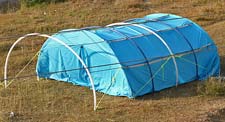 With
harsh winter conditions already developing, CRS is focused on providing
adequate winterized shelters to upwards of 20,000 households. After
delivering over 5,000 winterized tents within a month after the
earthquake, CRS transitioned its response to the provision of more
durable forms of transitional shelter. The initial model was a
barrel-vaulted transitional shelter that is constructed by stretching
cloth-lined plastic sheeting over arched plastic tubing. Materials are
available locally and have been distributed to an initial 2,500
households.
With
harsh winter conditions already developing, CRS is focused on providing
adequate winterized shelters to upwards of 20,000 households. After
delivering over 5,000 winterized tents within a month after the
earthquake, CRS transitioned its response to the provision of more
durable forms of transitional shelter. The initial model was a
barrel-vaulted transitional shelter that is constructed by stretching
cloth-lined plastic sheeting over arched plastic tubing. Materials are
available locally and have been distributed to an initial 2,500
households.
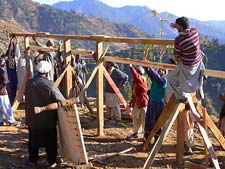 The
other alternative created by CRS consists of a wooden frame formed
around stone walls with metal sheeting serving as a roof. CRS
anticipates providing resources for households to build these framed
transitional structures. CRS is working with communities to build
demonstration shelters that can be used to teach local workers to build
additional shelters. To date, CRS has worked with partners to distribute
shelter kits to over 9,400 households at a rate of up to 300 per day,
making this the largest and most rapid emergency shelter distribution in
the agency's history.
The
other alternative created by CRS consists of a wooden frame formed
around stone walls with metal sheeting serving as a roof. CRS
anticipates providing resources for households to build these framed
transitional structures. CRS is working with communities to build
demonstration shelters that can be used to teach local workers to build
additional shelters. To date, CRS has worked with partners to distribute
shelter kits to over 9,400 households at a rate of up to 300 per day,
making this the largest and most rapid emergency shelter distribution in
the agency's history.
Water, Sanitation and Hygiene
CRS has reached more than 10,000 men, women and children with services
that improve access to potable water and sanitation facilities. Working
with partners to build 422 latrines and 179 washrooms, CRS also provides
mobilization/demonstrations for latrines and washroom structures for the
17 communities served to date.
Education
With so many children killed as a result of the earthquake, surviving
children and families are dealing with severe trauma. To help the
survivors cope with this trauma, CRS and local partners are working to
create a sense of normalcy and strongly believe that re-opening schools
is critical.
CRS is prioritizing Shangla and Batagram for immediate attention. In Manshera and Kohistan districts, a long winter recess is the norm and school may not resume until mid-February. CRS and local partners are proposing to provide large winterized tents, complementary materials and supplies so that 300 schools can resume after the break. Winterized tents have already been secured. Additional plans include training teachers to identify and respond to signs of trauma in children.
India Response Update
Medical Teams, Relief Packages, Education Reach More than 10,000
In India, CRS has distributed emergency relief packages to more than
10,000 people across 11 mountaintop villages. The relief package
includes four blankets, two tarps, one quilt, one mattress, one bucket,
a kitchen utensil set, and a 10-day food basket. To respond to the needs
of traumatized children, CRS' team of volunteers has conducted art and
play therapy targeting a total of 5,000 children.
CRS and its partners also manage three mobile medical teams—comprised of doctor, nurse, and social worker volunteers—which travel to two villages a week and have treated more than 3,500 patients. According to the medical teams, women make up the majority seeking medical assistance given their typically rare access to facilities far from their homes.
In addition to the families that received immediate relief distributions, over 2,700 families have received temporary shelter kits. CRS also distributed 1,014 donated winterized tents donated by CORDAID and completed construction of 382 houses.
How CRS Conducts Assessments
As long as weather permits, CRS will continue targeting remote mountain
villages along affected valleys in order to reach the greatest number of
the most vulnerable communities. CRS and partners teams typically walk
upwards of two hours to reach these villages for assessment.
Distributions are then organized at the closest accessible location.