|
Introduction |
|
Background: |
South Africa
occupied the German colony of South-West Africa during World War
I and administered it as a mandate until after World War II,
when it annexed the territory. In 1966 the Marxist South-West
Africa People's Organization (SWAPO) guerrilla group launched a
war of independence for the area that was soon named Namibia,
but it was not until 1988 that South Africa agreed to end its
administration in accordance with a UN peace plan for the entire
region. Namibia won its independence in 1990 and has been
governed by SWAPO since. Hifikepunye POHAMBA was elected
president in November 2004 in a landslide victory replacing Sam
NUJOMA who led the country during its first 14 years of self
rule.
|
|
Geography |
|
Location: |
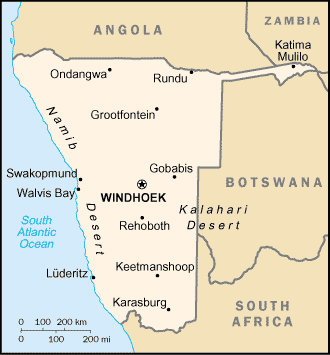
Southern Africa,
bordering the South Atlantic Ocean, between Angola and South
Africa
|
|
Geographic
coordinates: |
22 00 S, 17 00 E
|
|
Map references: |
Africa
|
|
Area: |
total:
825,418 sq km
land: 825,418 sq km
water: 0 sq km
|
|
Area -
comparative: |
slightly more than
half the size of Alaska
|
|
Land boundaries: |
total: 3,936
km
border countries: Angola 1,376 km, Botswana 1,360 km,
South Africa 967 km, Zambia 233 km
|
|
Coastline: |
1,572 km
|
|
Maritime claims: |
territorial sea:
12 nm
contiguous zone: 24 nm
exclusive economic zone: 200 nm
|
|
Climate: |
desert; hot, dry;
rainfall sparse and erratic
|
|
Terrain: |
mostly high
plateau; Namib Desert along coast; Kalahari Desert in east
|
|
Elevation
extremes: |
lowest point:
Atlantic Ocean 0 m
highest point: Konigstein 2,606 m
|
|
Natural
resources: |
diamonds, copper,
uranium, gold, lead, tin, lithium, cadmium, zinc, salt,
hydropower, fish
note: suspected deposits of oil, coal, and iron ore
|
|
Land use: |
arable land:
0.99%
permanent crops: 0%
other: 99.01% (2001)
|
|
Irrigated land: |
70 sq km (1998
est.)
|
|
Natural hazards: |
prolonged periods
of drought
|
|
Environment -
current issues: |
very limited
natural fresh water resources; desertification; wildlife
poaching; land degradation has led to few conservation areas
|
|
Environment -
international agreements: |
party to:
Antarctic-Marine Living Resources, Biodiversity, Climate Change,
Climate Change-Kyoto Protocol, Desertification, Endangered
Species, Hazardous Wastes, Law of the Sea, Ozone Layer
Protection, Wetlands
signed, but not ratified: none of the selected agreements
|
|
Geography -
note: |
first country in
the world to incorporate the protection of the environment into
its constitution; some 14% of the land is protected, including
virtually the entire Namib Desert coastal strip
|
|
People |
|
Population: |
2,030,692
note: estimates for this country explicitly take into
account the effects of excess mortality due to AIDS; this can
result in lower life expectancy, higher infant mortality and
death rates, lower population and growth rates, and changes in
the distribution of population by age and sex than would
otherwise be expected (July 2005 est.)
|
|
Age structure: |
0-14 years:
38.7% (male 396,247/female 389,543)
15-64 years: 57.7% (male 586,900/female 584,779)
65 years and over: 3.6% (male 33,524/female 39,699) (2005
est.)
|
|
Median age: |
total: 19.79
years
male: 19.63 years
female: 19.94 years (2005 est.)
|
|
Population
growth rate: |
0.73% (2005 est.)
|
|
Birth rate: |
25.16 births/1,000
population (2005 est.)
|
|
Death rate: |
18.36 deaths/1,000
population (2005 est.)
|
|
Net migration
rate: |
0.52 migrant(s)/1,000
population (2005 est.)
|
|
Sex ratio: |
at birth:
1.03 male(s)/female
under 15 years: 1.02 male(s)/female
15-64 years: 1 male(s)/female
65 years and over: 0.84 male(s)/female
total population: 1 male(s)/female (2005 est.)
|
|
Infant mortality
rate: |
total: 48.98
deaths/1,000 live births
male: 53 deaths/1,000 live births
female: 44.84 deaths/1,000 live births (2005 est.)
|
|
Life expectancy
at birth: |
total
population: 43.93 years
male: 44.71 years
female: 43.13 years (2005 est.)
|
|
Total fertility
rate: |
3.18 children
born/woman (2005 est.)
|
|
HIV/AIDS - adult
prevalence rate: |
21.3% (2003 est.)
|
|
HIV/AIDS -
people living with HIV/AIDS: |
210,000 (2001 est.)
|
|
HIV/AIDS -
deaths: |
16,000 (2003 est.)
|
|
Nationality: |
noun:
Namibian(s)
adjective: Namibian
|
|
Ethnic groups: |
black 87.5%, white
6%, mixed 6.5%
note: about 50% of the population belong to the Ovambo
tribe and 9% to the Kavangos tribe; other ethnic groups are:
Herero 7%, Damara 7%, Nama 5%, Caprivian 4%, Bushmen 3%, Baster
2%, Tswana 0.5%
|
|
Religions: |
Christian 80% to
90% (Lutheran 50% at least), indigenous beliefs 10% to 20%
|
|
Languages: |
English 7%
(official), Afrikaans common language of most of the population
and about 60% of the white population, German 32%, indigenous
languages: Oshivambo, Herero, Nama
|
|
Literacy: |
definition:
age 15 and over can read and write
total population: 84%
male: 84.4%
female: 83.7% (2003 est.)
|
|
Government |
|
Country name: |
conventional
long form: Republic of Namibia
conventional short form: Namibia
former: German Southwest Africa, South-West Africa
|
|
Government type: |
republic
|
|
Capital: |
Windhoek
|
|
Administrative
divisions: |
13 regions;
Caprivi, Erongo, Hardap, Karas, Khomas, Kunene, Ohangwena,
Okavango, Omaheke, Omusati, Oshana, Oshikoto, Otjozondjupa
|
|
Independence: |
21 March 1990 (from
South African mandate)
|
|
National
holiday: |
Independence Day,
21 March (1990)
|
|
Constitution: |
ratified 9 February
1990; effective 12 March 1990
|
|
Legal system: |
based on
Roman-Dutch law and 1990 constitution
|
|
Suffrage: |
18 years of age;
universal
|
|
Executive
branch: |
chief of state:
President Hifikepunye POHAMBA (since 15 November 2004)
head of government: Prime Minister Nahas ANGULA (since 21
March 2005)
cabinet: Cabinet appointed by the president from among
the members of the National Assembly
elections: president elected by popular vote for a
five-year term; election last held 15 November 2004 (next to be
held November 2009)
election results: Hifikepunye POHAMBA elected president;
percent of vote - NA%
|
|
Legislative
branch: |
bicameral
legislature consists of the National Council (26 seats; two
members are chosen from each regional council to serve six-year
terms) and the National Assembly (72 seats; members are elected
by popular vote to serve five-year terms)
elections: National Council - elections for regional
councils, to determine members of the National Council, held
15-16 November 2004 (next to be held November 2009); National
Assembly - last held 15-16 November 2004 (next to be held
November 2009)
election results: National Council - percent of vote by
party - NA%; seats by party - NA; National Assembly - percent of
vote by party - NA%; seats by party - SWAPO 55, COD 5, DTA 4,
UDF 3, MAG 1, other 4
note: the National Council is primarily an advisory body
|
|
Judicial branch: |
Supreme Court
(judges appointed by the president on the recommendation of the
Judicial Service Commission)
|
|
Political
parties and leaders: |
Congress of
Democrats or COD [Ben ULENGA]; Democratic Turnhalle Alliance of
Namibia or DTA [Katuutire KAURA, president]; Monitor Action
Group or MAG [Kosie PRETORIUS]; South West Africa People's
Organization or SWAPO [Sam Shafishuna NUJOMA]; United Democratic
Front or UDF [Justus GAROEB]
|
|
Political
pressure groups and leaders: |
NA
|
|
International
organization participation: |
ACP, AfDB, AU, C,
FAO, G-77, IAEA, IBRD, ICAO, ICCt, ICFTU, ICRM, IFAD, IFC, IFRCS,
ILO, IMF, IMO, Interpol, IOC, IOM (observer), ISO
(correspondent), ITU, MIGA, NAM, ONUB, OPCW, SACU, SADC, UN,
UNCTAD, UNESCO, UNHCR, UNIDO, UNMEE, UNMIL, UNOCI, UPU, WCL, WCO,
WHO, WIPO, WMO, WToO, WTO
|
|
Flag
description: |
a large blue
triangle with a yellow sunburst fills the upper left section and
an equal green triangle (solid) fills the lower right section;
the triangles are separated by a red stripe that is contrasted
by two narrow white-edge borders
|
|
Economy |
|
Economy -
overview: |
The economy is
heavily dependent on the extraction and processing of minerals
for export. Mining accounts for 20% of GDP. Rich alluvial
diamond deposits make Namibia a primary source for gem-quality
diamonds. Namibia is the fourth-largest exporter of nonfuel
minerals in Africa, the world's fifth-largest producer of
uranium, and the producer of large quantities of lead, zinc,
tin, silver, and tungsten. The mining sector employs only about
3% of the population while about half of the population depends
on subsistence agriculture for its livelihood. Namibia normally
imports about 50% of its cereal requirements; in drought years
food shortages are a major problem in rural areas. A high per
capita GDP, relative to the region, hides the great inequality
of income distribution; nearly one-third of Namibians had annual
incomes of less than $1,400 in constant 1994 dollars, according
to a 1993 study. The Namibian economy is closely linked to South
Africa with the Namibian dollar pegged to the South African
rand. Privatization of several enterprises in coming years may
stimulate long-run foreign investment. Mining of zinc, copper,
and silver and increased fish production led growth in 2003-04.
|
|
GDP: |
purchasing power
parity - $14.76 billion (2004 est.)
|
|
GDP - real
growth rate: |
4.8% (2004 est.)
|
|
GDP - per
capita: |
purchasing power
parity - $7,300 (2004 est.)
|
|
GDP -
composition by sector: |
agriculture:
11.3%
industry: 30.8%
services: 57.9% (2004 est.)
|
|
Labor force: |
840,000 (2004 est.)
|
|
Labor force - by
occupation: |
agriculture 47%,
industry 20%, services 33% (1999 est.)
|
|
Unemployment
rate: |
35% (1998)
|
|
Population below
poverty line: |
50% (2002 est.)
|
|
Household income
or consumption by percentage share: |
lowest 10%:
NA
highest 10%: NA
|
|
Distribution of
family income - Gini index: |
70 (2003)
|
|
Inflation rate
(consumer prices): |
4.2% (2004 est.)
|
|
Investment
(gross fixed): |
19.6% of GDP (2004
est.)
|
|
Budget: |
revenues:
$1.788 billion
expenditures: $1.956 billion, including capital
expenditures of NA (2004 est.)
|
|
Public debt: |
38.5% of GDP (2004
est.)
|
|
Agriculture -
products: |
millet, sorghum,
peanuts; livestock; fish
|
|
Industries: |
meatpacking, fish
processing, dairy products; mining (diamond, lead, zinc, tin,
silver, tungsten, uranium, copper)
|
|
Industrial
production growth rate: |
NA
|
|
Electricity -
production: |
1.167 billion kWh
(2002)
|
|
Electricity -
production by source: |
NA
|
|
Electricity -
consumption: |
1.92 billion kWh
(2002)
|
|
Electricity -
exports: |
65 million kWh
(2002)
|
|
Electricity -
imports: |
900 million kWh;
note - electricity supplied by South Africa (2002)
|
|
Oil -
production: |
0 bbl/day (2001
est.)
|
|
Oil -
consumption: |
13,000 bbl/day
(2001 est.)
|
|
Oil - proved
reserves: |
0 bbl (1 January
2002)
|
|
Natural gas -
proved reserves: |
31.15 billion cu m
(1 January 2002)
|
|
Current account
balance: |
$234.3 million
(2004 est.)
|
|
Exports: |
$1.356 billion
f.o.b. (2004 est.)
|
|
Exports -
commodities: |
diamonds, copper,
gold, zinc, lead, uranium; cattle, processed fish, karakul skins
|
|
Exports -
partners: |
EU 79%, US 4%
(2001)
|
|
Imports: |
$1.473 billion
f.o.b. (2004 est.)
|
|
Imports -
commodities: |
foodstuffs;
petroleum products and fuel, machinery and equipment, chemicals
|
|
Imports -
partners: |
US 50%, EU 31%
(2001)
|
|
Reserves of
foreign exchange and gold: |
$360 million (2004
est.)
|
|
Debt - external: |
$1.136 billion
(2004 est.)
|
|
Currency (code): |
Namibian dollar (NAD);
South African rand (ZAR)
|
|
Currency code: |
NAD; ZAR
|
|
Exchange rates: |
Namibian dollars
per US dollar - 6.4597 (2004), 7.5648 (2003), 10.5407 (2002),
8.6092 (2001), 6.9398 (2000)
|
|
Fiscal year: |
1 April - 31 March
|
|
Communications |
|
Telephones -
main lines in use: |
127,400 (2003)
|
|
Telephones -
mobile cellular: |
223,700 (2003)
|
|
Telephone
system: |
general
assessment: good system; about 6 telephones for each 100
persons
domestic: good urban services; fair rural service;
microwave radio relay links major towns; connections to other
populated places are by open wire; 100% digital
international: country code - 264; fiber-optic cable to
South Africa, microwave radio relay link to Botswana, direct
links to other neighboring countries; connected to Africa ONE
and South African Far East (SAFE) submarine cables through South
Africa; satellite earth stations - 4 Intelsat (2002)
|
|
Radio broadcast
stations: |
AM 2, FM 39,
shortwave 4 (2001)
|
|
Radios: |
232,000 (1997)
|
|
Television
broadcast stations: |
8 (plus about 20
low-power repeaters) (1997)
|
|
Televisions: |
60,000 (1997)
|
|
Internet country
code: |
.na
|
|
Internet hosts: |
3,164 (2003)
|
|
Internet Service
Providers (ISPs): |
2 (2000)
|
|
Internet users: |
65,000 (2003)
|
|
Transportation |
|
Railways: |
total: 2,382
km
narrow gauge: 2,382 km 1.067-m gauge (2004)
|
|
Highways: |
total:
42,237 km
paved: 5,406 km
unpaved: 36,831 km (2002)
|
|
Ports and
harbors: |
Luderitz, Walvis
Bay
|
|
Merchant marine: |
total: 1
ship (1,000 GRT or over) 2,265 GRT/3,605 DWT
by type: cargo 1 (2005)
|
|
Airports: |
136 (2004 est.)
|
|
Airports - with
paved runways: |
total: 21
over 3,047 m: 2
2,438 to 3,047 m: 2
1,524 to 2,437 m: 13
914 to 1,523 m: 4 (2004 est.)
|
|
Airports - with
unpaved runways: |
total: 115
2,438 to 3,047 m: 2
1,524 to 2,437 m: 22
914 to 1,523 m: 71
under 914 m: 20 (2004 est.)
|
|
Military |
|
Military
branches: |
Namibian Defense
Force: Army (includes Air Wing), Navy, Police
|
|
Military
manpower - military age and obligation: |
18 years of age for
voluntary military service (2001)
|
|
Military
manpower - availability: |
males age 18-49:
441,293 (2005 est.)
|
|
Military
manpower - fit for military service: |
males age 18-49:
217,118 (2005 est.)
|
|
Military
expenditures - dollar figure: |
$168.4 million
(2004)
|
|
Military
expenditures - percent of GDP: |
3.1% (2004)
|
|
Transnational Issues |
|
Disputes -
international: |
border commission
has yet to resolve small residual disputes with Botswana along
the Caprivi Strip, including the Situngu marshlands along the
Linyanti River; Botswana residents protest Namibia's planned
construction of the Okavango hydroelectric dam on Popa Falls;
managed dispute with South Africa over the location of the
boundary in the Orange River; Namibia has supported and in 2004
Zimbabwe dropped objections to plans between Botswana and Zambia
to build a bridge over the Zambezi River, thereby de facto
recognizing a short, but not clearly delimited Botswana-Zambia,
boundary in the river
|

 100+ Important Documents in United States History