|
Introduction |
|
Background: |
The site of
advanced Amerindian civilizations, Mexico came under Spanish
rule for three centuries before achieving independence early in
the 19th century. A devaluation of the peso in late 1994 threw
Mexico into economic turmoil, triggering the worst recession in
over half a century. The nation continues to make an impressive
recovery. Ongoing economic and social concerns include low real
wages, underemployment for a large segment of the population,
inequitable income distribution, and few advancement
opportunities for the largely Amerindian population in the
impoverished southern states. Elections held in July 2000 marked
the first time since the 1910 Mexican Revolution that the
opposition defeated the party in government, the Institutional
Revolutionary Party (PRI). Vicente FOX of the National Action
Party (PAN) was sworn in on 1 December 2000 as the first chief
executive elected in free and fair elections.
|
|
Geography |
|
Location: |
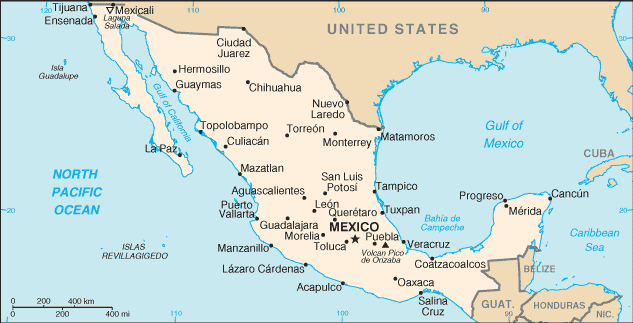
Middle America,
bordering the Caribbean Sea and the Gulf of Mexico, between
Belize and the US and bordering the North Pacific Ocean, between
Guatemala and the US
|
|
Geographic
coordinates: |
23 00 N, 102 00 W
|
|
Map references: |
North America
|
|
Area: |
total:
1,972,550 sq km
land: 1,923,040 sq km
water: 49,510 sq km
|
|
Area -
comparative: |
slightly less than
three times the size of Texas
|
|
Land boundaries: |
total: 4,353
km
border countries: Belize 250 km, Guatemala 962 km, US
3,141 km
|
|
Coastline: |
9,330 km
|
|
Maritime claims: |
territorial sea:
12 nm
contiguous zone: 24 nm
exclusive economic zone: 200 nm
continental shelf: 200 nm or to the edge of the
continental margin
|
|
Climate: |
varies from
tropical to desert
|
|
Terrain: |
high, rugged
mountains; low coastal plains; high plateaus; desert
|
|
Elevation
extremes: |
lowest point:
Laguna Salada -10 m
highest point: Volcan Pico de Orizaba 5,700 m
|
|
Natural
resources: |
petroleum, silver,
copper, gold, lead, zinc, natural gas, timber
|
|
Land use: |
arable land:
12.99%
permanent crops: 1.31%
other: 85.7% (2001)
|
|
Irrigated land: |
65,000 sq km (1998
est.)
|
|
Natural hazards: |
tsunamis along the
Pacific coast, volcanoes and destructive earthquakes in the
center and south, and hurricanes on the Pacific, Gulf of Mexico,
and Caribbean coasts
|
|
Environment -
current issues: |
scarcity of
hazardous waste disposal facilities; rural to urban migration;
natural fresh water resources scarce and polluted in north,
inaccessible and poor quality in center and extreme southeast;
raw sewage and industrial effluents polluting rivers in urban
areas; deforestation; widespread erosion; desertification;
deteriorating agricultural lands; serious air and water
pollution in the national capital and urban centers along
US-Mexico border; land subsidence in Valley of Mexico caused by
groundwater depletion
note: the government considers the lack of clean water
and deforestation national security issues
|
|
Environment -
international agreements: |
party to:
Biodiversity, Climate Change, Climate Change-Kyoto Protocol,
Desertification, Endangered Species, Hazardous Wastes, Law of
the Sea, Marine Dumping, Marine Life Conservation, Ozone Layer
Protection, Ship Pollution, Wetlands, Whaling
signed, but not ratified: none of the selected agreements
|
|
Geography -
note: |
strategic location
on southern border of US; corn (maize), one of the world's major
grain crops, is thought to have originated in Mexico
|
|
People |
|
Population: |
106,202,903 (July
2005 est.)
|
|
Age structure: |
0-14 years:
31.1% (male 16,844,400/female 16,159,511)
15-64 years: 63.3% (male 32,521,043/female 34,704,093)
65 years and over: 5.6% (male 2,715,010/female 3,258,846)
(2005 est.)
|
|
Median age: |
total: 24.93
years
male: 24.04 years
female: 25.85 years (2005 est.)
|
|
Population
growth rate: |
1.17% (2005 est.)
|
|
Birth rate: |
21.01 births/1,000
population (2005 est.)
|
|
Death rate: |
4.73 deaths/1,000
population (2005 est.)
|
|
Net migration
rate: |
-4.57 migrant(s)/1,000
population (2005 est.)
|
|
Sex ratio: |
at birth:
1.05 male(s)/female
under 15 years: 1.04 male(s)/female
15-64 years: 0.94 male(s)/female
65 years and over: 0.83 male(s)/female
total population: 0.96 male(s)/female (2005 est.)
|
|
Infant mortality
rate: |
total: 20.91
deaths/1,000 live births
male: 22.85 deaths/1,000 live births
female: 18.88 deaths/1,000 live births (2005 est.)
|
|
Life expectancy
at birth: |
total
population: 75.19 years
male: 72.42 years
female: 78.1 years (2005 est.)
|
|
Total fertility
rate: |
2.45 children
born/woman (2005 est.)
|
|
HIV/AIDS - adult
prevalence rate: |
0.3% (2003 est.)
|
|
HIV/AIDS -
people living with HIV/AIDS: |
160,000 (2003 est.)
|
|
HIV/AIDS -
deaths: |
5,000 (2003 est.)
|
|
Nationality: |
noun:
Mexican(s)
adjective: Mexican
|
|
Ethnic groups: |
mestizo
(Amerindian-Spanish) 60%, Amerindian or predominantly Amerindian
30%, white 9%, other 1%
|
|
Religions: |
nominally Roman
Catholic 89%, Protestant 6%, other 5%
|
|
Languages: |
Spanish, various
Mayan, Nahuatl, and other regional indigenous languages
|
|
Literacy: |
definition:
age 15 and over can read and write
total population: 92.2%
male: 94%
female: 90.5% (2003 est.)
|
|
Government |
|
Country name: |
conventional
long form: United Mexican States
conventional short form: Mexico
local long form: Estados Unidos Mexicanos
local short form: Mexico
|
|
Government type: |
federal republic
|
|
Capital: |
Mexico (Distrito
Federal)
|
|
Administrative
divisions: |
31 states (estados,
singular - estado) and 1 federal district* (distrito federal);
Aguascalientes, Baja California, Baja California Sur, Campeche,
Chiapas, Chihuahua, Coahuila de Zaragoza, Colima, Distrito
Federal*, Durango, Guanajuato, Guerrero, Hidalgo, Jalisco,
Mexico, Michoacan de Ocampo, Morelos, Nayarit, Nuevo Leon,
Oaxaca, Puebla, Queretaro de Arteaga, Quintana Roo, San Luis
Potosi, Sinaloa, Sonora, Tabasco, Tamaulipas, Tlaxcala,
Veracruz-Llave, Yucatan, Zacatecas
|
|
Independence: |
16 September 1810
(from Spain)
|
|
National
holiday: |
Independence Day,
16 September (1810)
|
|
Constitution: |
5 February 1917
|
|
Legal system: |
mixture of US
constitutional theory and civil law system; judicial review of
legislative acts; accepts compulsory ICJ jurisdiction, with
reservations
|
|
Suffrage: |
18 years of age;
universal and compulsory (but not enforced)
|
|
Executive
branch: |
chief of state:
President Vicente FOX Quesada (since 1 December 2000); note -
the president is both the chief of state and head of government
head of government: President Vicente FOX Quesada (since
1 December 2000); note - the president is both the chief of
state and head of government
cabinet: Cabinet appointed by the president; note -
appointment of attorney general requires consent of the Senate
elections: president elected by popular vote for a
six-year term; election last held 2 July 2000 (next to be held 2
July 2006)
election results: Vicente FOX Quesada elected president;
percent of vote - Vicente FOX Quesada (PAN) 42.52%, Francisco
LABASTIDA Ochoa (PRI) 36.1%, Cuauhtemoc CARDENAS Solorzano (PRD)
16.64%, other 4.74%
|
|
Legislative
branch: |
bicameral National
Congress or Congreso de la Union consists of the Senate or
Camara de Senadores (128 seats; 96 are elected by popular vote
to serve six-year terms, and 32 are allocated on the basis of
each party's popular vote) and the Federal Chamber of Deputies
or Camara Federal de Diputados (500 seats; 300 members are
directly elected by popular vote to serve three-year terms;
remaining 200 members are allocated on the basis of each party's
popular vote, also for three-year terms)
elections: Senate - last held 2 July 2000 for all of the
seats (next to be held 2 July 2006); Chamber of Deputies - last
held 6 July 2003 (next to be held 2 July 2006)
election results: Senate - percent of vote by party -
NA%; seats by party - PRI 60, PAN 46, PRD 16, PVEM 5, unassigned
1; Chamber of Deputies - percent of vote by party - NA%; seats
by party - PRI 222, PAN 151, PRD 95, PVEM 17, PT 6, CD 5,
unassigned 4; note - special elections were held in December
2003; the PRI and the PRD each won one seat and were each
assigned one additional proportional representation seat
|
|
Judicial branch: |
Supreme Court of
Justice or Suprema Corte de Justicia Nacional (justices or
ministros are appointed by the president with consent of the
Senate)
|
|
Political
parties and leaders: |
Convergence for
Democracy or CD [Dante DELGADO Ranauro]; Institutional
Revolutionary Party or PRI [Roberto MADRAZO Pintado]; Mexican
Green Ecological Party or PVEM [Jorge Emilio GONZALEZ Martinez];
National Action Party or PAN [Luis Felipe BRAVO Mena]; Party of
the Democratic Revolution or PRD [Leonel GODOY]; Workers Party
or PT [Alberto ANAYA Gutierrez]
|
|
Political
pressure groups and leaders: |
Confederation of
Employers of the Mexican Republic or COPARMEX; Confederation of
Industrial Chambers or CONCAMIN; Confederation of Mexican
Workers or CTM; Confederation of National Chambers of Commerce
or CONCANACO; Coordinator for Foreign Trade Business
Organizations or COECE; Federation of Unions Providing Goods and
Services or FESEBES; National Chamber of Transformation
Industries or CANACINTRA; National Peasant Confederation or CNC;
National Union of Workers or UNT; Regional Confederation of
Mexican Workers or CROM; Revolutionary Confederation of Workers
and Peasants or CROC; Roman Catholic Church
|
|
International
organization participation: |
APEC, BCIE, BIS,
CDB, CE (observer), EBRD, FAO, G-3, G-6, G-15, G-19, G-24, IADB,
IAEA, IBRD, ICAO, ICC, ICCt (signatory), ICFTU, ICRM, IDA, IFAD,
IFC, IFRCS, IHO, ILO, IMF, IMO, Interpol, IOC, IOM, ISO, ITU,
LAES, LAIA, NAM (observer), NEA, OAS, OECD, OPANAL, OPCW, PCA,
RG, UN, UNCTAD, UNESCO, UNHCR, UNIDO, UNITAR, UNMOVIC, UPU, WCL,
WCO, WFTU, WHO, WIPO, WMO, WToO, WTO
|
|
Flag
description: |
three equal
vertical bands of green (hoist side), white, and red; the coat
of arms (an eagle perched on a cactus with a snake in its beak)
is centered in the white band
|
|
Economy |
|
Economy -
overview: |
Mexico has a free
market economy that recently entered the trillion dollar class.
It contains a mixture of modern and outmoded industry and
agriculture, increasingly dominated by the private sector.
Recent administrations have expanded competition in seaports,
railroads, telecommunications, electricity generation, natural
gas distribution, and airports. Per capita income is one-fourth
that of the US; income distribution remains highly unequal.
Trade with the US and Canada has tripled since the
implementation of NAFTA in 1994. Mexico has 12 free trade
agreements with over 40 countries including, Guatemala,
Honduras, El Salvador, the European Free Trade Area, and Japan,
putting more than 90% of trade under free trade agreements. The
government is cognizant of the need to upgrade infrastructure,
modernize the tax system and labor laws, and provide incentives
to invest in the energy sector, but progress is slow.
|
|
GDP: |
purchasing power
parity - $1.006 trillion (2004 est.)
|
|
GDP - real
growth rate: |
4.1% (2004 est.)
|
|
GDP - per
capita: |
purchasing power
parity - $9,600 (2004 est.)
|
|
GDP -
composition by sector: |
agriculture:
4%
industry: 27.2%
services: 68.9% (2004 est.)
|
|
Labor force: |
34.73 million (2004
est.)
|
|
Labor force - by
occupation: |
agriculture 18%,
industry 24%, services 58% (2003)
|
|
Unemployment
rate: |
3.2% plus
underemployment of perhaps 25% (2004 est.)
|
|
Population below
poverty line: |
40% (2003 est.)
|
|
Household income
or consumption by percentage share: |
lowest 10%:
1.6%
highest 10%: 35.6% (2002)
|
|
Distribution of
family income - Gini index: |
53.1 (1998)
|
|
Inflation rate
(consumer prices): |
5.4% (2004 est.)
|
|
Investment
(gross fixed): |
19.4% of GDP (2004
est.)
|
|
Budget: |
revenues:
$160 billion
expenditures: $158 billion, including capital
expenditures of NA (2004 est.)
|
|
Public debt: |
23.5% of GDP (2004
est.)
|
|
Agriculture -
products: |
corn, wheat,
soybeans, rice, beans, cotton, coffee, fruit, tomatoes; beef,
poultry, dairy products; wood products
|
|
Industries: |
food and beverages,
tobacco, chemicals, iron and steel, petroleum, mining, textiles,
clothing, motor vehicles, consumer durables, tourism
|
|
Industrial
production growth rate: |
3.8% (2004 est.)
|
|
Electricity -
production: |
203.6 billion kWh
(2002)
|
|
Electricity -
production by source: |
fossil fuel:
78.7%
hydro: 14.2%
nuclear: 4.2%
other: 2.9% (2001)
|
|
Electricity -
consumption: |
189.7 billion kWh
(2002)
|
|
Electricity -
exports: |
98.65 million kWh
(2002)
|
|
Electricity -
imports: |
367.7 million kWh
(2002)
|
|
Oil -
production: |
3.46 million
bbl/day (2004 est.)
|
|
Oil -
consumption: |
1.752 million
bbl/day (2004 est.)
|
|
Oil - exports: |
1.863 million
bbl/day (2004)
|
|
Oil - imports: |
205,000 bbl/day
(2004)
|
|
Oil - proved
reserves: |
18 billion bbl
(2004 est.)
|
|
Natural gas -
production: |
47.3 billion cu m
(2004 est.)
|
|
Natural gas -
consumption: |
55.1 billion cu m
(2004 est.)
|
|
Natural gas -
exports: |
0 cu m (2004 est.)
|
|
Natural gas -
imports: |
7.85 billion cu m
(2004 est.)
|
|
Natural gas -
proved reserves: |
420 billion cu m
(2004)
|
|
Current account
balance: |
$-4.113 billion
(2004 est.)
|
|
Exports: |
$182.4 billion
f.o.b. (2004 est.)
|
|
Exports -
commodities: |
manufactured goods,
oil and oil products, silver, fruits, vegetables, coffee, cotton
|
|
Exports -
partners: |
US 81%, Canada
5.9%, Japan 1.1% (2004)
|
|
Imports: |
$190.8 billion
f.o.b. (2004 est.)
|
|
Imports -
commodities: |
metalworking
machines, steel mill products, agricultural machinery,
electrical equipment, car parts for assembly, repair parts for
motor vehicles, aircraft, and aircraft parts
|
|
Imports -
partners: |
US 65.8%, Germany
3.8%, China 3.7% (2004)
|
|
Reserves of
foreign exchange and gold: |
$60.67 billion
(2004 est.)
|
|
Debt - external: |
$149.9 billion
(2004 est.)
|
|
Currency (code): |
Mexican peso (MXN)
|
|
Currency code: |
MXN
|
|
Exchange rates: |
Mexican pesos per
US dollar - 11.286 (2004), 10.789 (2003), 9.656 (2002), 9.342
(2001), 9.456 (2000)
|
|
Fiscal year: |
calendar year
|
|
Communications |
|
Telephones -
main lines in use: |
15,958,700 (2003)
|
|
Telephones -
mobile cellular: |
28.125 million
(2003)
|
|
Telephone
system: |
general
assessment: low telephone density with about 15.2 main lines
per 100 persons; privatized in December 1990; the opening to
competition in January 1997 improved prospects for development,
but Telmex remains dominant
domestic: adequate telephone service for business and
government, but the population is poorly served; mobile
subscribers far outnumber fixed-line subscribers; domestic
satellite system with 120 earth stations; extensive microwave
radio relay network; considerable use of fiber-optic cable and
coaxial cable
international: country code - 52; satellite earth
stations - 32 Intelsat, 2 Solidaridad (giving Mexico improved
access to South America, Central America, and much of the US as
well as enhancing domestic communications), numerous Inmarsat
mobile earth stations; linked to Central American Microwave
System of trunk connections; high capacity Columbus-2
fiber-optic submarine cable with access to the US, Virgin
Islands, Canary Islands, Morocco, Spain, and Italy (1997)
|
|
Radio broadcast
stations: |
AM 850, FM 545,
shortwave 15 (2003)
|
|
Radios: |
31 million (1997)
|
|
Television
broadcast stations: |
236 (plus
repeaters) (1997)
|
|
Televisions: |
25.6 million (1997)
|
|
Internet country
code: |
.mx
|
|
Internet hosts: |
1,333,406 (2003)
|
|
Internet Service
Providers (ISPs): |
51 (2000)
|
|
Internet users: |
10.033 million
(2002)
|
|
Transportation |
|
Railways: |
total:
17,634 km
standard gauge: 17,634 km 1.435-m gauge (2004)
|
|
Highways: |
total:
329,532 km
paved: 108,087 km (including 6,429 km of expressways)
unpaved: 221,445 km (1999 est.)
|
|
Waterways: |
2,900 km
note: navigable rivers and coastal canals (2004)
|
|
Pipelines: |
crude oil 28,200
km; petroleum products 10,150 km; natural gas 13,254 km;
petrochemical 1,400 km (2003)
|
|
Ports and
harbors: |
Altamira,
Manzanillo, Morro Redondo, Salina Cruz, Tampico, Topolobampo,
Veracruz
|
|
Merchant marine: |
total: 57
ships (1,000 GRT or over) 649,389 GRT/942,766 DWT
by type: bulk carrier 2, cargo 6, chemical tanker 5,
liquefied gas 5, passenger/cargo 9, petroleum tanker 26, roll
on/roll off 4
foreign-owned: 4 (Denmark 1, Germany 1, UAE 1, United
States 1)
registered in other countries: 6 (2005)
|
|
Airports: |
1,833 (2004 est.)
|
|
Airports - with
paved runways: |
total: 233
over 3,047 m: 12
2,438 to 3,047 m: 28
1,524 to 2,437 m: 84
914 to 1,523 m: 80
under 914 m: 29 (2004 est.)
|
|
Airports - with
unpaved runways: |
total: 1,600
over 3,047 m: 1
2,438 to 3,047 m: 1
1,524 to 2,437 m: 69
914 to 1,523 m: 454
under 914 m: 1,075 (2004 est.)
|
|
Heliports: |
2 (2004 est.)
|
|
Military |
|
Military
branches: |
Secretariat of
National Defense (Sedena): Army and Air Force (FAM)
Secretariat of the Navy (Semar): Naval Air and Marines
(2004)
|
|
Military
manpower - military age and obligation: |
18 years of age for
compulsory military service, conscript service obligation - 12
months; 16 years of age with consent for voluntary enlistment
(2004)
|
|
Military
manpower - availability: |
males age 18-49:
24,488,008 (2005 est.)
|
|
Military
manpower - fit for military service: |
males age 18-49:
19,058,337 (2005 est.)
|
|
Military
manpower - reaching military age annually: |
males:
1,063,233 (2005 est.)
|
|
Military
expenditures - dollar figure: |
$6.043 billion
(2004)
|
|
Military
expenditures - percent of GDP: |
0.9% (2004)
|
|
Transnational Issues |
|
Disputes -
international: |
prolonged drought,
population growth, and outmoded practices and infrastructure in
the border region have strained water-sharing arrangements with
the US; the US has stepped up efforts to stem nationals from
Mexico, Central America, and other parts of the world from
illegally crossing the border with Mexico
|
|
Refugees and
internally displaced persons:: |
IDPs: 12,000
(government's quashing of Zapatista uprising in 1994 in eastern
Chiapas Region) (2004)
|
|
Illicit drugs: |
illicit cultivation
of opium poppy (cultivation in 2001 - 4,400 hectares; potential
heroin production - 7 metric tons) and of cannabis (in 2001 -
4,100 hectares); government eradication efforts have been key in
keeping illicit crop levels low; major supplier of heroin and
largest foreign supplier of marijuana and methamphetamine to the
US market; continues as the primary transshipment country for
US-bound cocaine from South America, accounting for about 70
percent of estimated annual cocaine movement to the US; major
drug syndicates control majority of drug trafficking throughout
the country; producer and distributor of ecstasy; significant
money-laundering center
|

 100+ Important Documents in United States History