|
Introduction |
Top |
|
Background: |
During the late 18th and 19th
centuries, Great Britain established colonies and protectorates
in the area of current Malaysia; these were occupied by Japan
from 1942 to 1945. In 1948, the British-ruled territories on the
Malay Peninsula formed the Federation of Malaya, which became
independent in 1957. Malaysia was formed in 1963 when the former
British colonies of Singapore and the East Malaysian states of
Sabah and Sarawak on the northern coast of Borneo joined the
Federation. The first several years of the country's history
were marred by Indonesian efforts to control Malaysia,
Philippine claims to Sabah, and Singapore's secession from the
Federation in 1965.
|
|
|
Geography |
Top |
|
Location: |
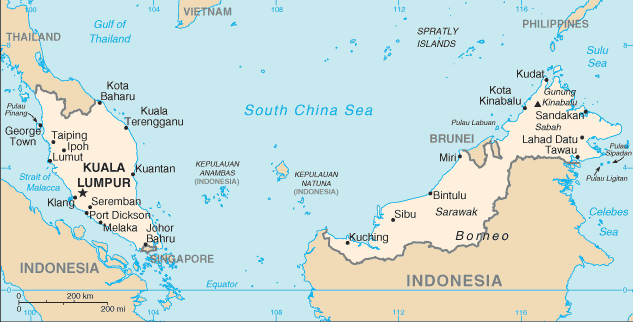
Southeastern Asia, peninsula
bordering Thailand and northern one-third of the island of
Borneo, bordering Indonesia, Brunei, and the South China Sea,
south of Vietnam
|
|
|
Geographic
coordinates: |
2 30 N, 112 30 E
|
|
|
Map references: |
Southeast Asia
|
|
|
Area: |
total: 329,750 sq km
land: 328,550 sq km
water: 1,200 sq km
|
|
|
Area -
comparative: |
slightly larger than New Mexico
|
|
|
Land boundaries: |
total: 2,669 km
border countries: Brunei 381 km, Indonesia 1,782 km,
Thailand 506 km
|
|
|
Coastline: |
4,675 km (Peninsular Malaysia 2,068
km, East Malaysia 2,607 km)
|
|
|
Maritime claims: |
territorial sea: 12 nm
exclusive economic zone: 200 nm
continental shelf: 200-m depth or to the depth of
exploitation; specified boundary in the South China Sea
|
|
|
Climate: |
tropical; annual southwest (April to
October) and northeast (October to February) monsoons
|
|
|
Terrain: |
coastal plains rising to hills and
mountains
|
|
|
Elevation
extremes: |
lowest point: Indian Ocean 0
m
highest point: Gunung Kinabalu 4,100 m
|
|
|
Natural
resources: |
tin, petroleum, timber, copper, iron
ore, natural gas, bauxite
|
|
|
Land use: |
arable land: 5.48%
permanent crops: 17.61%
other: 76.91% (2001)
|
|
|
Irrigated land: |
3,650 sq km (1998 est.)
|
|
|
Natural hazards: |
flooding, landslides, forest fires
|
|
|
Environment -
current issues: |
air pollution from industrial and
vehicular emissions; water pollution from raw sewage;
deforestation; smoke/haze from Indonesian forest fires
|
|
|
Environment -
international agreements: |
party to: Biodiversity,
Climate Change, Climate Change-Kyoto Protocol, Desertification,
Endangered Species, Hazardous Wastes, Law of the Sea, Marine
Life Conservation, Ozone Layer Protection, Ship Pollution,
Tropical Timber 83, Tropical Timber 94, Wetlands
|
|
|
Geography - note: |
strategic location along Strait of
Malacca and southern South China Sea
|
|
|
People |
Top |
|
Population: |
23,953,136 (July 2005 est.)
|
|
|
Age structure: |
0-14 years: 33% (male
4,067,006/female 3,837,758)
15-64 years: 62.4% (male 7,488,367/female 7,447,047)
65 years and over: 4.6% (male 490,334/female 622,624)
(2005 est.)
|
|
|
Median age: |
total: 23.92 years
male: 23.32 years
female: 24.54 years (2005 est.)
|
|
|
Population growth
rate: |
1.8% (2005 est.)
|
|
|
Birth rate: |
23.07 births/1,000 population (2005
est.)
|
|
|
Death rate: |
5.06 deaths/1,000 population (2005
est.)
|
|
|
Net migration
rate: |
0 migrant(s)/1,000 population
note: does not reflect net flow of an unknown number of
illegal immigrants from other countries in the region (2005
est.)
|
|
|
Sex ratio: |
at birth: 1.07 male(s)/female
under 15 years: 1.06 male(s)/female
15-64 years: 1.01 male(s)/female
65 years and over: 0.79 male(s)/female
total population: 1.01 male(s)/female (2005 est.)
|
|
|
Infant mortality
rate: |
total: 17.7 deaths/1,000 live
births
male: 20.49 deaths/1,000 live births
female: 14.71 deaths/1,000 live births (2005 est.)
|
|
|
Life expectancy
at birth: |
total population: 72.24 years
male: 69.56 years
female: 75.11 years (2005 est.)
|
|
|
Total fertility
rate: |
3.07 children born/woman (2005 est.)
|
|
|
HIV/AIDS - adult
prevalence rate: |
0.4% (2003 est.)
|
|
|
HIV/AIDS - people
living with HIV/AIDS: |
52,000 (2003 est.)
|
|
|
HIV/AIDS -
deaths: |
2,000 (2003 est.)
|
|
|
Nationality: |
noun: Malaysian(s)
adjective: Malaysian
|
|
|
Ethnic groups: |
Malay 50.4%, Chinese 23.7%,
Bumiputera 11%, Indian 7.1%, others 7.8% (2004 est.)
|
|
|
Religions: |
Muslim, Buddhist, Daoist, Hindu,
Christian, Sikh; note - in addition, Shamanism is practiced in
East Malaysia
|
|
|
Languages: |
Bahasa Melayu (official), English,
Chinese dialects (Cantonese, Mandarin, Hokkien, Hakka, Hainan,
Foochow), Tamil, Telugu, Malayalam, Panjabi, Thai
note: in addition, in East Malaysia several indigenous
languages are spoken, the largest are Iban and Kadazan
|
|
|
Literacy: |
definition: age 15 and over
can read and write
total population: 88.7%
male: 92%
female: 85.4% (2002)
|
|
|
Government |
Top |
|
Country name: |
conventional long form: none
conventional short form: Malaysia
former: Federation of Malaysia
|
|
|
Government type: |
constitutional monarchy
note: nominally headed by paramount ruler and a bicameral
Parliament consisting of a nonelected upper house and an elected
lower house; all Peninsular Malaysian states have hereditary
rulers except Melaka and Pulau Pinang (Penang); those two states
along with Sabah and Sarawak in East Malaysia have governors
appointed by government; powers of state governments are limited
by federal constitution; under terms of federation, Sabah and
Sarawak retain certain constitutional prerogatives (e.g., right
to maintain their own immigration controls); Sabah - holds 20
seats in House of Representatives and will hold 25 seats after
the next election; Sarawak holds 28 seats in House of
Representatives
|
|
|
Capital: |
Kuala Lumpur
note: Putrajaya is referred to as administrative center
not capital; Parliament meets in Kuala Lumpur
|
|
|
Administrative
divisions: |
13 states (negeri-negeri, singular -
negeri) Johor, Kedah, Kelantan, Melaka, Negeri Sembilan, Pahang,
Perak, Perlis, Pulau Pinang, Sabah, Sarawak, Selangor, and
Terengganu; and one federal territory (wilayah persekutuan) with
three components, city of Kuala Lumpur, Labuan, and Putrajaya
|
|
|
Independence: |
31 August 1957 (from UK)
|
|
|
National holiday: |
Independence Day/Malaysia Day, 31
August (1957)
|
|
|
Constitution: |
31 August 1957, amended 16 September
1963
|
|
|
Legal system: |
based on English common law;
judicial review of legislative acts in the Supreme Court at
request of supreme head of the federation; has not accepted
compulsory ICJ jurisdiction
|
|
|
Suffrage: |
21 years of age; universal
|
|
|
Executive branch: |
chief of state: Paramount
Ruler Tuanku SYED SIRAJUDDIN ibni Almarhum Tuanku Syed Putra
Jamalullail, the Raja of Perlis (since 12 December 2001)
head of government: Prime Minister ABDULLAH bin Ahmad
Badawi (since 31 October 2003); Deputy Prime Minister Mohamed
NAJIB bin Abdul Razak (since 7 January 2004)
cabinet: Cabinet appointed by the prime minister from
among the members of Parliament with consent of the paramount
ruler
elections: paramount ruler elected by and from the
hereditary rulers of nine of the states for five-year terms;
election last held 12 December 2001 (next to be held in 2006);
prime minister designated from among the members of the House of
Representatives; following legislative elections, the leader of
the party that wins a plurality of seats in the House of
Representatives becomes prime minister
election results: Tuanku SYED SIRAJUDDIN ibni Almarhum
Tuanku Syed Putra Jamalullail elected paramount ruler
|
|
|
Legislative
branch: |
bicameral Parliament or Parlimen
consists of the Senate or Dewan Negara (70 seats; 44 appointed
by the paramount ruler, 26 appointed by the state legislatures)
and the House of Representatives or Dewan Rakyat (219 seats;
members elected by popular vote to serve five-year terms)
elections: House of Representatives - last held 21 March
2004 (next must be held by 2009)
election results: House of Representatives - percent of
vote by party - BN 91%, DAP 5%, PAS 3%, other 1%; seats by party
- BN 199, DAP 12, PAS 6, PKR 1, independent 1
|
|
|
Judicial branch: |
Federal Court (judges appointed by
the paramount ruler on the advice of the prime minister)
|
|
|
Political parties
and leaders: |
ruling-coalition National Front
(Barisan Nasional) or BN, consisting of the following parties:
Gerakan Rakyat Malaysia Party or PGRM [LIM Keng Yaik]; Liberal
Democratic Party (Parti Liberal Demokratik - Sabah) or LDP
[CHONG Kah Kiat]; Malaysian Chinese Association (Persatuan China
Malaysia) or MCA [ONG Ka Ting]; Malaysian Indian Congress
(Kongresi India Malaysia) or MIC [S. Samy VELLU]; Parti Bersatu
Pakyat Sabah or PBRS [Joseph KURUP]; Parti Bersatu Sabah or PBS
[Joseph PAIRIN Kitingan]; Parti Pesaka Bumiputra Bersatu or PBB
[Patinggi Haji Abdul TAIB Mahmud]; Parti Rakyat Sarawak or PRS
[James MASING]; Sabah Progressive Party (Parti Progresif Sabah)
or SAPP [YONG Teck Lee]; Sarawak United People's Party (Parti
Bersatu Rakyat Sarawak) or SUPP [George CHAN Hong Nam]; United
Malays National Organization or UMNO [ABDULLAH bin Ahmad
Badawi]; United Pasokmomogun Kadazandusun Murut Organization
(Pertubuhan Pasko Momogun Kadazan Dusun Bersatu) or UPKO
[Bernard DOMPOK]; People's Progressive Party (Parti Progresif
Penduduk Malaysia) or PPP [M.Keyveas]; Sarawak Progressive
Democratic Party or SPDP [William MAWANI]; opposition parties:
Democratic Action Party (Parti Tindakan Demokratik) or DAP
[KARPAL Singh]; Islamic Party of Malaysia (Parti Islam se
Malaysia) or PAS [Abdul HADI Awang]; People's Justice Party
(Parti Keadilan Rakyat) or PKR [WAN AZIZAH Wan Ismael]; Sarawak
National Party or SNAP [Edwin DANDUNG]; opposition coalition
Alternative Front (Barisan Alternatif) or BA consists of PAS and
PKR
|
|
|
Political
pressure groups and leaders: |
NA
|
|
|
International
organization participation: |
ABEDA, APEC, APT, ARF, AsDB, ASEAN,
BIS, C, CP, FAO, G-15, G-77, IAEA, IBRD, ICAO, ICC, ICFTU, ICRM,
IDA, IDB, IFAD, IFC, IFRCS, IHO, ILO, IMF, IMO, Interpol, IOC,
ISO, ITU, MIGA, MINURSO, MONUC, NAM, OIC, ONUB, OPCW, PCA, UN,
UNAMSIL, UNCTAD, UNESCO, UNIDO, UNMEE, UNMIK, UNMIL, UNMISET,
UPU, WCL, WCO, WFTU, WHO, WIPO, WMO, WToO, WTO
|
|
|
Flag description: |
14 equal horizontal stripes of red
(top) alternating with white (bottom); there is a blue rectangle
in the upper hoist-side corner bearing a yellow crescent and a
yellow 14-pointed star; the crescent and the star are
traditional symbols of Islam; the design was based on the flag
of the US
|
|
|
Economy |
Top |
|
Economy -
overview: |
Malaysia, a middle-income country,
transformed itself from 1971 through the late 1990's from a
producer of raw materials into an emerging multi-sector economy.
Growth was almost exclusively driven by exports - particularly
of electronics. As a result, Malaysia was hard hit by the global
economic downturn and the slump in the information technology
(IT) sector in 2001 and 2002. GDP in 2001 grew only 0.5% due to
an estimated 11% contraction in exports, but a substantial
fiscal stimulus package equal to US $1.9 billion mitigated the
worst of the recession and the economy rebounded in 2002 with a
4.1% increase. The economy grew 4.9% in 2003, notwithstanding a
difficult first half, when external pressures from SARS and the
Iraq War led to caution in the business community. Growth topped
7% in 2004. Healthy foreign exchange reserves, low inflation,
and a small external debt are all strengths that make it
unlikely that Malaysia will experience a financial crisis
similar to the one in 1997. The economy remains dependent on
continued growth in the US, China, and Japan, top export
destinations and key sources of foreign investment.
|
|
|
GDP: |
purchasing power parity - $229.3
billion (2004 est.)
|
|
|
GDP - real growth
rate: |
7.1% (2004 est.)
|
|
|
GDP - per capita: |
purchasing power parity - $9,700
(2004 est.)
|
|
|
GDP - composition
by sector: |
agriculture: 7.2%
industry: 33.6%
services: 59.1% (2004 est.)
|
|
|
Labor force: |
10.49 million (2004 est.)
|
|
|
Labor force - by
occupation: |
agriculture 14.5%, industry 36%,
services 49.5% (2000 est.)
|
|
|
Unemployment
rate: |
3% (2004 est.)
|
|
|
Population below
poverty line: |
8% (1998 est.)
|
|
|
Household income
or consumption by percentage share: |
lowest 10%: 1.4%
highest 10%: 39.2% (2003 est.)
|
|
|
Distribution of
family income - Gini index: |
49.2 (1997)
|
|
|
Inflation rate
(consumer prices): |
1.3% (2004 est.)
|
|
|
Investment (gross
fixed): |
21.7% of GDP (2004 est.)
|
|
|
Budget: |
revenues: $25.33 billion
expenditures: $29.33 billion, including capital
expenditures of $9.4 billion (2004 est.)
|
|
|
Public debt: |
45.4% of GDP (2004 est.)
|
|
|
Agriculture -
products: |
Peninsular Malaysia - rubber, palm
oil, cocoa, rice; Sabah - subsistence crops, rubber, timber,
coconuts, rice; Sarawak - rubber, pepper, timber
|
|
|
Industries: |
Peninsular Malaysia - rubber and oil
palm processing and manufacturing, light manufacturing industry,
electronics, tin mining and smelting, logging and processing
timber; Sabah - logging, petroleum production; Sarawak -
agriculture processing, petroleum production and refining,
logging
|
|
|
Industrial
production growth rate: |
10.2% (2004 est.)
|
|
|
Electricity -
production: |
75.33 billion kWh (2002)
|
|
|
Electricity -
production by source: |
fossil fuel: 89.5%
hydro: 10.5%
nuclear: 0%
other: 0% (2001)
|
|
|
Electricity -
consumption: |
68.4 billion kWh (2002)
|
|
|
Electricity -
exports: |
70 million kWh (2002)
|
|
|
Electricity -
imports: |
0 kWh (2002)
|
|
|
Oil - production: |
785,000 bbl/day (2004 est.)
|
|
|
Oil -
consumption: |
460,000 bbl/day (2003 est.)
|
|
|
Oil - exports: |
230,200 bbl/day (2003)
|
|
|
Oil - imports: |
NA
|
|
|
Oil - proved
reserves: |
3.2 billion bbl (2004 est.)
|
|
|
Natural gas -
production: |
53.66 billion cu m (2001 est.)
|
|
|
Natural gas -
consumption: |
31.25 billion cu m (2001 est.)
|
|
|
Natural gas -
exports: |
22.41 billion cu m (2001 est.)
|
|
|
Natural gas -
imports: |
0 cu m (2001 est.)
|
|
|
Natural gas -
proved reserves: |
2.23 trillion cu m (2004)
|
|
|
Current account
balance: |
$11.81 billion (2004 est.)
|
|
|
Exports: |
$123.5 billion f.o.b. (2004 est.)
|
|
|
Exports -
commodities: |
electronic equipment, petroleum and
liquefied natural gas, wood and wood products, palm oil, rubber,
textiles, chemicals
|
|
|
Exports -
partners: |
US 18.8%, Singapore 15%, Japan
10.1%, China 6.7%, Hong Kong 6%, Thailand 4.8% (2004)
|
|
|
Imports: |
$99.3 billion f.o.b. (2004 est.)
|
|
|
Imports -
commodities: |
electronics, machinery, petroleum
products, plastics, vehicles, iron and steel products, chemicals
|
|
|
Imports -
partners: |
Japan 16.1%, US 14.6%, Singapore
11.2%, China 9.9%, Thailand 5.6%, Taiwan 5.5%, South Korea 5%,
Germany 4.5%, Indonesia 4% (2004)
|
|
|
Reserves of
foreign exchange and gold: |
$55.27 billion (2004 est.)
|
|
|
Debt - external: |
$53.36 billion (2004 est.)
|
|
|
Currency (code): |
ringgit (MYR)
|
|
|
Currency code: |
MYR
|
|
|
Exchange rates: |
ringgits per US dollar - 3.8 (2004),
3.8 (2003), 3.8 (2002), 3.8 (2001), 3.8 (2000)
|
|
|
Fiscal year: |
calendar year
|
|
|
Communications |
Top |
|
Telephones - main
lines in use: |
4,571,600 (2003)
|
|
|
Telephones -
mobile cellular: |
11,124,100 (2003)
|
|
|
Telephone system: |
general assessment: modern
system; international service excellent
domestic: good intercity service provided on Peninsular
Malaysia mainly by microwave radio relay; adequate intercity
microwave radio relay network between Sabah and Sarawak via
Brunei; domestic satellite system with 2 earth stations
international: country code - 60; submarine cables to
India, Hong Kong, and Singapore; satellite earth stations - 2
Intelsat (1 Indian Ocean and 1 Pacific Ocean) (2001)
|
|
|
Radio broadcast
stations: |
AM 35, FM 391, shortwave 15 (2001)
|
|
|
Radios: |
10.9 million (1999)
|
|
|
Television
broadcast stations: |
1 (plus 15 high-power repeaters)
(2001)
|
|
|
Televisions: |
10.8 million (1999)
|
|
|
Internet country
code: |
.my
|
|
|
Internet hosts: |
107,971 (2003)
|
|
|
Internet Service
Providers (ISPs): |
7 (2000)
|
|
|
Internet users: |
8,692,100 (2003)
|
|
|
Transportation |
Top |
|
Railways: |
total: 1,890 km (207 km
electrified)
standard gauge: 57 km 1.435-m gauge (57 km electrified)
narrow gauge: 1,833 km 1.000-m gauge (150 km electrified)
(2004)
|
|
|
Highways: |
total: 65,877 km
paved: 51,318 km
unpaved: 14,559 km (2001)
|
|
|
Waterways: |
7,200 km
note: Peninsular Malaysia 3,200 km, Sabah 1,500 km,
Sarawak 2,500 km (2004)
|
|
|
Pipelines: |
condensate 279 km; gas 5,047 km; oil
1,841 km; refined products 114 km (2004)
|
|
|
Ports and
harbors: |
Bintulu, Johor, Labuan, Lahad Datu,
Lumut, Miri, George Town (Penang), Port Kelang, Tanjung Pelepas
|
|
|
Merchant marine: |
total: 346 ships (1,000 GRT
or over) 5,389,397 GRT/7,539,178 DWT
by type: bulk carrier 45, cargo 109, chemical tanker 38,
container 47, liquefied gas 26, livestock carrier 1, passenger
1, passenger/cargo 6, petroleum tanker 62, roll on/roll off 6,
vehicle carrier 5
foreign-owned: 77 (China 1, Hong Kong 12, Japan 3,
Singapore 61)
registered in other countries: 59 (2005)
|
|
|
Airports: |
117 (2004 est.)
|
|
|
Airports - with
paved runways: |
total: 38
over 3,047 m: 5
2,438 to 3,047 m: 7
1,524 to 2,437 m: 10
914 to 1,523 m: 9
under 914 m: 7 (2004 est.)
|
|
|
Airports - with
unpaved runways: |
total: 79
1,524 to 2,437 m: 1
914 to 1,523 m: 6
under 914 m: 72 (2004 est.)
|
|
|
Heliports: |
1 (2004 est.)
|
|
|
Military |
Top |
|
Military
branches: |
Malaysian Army (Tentera Darat
Malaysia), Royal Malaysian Navy (Tentera Laut Diraja Malaysia,
TLDM), Royal Malaysian Air Force (Tentera Udara Diraja Malaysia,
TUDM) (2005)
|
|
|
Military manpower
- military age and obligation: |
18 years of age for voluntary
military service (2005)
|
|
|
Military manpower
- availability: |
males age 18-49: 5,584,231
(2005 est.)
|
|
|
Military manpower
- fit for military service: |
males age 18-49: 4,574,854
(2005 est.)
|
|
|
Military manpower
- reaching military age annually: |
males: 244,418 (2005 est.)
|
|
|
Military
expenditures - dollar figure: |
$1.69 billion (FY00 est.)
|
|
|
Military
expenditures - percent of GDP: |
2.03% (FY00)
|
|
|
Transnational Issues |
Top |
|
Disputes -
international: |
Malaysia has asserted sovereignty
over the Spratly Islands together with China, Philippines,
Taiwan, Vietnam, and possibly Brunei; while the 2002
"Declaration on the Conduct of Parties in the South China Sea"
has eased tensions over the Spratly Islands, it is not the
legally binding "code of conduct" sought by some parties;
Malaysia was not party to the March 2005 joint accord among the
national oil companies of China, the Philippines, and Vietnam on
conducting marine seismic activities in the Spratly Islands;
disputes continue over deliveries of fresh water to Singapore,
Singapore's land reclamation, bridge construction, maritime
boundaries, and Pedra Branca Island/Pulau Batu Putih - but
parties agree to ICJ arbitration on island dispute within three
years; ICJ awarded Ligitan and Sipadan islands, also claimed by
Indonesia and Philippines, to Malaysia but left maritime
boundary in the hydrocarbon-rich Celebes Sea in dispute,
culminating in hostile confrontations in March 2005 over
concessions to the Ambalat oil block; separatist violence in
Thailand's predominantly Muslim southern provinces prompts
measures to close and monitor border with Malaysia to stem
terrorist activities; Philippines retains a now dormant claim to
Malaysia's Sabah State in northern Borneo; in 2003, Brunei and
Malaysia ceased gas and oil exploration in their disputed
offshore and deepwater seabeds and negotiations have stalemated
prompting consideration of international adjudication;
Malaysia's land boundary with Brunei around Limbang is in
dispute; piracy remains a problem in the Malacca Strait
|
|
|
Illicit drugs: |
transit point for some illicit
drugs; drug trafficking prosecuted vigorously and carries severe
penalties
|

 100+ Important Documents in United States History