|
Introduction |
|
Background: |
From the earliest
days of his rule following his 1969 military coup, Col. Muammar
Abu Minyar al-QADHAFI has espoused his own political system, the
Third Universal Theory. The system is a combination of socialism
and Islam derived in part from tribal practices and is supposed
to be implemented by the Libyan people themselves in a unique
form of "direct democracy." QADHAFI has always seen himself as a
revolutionary and visionary leader. He used oil funds during the
1970s and 1980s to promote his ideology outside Libya,
supporting subversives and terrorists abroad to hasten the end
of Marxism and capitalism. In addition, beginning in 1973, he
engaged in military operations in northern Chad's Aozou Strip -
to gain access to minerals and to use as a base of influence in
Chadian politics - but was forced to retreat in 1987. UN
sanctions in 1992 isolated QADHAFI politically following the
downing of Pan AM Flight 103 over Lockerbie, Scotland. Libyan
support for terrorism appeared to have decreased after the
imposition of sanctions. During the 1990s, QADHAFI also began to
rebuild his relationships with Europe. UN sanctions were
suspended in April 1999 and finally lifted in September 2003
after Libya resolved the Lockerbie case. In December 2003, Libya
announced that it had agreed to reveal and end its programs to
develop weapons of mass destruction, and QADHAFI has made
significant strides in normalizing relations with western
nations since then. He has received various Western European
leaders as well as many working-level and commercial
delegations, and made his first trip to Western Europe in 15
years when he traveled to Brussels in April 2004. QADHAFI also
finally resolved in 2004 several outstanding cases against his
government for terrorist activities in the 1980s by paying
compensation to the families of victims of the UTA and La Belle
disco bombings.
|
|
Geography |
|
Location: |
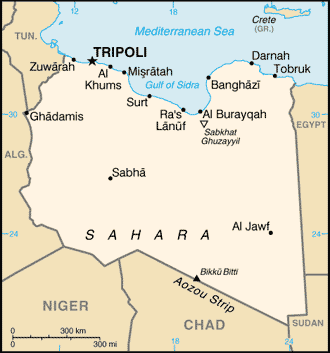
Northern Africa,
bordering the Mediterranean Sea, between Egypt and Tunisia
|
|
Geographic
coordinates: |
25 00 N, 17 00 E
|
|
Map references: |
Africa
|
|
Area: |
total:
1,759,540 sq km
land: 1,759,540 sq km
water: 0 sq km
|
|
Area -
comparative: |
slightly larger
than Alaska
|
|
Land boundaries: |
total: 4,348
km
border countries: Algeria 982 km, Chad 1,055 km, Egypt
1,115 km, Niger 354 km, Sudan 383 km, Tunisia 459 km
|
|
Coastline: |
1,770 km
|
|
Maritime claims: |
territorial sea:
12 nm
note: Gulf of Sidra closing line - 32 degrees, 30 minutes
north
|
|
Climate: |
Mediterranean along
coast; dry, extreme desert interior
|
|
Terrain: |
mostly barren, flat
to undulating plains, plateaus, depressions
|
|
Elevation
extremes: |
lowest point:
Sabkhat Ghuzayyil -47 m
highest point: Bikku Bitti 2,267 m
|
|
Natural
resources: |
petroleum, natural
gas, gypsum
|
|
Land use: |
arable land:
1.03%
permanent crops: 0.19%
other: 98.78% (2001)
|
|
Irrigated land: |
4,700 sq km (1998
est.)
|
|
Natural hazards: |
hot, dry,
dust-laden ghibli is a southern wind lasting one to four days in
spring and fall; dust storms, sandstorms
|
|
Environment -
current issues: |
desertification;
very limited natural fresh water resources; the Great Manmade
River Project, the largest water development scheme in the
world, is being built to bring water from large aquifers under
the Sahara to coastal cities
|
|
Environment -
international agreements: |
party to:
Biodiversity, Climate Change, Desertification, Endangered
Species, Hazardous Wastes, Marine Dumping, Ozone Layer
Protection
signed, but not ratified: Law of the Sea
|
|
Geography -
note: |
more than 90% of
the country is desert or semidesert
|
|
People |
|
Population: |
5,765,563
note: includes 166,510 non-nationals (July 2005 est.)
|
|
Age structure: |
0-14 years:
33.9% (male 997,364/female 955,272)
15-64 years: 62% (male 1,842,775/female 1,729,235)
65 years and over: 4.2% (male 117,967/female 122,950)
(2005 est.)
|
|
Median age: |
total: 22.68
years
male: 22.8 years
female: 22.56 years (2005 est.)
|
|
Population
growth rate: |
2.33% (2005 est.)
|
|
Birth rate: |
26.82 births/1,000
population (2005 est.)
|
|
Death rate: |
3.48 deaths/1,000
population (2005 est.)
|
|
Net migration
rate: |
0 migrant(s)/1,000
population (2005 est.)
|
|
Sex ratio: |
at birth:
1.05 male(s)/female
under 15 years: 1.04 male(s)/female
15-64 years: 1.07 male(s)/female
65 years and over: 0.96 male(s)/female
total population: 1.05 male(s)/female (2005 est.)
|
|
Infant mortality
rate: |
total: 24.6
deaths/1,000 live births
male: 26.92 deaths/1,000 live births
female: 22.17 deaths/1,000 live births (2005 est.)
|
|
Life expectancy
at birth: |
total
population: 76.5 years
male: 74.29 years
female: 78.82 years (2005 est.)
|
|
Total fertility
rate: |
3.34 children
born/woman (2005 est.)
|
|
HIV/AIDS - adult
prevalence rate: |
0.3% (2001 est.)
|
|
HIV/AIDS -
people living with HIV/AIDS: |
10,000 (2001 est.)
|
|
HIV/AIDS -
deaths: |
NA
|
|
Nationality: |
noun:
Libyan(s)
adjective: Libyan
|
|
Ethnic groups: |
Berber and Arab
97%, Greeks, Maltese, Italians, Egyptians, Pakistanis, Turks,
Indians, Tunisians
|
|
Religions: |
Sunni Muslim 97%
|
|
Languages: |
Arabic, Italian,
English, all are widely understood in the major cities
|
|
Literacy: |
definition:
age 15 and over can read and write
total population: 82.6%
male: 92.4%
female: 72% (2003 est.)
|
|
Government |
|
Country name: |
conventional
long form: Great Socialist People's Libyan Arab Jamahiriya
conventional short form: Libya
local long form: Al Jumahiriyah al Arabiyah al Libiyah
ash Shabiyah al Ishtirakiyah al Uzma
local short form: none
|
|
Government type: |
Jamahiriya (a state
of the masses) in theory, governed by the populace through local
councils; in fact, a military dictatorship
|
|
Capital: |
Tripoli
|
|
Administrative
divisions: |
25 municipalities (baladiyat,
singular - baladiyah); Ajdabiya, Al 'Aziziyah, Al Fatih, Al
Jabal al Akhdar, Al Jufrah, Al Khums, Al Kufrah, An Nuqat al
Khams, Ash Shati', Awbari, Az Zawiyah, Banghazi, Darnah,
Ghadamis, Gharyan, Misratah, Murzuq, Sabha, Sawfajjin, Surt,
Tarabulus, Tarhunah, Tubruq, Yafran, Zlitan; note - the 25
municipalities may have been replaced by 13 regions
|
|
Independence: |
24 December 1951
(from Italy)
|
|
National
holiday: |
Revolution Day, 1
September (1969)
|
|
Constitution: |
11 December 1969,
amended 2 March 1977
|
|
Legal system: |
based on Italian
civil law system and Islamic law; separate religious courts; no
constitutional provision for judicial review of legislative
acts; has not accepted compulsory ICJ jurisdiction
|
|
Suffrage: |
18 years of age;
universal and compulsory
|
|
Executive
branch: |
chief of state:
Revolutionary Leader Col. Muammar Abu Minyar al-QADHAFI (since 1
September 1969); note - holds no official title, but is de facto
chief of state
head of government: Secretary of the General People's
Committee (Prime Minister) Shukri Muhammad GHANIM (since 14 June
2003)
cabinet: General People's Committee established by the
General People's Congress
elections: national elections are indirect through a
hierarchy of people's committees; head of government elected by
the General People's Congress; election last held 2 March 2000
(next to be held NA)
election results: NA
|
|
Legislative
branch: |
unicameral General
People's Congress (NA seats; members elected indirectly through
a hierarchy of people's committees)
|
|
Judicial branch: |
Supreme Court
|
|
Political
parties and leaders: |
none
|
|
Political
pressure groups and leaders: |
various Arab
nationalist movements with almost negligible memberships may be
functioning clandestinely, as well as some Islamic elements; an
anti-QADHAFI Libyan exile movement exists, primarily based in
London, but has little influence
|
|
International
organization participation: |
ABEDA, AfDB, AFESD,
AMF, AMU, AU, CAEU, FAO, G-77, IAEA, IBRD, ICAO, ICRM, IDA, IDB,
IFAD, IFC, IFRCS, ILO, IMF, IMO, Interpol, IOC, IOM, ISO, ITU,
LAS, MIGA, NAM, OAPEC, OIC, OPCW, OPEC, PCA, UN, UNCTAD, UNESCO,
UNIDO, UPU, WCO, WFTU, WHO, WIPO, WMO, WTO (observer), WToO
|
|
Flag
description: |
plain green; green
is the traditional color of Islam (the state religion)
|
|
Economy |
|
Economy -
overview: |
The Libyan economy
depends primarily upon revenues from the oil sector, which
contribute practically all export earnings and about one-quarter
of GDP. These oil revenues and a small population give Libya one
of the highest per capita GDPs in Africa, but little of this
income flows down to the lower orders of society. Libyan
officials in the past four years have made progress on economic
reforms as part of a broader campaign to reintegrate the country
into the international fold. This effort picked up steam after
UN sanctions were lifted in September 2003 and as Libya
announced in December 2003 that it would abandon programs to
build weapons of mass destruction. Almost all US unilateral
sanctions against Libya were removed in April 2004. Libya faces
a long road ahead in liberalizing the socialist-oriented
economy, but initial steps - including applying for WTO
membership, reducing some subsidies, and announcing plans for
privatization - are laying the groundwork for a transition to a
more market-based economy. The non-oil manufacturing and
construction sectors, which account for about 20% of GDP, have
expanded from processing mostly agricultural products to include
the production of petrochemicals, iron, steel, and aluminum.
Climatic conditions and poor soils severely limit agricultural
output, and Libya imports about 75% of its food.
|
|
GDP: |
purchasing power
parity - $37.48 billion (2004 est.)
|
|
GDP - real
growth rate: |
4.9% (2004 est.)
|
|
GDP - per
capita: |
purchasing power
parity - $6,700 (2004 est.)
|
|
GDP -
composition by sector: |
agriculture:
8.7%
industry: 45.7%
services: 45.6% (2004 est.)
|
|
Labor force: |
1.59 million (2004
est.)
|
|
Labor force - by
occupation: |
agriculture 17%,
industry 29%, services 54% (1997 est.)
|
|
Unemployment
rate: |
30% (2004)
|
|
Population below
poverty line: |
NA
|
|
Household income
or consumption by percentage share: |
lowest 10%:
NA
highest 10%: NA
|
|
Inflation rate
(consumer prices): |
2.9% (2004 est.)
|
|
Investment
(gross fixed): |
9.9% of GDP (2004
est.)
|
|
Budget: |
revenues:
$13.52 billion
expenditures: $12.23 billion, including capital
expenditures of $5.6 billion (2004 est.)
|
|
Public debt: |
8.8% of GDP (2004
est.)
|
|
Agriculture -
products: |
wheat, barley,
olives, dates, citrus, vegetables, peanuts, soybeans; cattle
|
|
Industries: |
petroleum, iron and
steel, food processing, textiles, handicrafts, cement
|
|
Industrial
production growth rate: |
NA
|
|
Electricity -
production: |
20.89 billion kWh
(2002)
|
|
Electricity -
production by source: |
fossil fuel:
100%
hydro: 0%
nuclear: 0%
other: 0% (2001)
|
|
Electricity -
consumption: |
19.43 billion kWh
(2002)
|
|
Electricity -
exports: |
0 kWh (2002)
|
|
Electricity -
imports: |
0 kWh (2002)
|
|
Oil -
production: |
1.518 million
bbl/day (2004 est.)
|
|
Oil -
consumption: |
216,000 bbl/day
(2001 est.)
|
|
Oil - exports: |
NA
|
|
Oil - imports: |
NA
|
|
Oil - proved
reserves: |
38 billion bbl
(2004 est.)
|
|
Natural gas -
production: |
6.18 billion cu m
(2001 est.)
|
|
Natural gas -
consumption: |
5.41 billion cu m
(2001 est.)
|
|
Natural gas -
exports: |
770 million cu m
(2001 est.)
|
|
Natural gas -
imports: |
0 cu m (2001 est.)
|
|
Natural gas -
proved reserves: |
1.321 trillion cu m
(2004)
|
|
Current account
balance: |
$9.895 billion
(2004 est.)
|
|
Exports: |
$18.65 billion
f.o.b. (2004 est.)
|
|
Exports -
commodities: |
crude oil, refined
petroleum products, natural gas
|
|
Exports -
partners: |
Italy 37.7%,
Germany 16.7%, Spain 11.6%, Turkey 7.5%, France 6.5% (2004)
|
|
Imports: |
$7.224 billion
f.o.b. (2004 est.)
|
|
Imports -
commodities: |
machinery,
transport equipment, semi-finished goods, food, consumer
products (1999)
|
|
Imports -
partners: |
Italy 28.2%,
Germany 11.1%, Tunisia 6%, UK 5.8%, Turkey 5%, France 4.1%
(2004)
|
|
Reserves of
foreign exchange and gold: |
$24.18 billion
(2004 est.)
|
|
Debt - external: |
$4.069 billion
(2004 est.)
|
|
Currency (code): |
Libyan dinar (LYD)
|
|
Currency code: |
LYD
|
|
Exchange rates: |
Libyan dinars per
US dollar - 1.305 (2004), 1.2929 (2003), 1.2707 (2002), 0.6051
(2001), 0.5122 (2000)
|
|
Fiscal year: |
calendar year
|
|
Communications |
|
Telephones -
main lines in use: |
750,000 (2003)
|
|
Telephones -
mobile cellular: |
100,000 (2003)
|
|
Telephone
system: |
general
assessment: telecommunications system is being modernized;
mobile cellular telephone system became operational in 1996
domestic: microwave radio relay, coaxial cable, cellular,
tropospheric scatter, and a domestic satellite system with 14
earth stations
international: country code - 218; satellite earth
stations - 4 Intelsat, NA Arabsat, and NA Intersputnik;
submarine cables to France and Italy; microwave radio relay to
Tunisia and Egypt; tropospheric scatter to Greece; participant
in Medarabtel (1999)
|
|
Radio broadcast
stations: |
AM 16, FM 3,
shortwave 3 (2002)
|
|
Radios: |
1.35 million (1997)
|
|
Television
broadcast stations: |
12 (plus one
low-power repeater) (1999)
|
|
Televisions: |
730,000 (1997)
|
|
Internet country
code: |
.ly
|
|
Internet hosts: |
67 (2003)
|
|
Internet Service
Providers (ISPs): |
1 (2002)
|
|
Internet users: |
160,000 (2003)
|
|
Transportation |
|
Railways: |
0 km
note: Libya is working on 7 lines totaling 2,757 km of
1.435-m gauge track; it hopes to have trains running by 2008
(2004)
|
|
Highways: |
total:
83,200 km
paved: 47,590 km
unpaved: 35,610 km (1999 est.)
|
|
Pipelines: |
condensate 225 km;
gas 3,611 km; oil 7,252 km (2004)
|
|
Ports and
harbors: |
As Sidrah, Az
Zuwaytinah, Marsa al Burayqah, Ra's Lanuf, Tripoli, Zawiyah
|
|
Merchant marine: |
total: 17
ships (1,000 GRT or over) 129,627 GRT/105,110 DWT
by type: cargo 7, liquefied gas 3, passenger/cargo 2,
petroleum tanker 1, roll on/roll off 4
foreign-owned: 1 (Algeria 1) (2005)
|
|
Airports: |
139 (2004 est.)
|
|
Airports - with
paved runways: |
total: 59
over 3,047 m: 23
2,438 to 3,047 m: 6
1,524 to 2,437 m: 23
914 to 1,523 m: 5
under 914 m: 2 (2004 est.)
|
|
Airports - with
unpaved runways: |
total: 80
over 3,047 m: 5
2,438 to 3,047 m: 2
1,524 to 2,437 m: 14
914 to 1,523 m: 41
under 914 m: 18 (2004 est.)
|
|
Heliports: |
1 (2004 est.)
|
|
Military |
|
Military
branches: |
Armed Peoples on
Duty (Army), Navy, Air Force, Air Defense Command
|
|
Military
manpower - military age and obligation: |
17 years of age
(2004)
|
|
Military
manpower - availability: |
males age 17-49:
1,505,675 (2005 est.)
|
|
Military
manpower - fit for military service: |
males age 17-49:
1,291,624 (2005 est.)
|
|
Military
manpower - reaching military age annually: |
males:
62,034 (2005 est.)
|
|
Military
expenditures - dollar figure: |
$1.3 billion (FY99)
|
|
Military
expenditures - percent of GDP: |
3.9% (FY99)
|
|
Transnational Issues |
|
Disputes -
international: |
Libya has claimed
more than 32,000 sq km in southeastern Algeria and about 25,000
sq km in Niger in currently dormant disputes; various Chadian
rebels from the Aozou region reside in southern Libya
|

 100+ Important Documents in United States History