|
Introduction |
|
Background: |
Celtic tribes
arrived on the island between 600-150 B.C. Invasions by Norsemen
that began in the late 8th century were finally ended when King
Brian BORU defeated the Danes in 1014. English invasions began
in the 12th century and set off more than seven centuries of
Anglo-Irish struggle marked by fierce rebellions and harsh
repressions. A failed 1916 Easter Monday Rebellion touched off
several years of guerrilla warfare that in 1921 resulted in
independence from the UK for 26 southern counties; six northern
(Ulster) counties remained part of the United Kingdom. In 1948
Ireland withdrew from the British Commonwealth; it joined the
European Community in 1973. Irish governments have sought the
peaceful unification of Ireland and have cooperated with Britain
against terrorist groups. A peace settlement for Northern
Ireland, known as the Good Friday Agreement and approved in
1998, is being implemented with some difficulties.
|
|
Geography |
|
Location: |
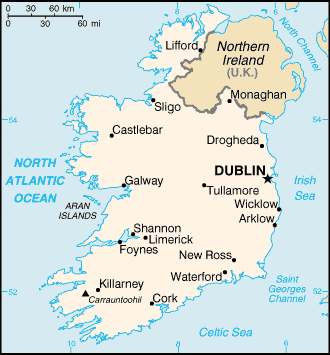
Western Europe,
occupying five-sixths of the island of Ireland in the North
Atlantic Ocean, west of Great Britain
|
|
Geographic
coordinates: |
53 00 N, 8 00 W
|
|
Map references: |
Europe
|
|
Area: |
total:
70,280 sq km
land: 68,890 sq km
water: 1,390 sq km
|
|
Area -
comparative: |
slightly larger
than West Virginia
|
|
Land boundaries: |
total: 360
km
border countries: UK 360 km
|
|
Coastline: |
1,448 km
|
|
Maritime claims: |
territorial sea:
12 nm
exclusive fishing zone: 200 nm
|
|
Climate: |
temperate maritime;
modified by North Atlantic Current; mild winters, cool summers;
consistently humid; overcast about half the time
|
|
Terrain: |
mostly level to
rolling interior plain surrounded by rugged hills and low
mountains; sea cliffs on west coast
|
|
Elevation
extremes: |
lowest point:
Atlantic Ocean 0 m
highest point: Carrauntoohil 1,041 m
|
|
Natural
resources: |
natural gas, peat,
copper, lead, zinc, silver, barite, gypsum, limestone, dolomite
|
|
Land use: |
arable land:
15.2%
permanent crops: 0.03%
other: 84.77% (2001)
|
|
Irrigated land: |
NA sq km
|
|
Natural hazards: |
NA
|
|
Environment -
current issues: |
water pollution,
especially of lakes, from agricultural runoff
|
|
Environment -
international agreements: |
party to:
Air Pollution, Air Pollution-Nitrogen Oxides, Air
Pollution-Sulfur 94, Biodiversity, Climate Change, Climate
Change-Kyoto Protocol, Desertification, Endangered Species,
Environmental Modification, Hazardous Wastes, Law of the Sea,
Marine Dumping, Ozone Layer Protection, Ship Pollution, Tropical
Timber 83, Tropical Timber 94, Wetlands, Whaling
signed, but not ratified: Air Pollution-Persistent
Organic Pollutants, Marine Life Conservation
|
|
Geography -
note: |
strategic location
on major air and sea routes between North America and northern
Europe; over 40% of the population resides within 100 km of
Dublin
|
|
People |
|
Population: |
4,015,676 (July
2005 est.)
|
|
Age structure: |
0-14 years:
20.9% (male 434,225/female 406,730)
15-64 years: 67.5% (male 1,358,086/female 1,354,148)
65 years and over: 11.5% (male 203,614/female 258,873)
(2005 est.)
|
|
Median age: |
total: 33.7
years
male: 32.9 years
female: 34.49 years (2005 est.)
|
|
Population
growth rate: |
1.16% (2005 est.)
|
|
Birth rate: |
14.47 births/1,000
population (2005 est.)
|
|
Death rate: |
7.85 deaths/1,000
population (2005 est.)
|
|
Net migration
rate: |
4.93 migrant(s)/1,000
population (2005 est.)
|
|
Sex ratio: |
at birth:
1.07 male(s)/female
under 15 years: 1.07 male(s)/female
15-64 years: 1 male(s)/female
65 years and over: 0.79 male(s)/female
total population: 0.99 male(s)/female (2005 est.)
|
|
Infant mortality
rate: |
total: 5.39
deaths/1,000 live births
male: 5.91 deaths/1,000 live births
female: 4.84 deaths/1,000 live births (2005 est.)
|
|
Life expectancy
at birth: |
total
population: 77.56 years
male: 74.95 years
female: 80.34 years (2005 est.)
|
|
Total fertility
rate: |
1.87 children
born/woman (2005 est.)
|
|
HIV/AIDS - adult
prevalence rate: |
0.1% (2001 est.)
|
|
HIV/AIDS -
people living with HIV/AIDS: |
2,800 (2001 est.)
|
|
HIV/AIDS -
deaths: |
less than 100 (2003
est.)
|
|
Nationality: |
noun:
Irishman(men), Irishwoman(women), Irish (collective plural)
adjective: Irish
|
|
Ethnic groups: |
Celtic, English
|
|
Religions: |
Roman Catholic
88.4%, Church of Ireland 3%, other Christian 1.6%, other 1.5%,
unspecified 2%, none 3.5% (2002 census)
|
|
Languages: |
English (official)
is the language generally used, Irish (official) (Gaelic or
Gaeilge) spoken mainly in areas located along the western
seaboard
|
|
Literacy: |
definition:
age 15 and over can read and write
total population: 98% (1981 est.)
male: NA%
female: NA%
|
|
Government |
|
Country name: |
conventional
long form: none
conventional short form: Ireland
local long form: none
local short form: Eire
|
|
Government type: |
republic
|
|
Capital: |
Dublin
|
|
Administrative
divisions: |
26 counties; Carlow,
Cavan, Clare, Cork, Donegal, Dublin, Galway, Kerry, Kildare,
Kilkenny, Laois, Leitrim, Limerick, Longford, Louth, Mayo, Meath,
Monaghan, Offaly, Roscommon, Sligo, Tipperary, Waterford,
Westmeath, Wexford, Wicklow
note: Cavan, Donegal, and Monaghan are part of Ulster
Province
|
|
Independence: |
6 December 1921
(from UK by treaty)
|
|
National
holiday: |
Saint Patrick's
Day, 17 March
|
|
Constitution: |
29 December 1937;
adopted 1 July 1937 by plebiscite
|
|
Legal system: |
based on English
common law, substantially modified by indigenous concepts;
judicial review of legislative acts in Supreme Court; has not
accepted compulsory ICJ jurisdiction
|
|
Suffrage: |
18 years of age;
universal
|
|
Executive
branch: |
chief of state:
President Mary MCALEESE (since 11 November 1997)
head of government: Prime Minister Bertie AHERN (since 26
June 1997)
cabinet: Cabinet appointed by the president with previous
nomination by the prime minister and approval of the House of
Representatives
elections: president elected by popular vote for a
seven-year term; election last held 31 October 1997 (next
scheduled for October 2011); note - Mary MCALEESE appointed to a
second term when no other candidate qualified for the 2004
presidential election; prime minister nominated by the House of
Representatives and appointed by the president
election results: Mary MCALEESE elected president;
percent of vote - Mary MCALEESE 44.8%, Mary BANOTTI 29.6%
note: government coalition - Fianna Fail and the
Progressive Democrats
|
|
Legislative
branch: |
bicameral
Parliament or Oireachtas consists of the Senate or Seanad
Eireann (60 seats - 49 elected by the universities and from
candidates put forward by five vocational panels, 11 are
nominated by the prime minister; members serve five-year terms)
and the House of Representatives or Dail Eireann (166 seats;
members are elected by popular vote on the basis of proportional
representation to serve five-year terms)
elections: Senate - last held 16 and 17 July 2002 (next
to be held by July 2007); House of Representatives - last held
17 May 2002 (next to be held by May 2007)
election results: Senate - percent of vote by party -
NA%; seats by party - Fianna Fail 30, Fine Gael 15, Labor Party
5, Progressive Democrats 4, independents and others 6; House of
Representatives - percent of vote by party - Fianna Fail 41.5%,
Fine Gael 22.5%, Labor Party 10.8%, Sinn Fein 6.5%, Progressive
Democrats 4.0%, Green Party 3.8%, others 10.9%; seats by party -
Fianna Fail 81, Fine Gael 31, Labor Party 21, Progressive
Democrats 8, Green Party 6, Sinn Fein 5, others 14
|
|
Judicial branch: |
Supreme Court
(judges appointed by the president on the advice of the prime
minister and cabinet)
|
|
Political
parties and leaders: |
Fianna Fail [Bertie
AHERN]; Fine Gael [Enda KENNY]; Green Party [Trevor SARGENT];
Labor Party [Pat RABITTE]; Progressive Democrats [Mary HARNEY];
Sinn Fein [Gerry ADAMS]; Socialist Party [Joe HIGGINS]; The
Workers' Party [Sean GARLAND]
|
|
Political
pressure groups and leaders: |
NA
|
|
International
organization participation: |
Australia Group,
BIS, CE, EAPC, EBRD, EIB, EMU, ESA, EU, FAO, IAEA, IBRD, ICAO,
ICC, ICCt, ICFTU, ICRM, IDA, IEA, IFAD, IFC, IFRCS, ILO, IMF,
IMO, Interpol, IOC, IOM, ISO, ITU, MIGA, MINURSO, MONUC, NAM
(guest), NEA, NSG, OAS (observer), OECD, OPCW, OSCE, Paris Club,
PCA, PFP, UN, UNCTAD, UNESCO, UNFICYP, UNHCR, UNIDO, UNIFIL,
UNMIK, UNMIL, UNOCI, UNTSO, UPU, WCO, WEU (observer), WHO, WIPO,
WMO, WTO, ZC
|
|
Flag
description: |
three equal
vertical bands of green (hoist side), white, and orange; similar
to the flag of Cote d'Ivoire, which is shorter and has the
colors reversed - orange (hoist side), white, and green; also
similar to the flag of Italy, which is shorter and has colors of
green (hoist side), white, and red
|
|
Economy |
|
Economy -
overview: |
Ireland is a small,
modern, trade-dependent economy with growth averaging a robust
7% in 1995-2004. Agriculture, once the most important sector, is
now dwarfed by industry and services. Industry accounts for 46%
of GDP, about 80% of exports, and 29% of the labor force.
Although exports remain the primary engine for Ireland's growth,
the economy has also benefited from a rise in consumer spending,
construction, and business investment. Per capita GDP is 10%
above that of the four big European economies and the second
highest in the EU behind Luxembourg. Over the past decade, the
Irish Government has implemented a series of national economic
programs designed to curb price and wage inflation, reduce
government spending, increase labor force skills, and promote
foreign investment. Ireland joined in circulating the euro on 1
January 2002 along with 11 other EU nations.
|
|
GDP: |
purchasing power
parity - $126.4 billion (2004 est.)
|
|
GDP - real
growth rate: |
5.1% (2004 est.)
|
|
GDP - per
capita: |
purchasing power
parity - $31,900 (2004 est.)
|
|
GDP -
composition by sector: |
agriculture:
5%
industry: 46%
services: 49% (2002 est.)
|
|
Labor force: |
1.92 million (2004
est.)
|
|
Labor force - by
occupation: |
agriculture 8%,
industry 29%, services 63% (2002 est.)
|
|
Unemployment
rate: |
4.3% (2004 est.)
|
|
Population below
poverty line: |
10% (1997 est.)
|
|
Household income
or consumption by percentage share: |
lowest 10%:
2%
highest 10%: 27.3% (1997)
|
|
Distribution of
family income - Gini index: |
35.9 (1987)
|
|
Inflation rate
(consumer prices): |
2.2% (2004 est.)
|
|
Investment
(gross fixed): |
23.8% of GDP (2004
est.)
|
|
Budget: |
revenues:
$62.51 billion
expenditures: $63.52 billion, including capital
expenditures of $5.5 billion (2004 est.)
|
|
Public debt: |
31.2% of GDP (2004
est.)
|
|
Agriculture -
products: |
turnips, barley,
potatoes, sugar beets, wheat; beef, dairy products
|
|
Industries: |
steel, lead, zinc,
silver, aluminum, barite, and gypsum mining processing; food
products, brewing, textiles, clothing; chemicals,
pharmaceuticals; machinery, rail transportation equipment,
passenger and commercial vehicles, ship construction and
refurbishment; glass and crystal; software, tourism
|
|
Industrial
production growth rate: |
7% (2004 est.)
|
|
Electricity -
production: |
22.88 billion kWh
(2002)
|
|
Electricity -
production by source: |
fossil fuel:
95.9%
hydro: 2.3%
nuclear: 0%
other: 1.7% (2001)
|
|
Electricity -
consumption: |
21.78 billion kWh
(2002)
|
|
Electricity -
exports: |
100 million kWh
(2002)
|
|
Electricity -
imports: |
600 million kWh
(2002)
|
|
Oil -
production: |
0 bbl/day (2001
est.)
|
|
Oil -
consumption: |
174,400 bbl/day
(2001 est.)
|
|
Oil - exports: |
27,450 bbl/day
(2001)
|
|
Oil - imports: |
178,600 bbl/day
(2001)
|
|
Oil - proved
reserves: |
0 bbl (1 January
2002)
|
|
Natural gas -
production: |
815 million cu m
(2001 est.)
|
|
Natural gas -
consumption: |
4.199 billion cu m
(2001 est.)
|
|
Natural gas -
exports: |
0 cu m (2001 est.)
|
|
Natural gas -
imports: |
3.384 billion cu m
(2001 est.)
|
|
Natural gas -
proved reserves: |
9.911 billion cu m
(1 January 2002)
|
|
Current account
balance: |
$-2.881 billion
(2004 est.)
|
|
Exports: |
$103.8 billion
f.o.b. (2004 est.)
|
|
Exports -
commodities: |
machinery and
equipment, computers, chemicals, pharmaceuticals; live animals,
animal products
|
|
Exports -
partners: |
US 20.2%, UK 17.5%,
Belgium 14.8%, Germany 7.5%, France 5.9%, Italy 4.5%,
Netherlands 4.4% (2004)
|
|
Imports: |
$60.65 billion
f.o.b. (2004 est.)
|
|
Imports -
commodities: |
data processing
equipment, other machinery and equipment, chemicals, petroleum
and petroleum products, textiles, clothing
|
|
Imports -
partners: |
UK 35.2%, US 13.5%,
Germany 8.9%, France 4.3%, Netherlands 4.3% (2004)
|
|
Reserves of
foreign exchange and gold: |
$4.152 billion
(2003)
|
|
Debt - external: |
$11 billion (1998)
|
|
Economic aid -
donor: |
ODA, $283 million
(2001)
|
|
Currency (code): |
euro (EUR)
note: on 1 January 1999, the European Monetary Union
introduced the euro as a common currency to be used by financial
institutions of member countries; on 1 January 2002, the euro
became the sole currency for everyday transactions within the
member countries
|
|
Currency code: |
EUR
|
|
Exchange rates: |
euros per US dollar
- 0.8054 (2004), 0.886 (2003), 1.0626 (2002), 1.1175 (2001),
1.0854 (2000)
|
|
Fiscal year: |
calendar year
|
|
Communications |
|
Telephones -
main lines in use: |
1.955 million
(2003)
|
|
Telephones -
mobile cellular: |
3.4 million (2003)
|
|
Telephone
system: |
general
assessment: modern digital system using cable and microwave
radio relay
domestic: microwave radio relay
international: country code - 353; satellite earth
station - 1 Intelsat (Atlantic Ocean)
|
|
Radio broadcast
stations: |
AM 9, FM 106,
shortwave 0 (1998)
|
|
Radios: |
2.55 million (1997)
|
|
Television
broadcast stations: |
4 (many low-power
repeaters) (2001)
|
|
Televisions: |
1.82 million (2001)
|
|
Internet country
code: |
.ie
|
|
Internet hosts: |
162,228 (2004)
|
|
Internet Service
Providers (ISPs): |
22 (2000)
|
|
Internet users: |
1.26 million (2003)
|
|
Transportation |
|
Railways: |
total: 3,312
km
broad gauge: 1,947 km 1.600-m gauge (46 km electrified)
narrow gauge: 1,365 km 0.914-m gauge (operated by the
Irish Peat Board to transport peat to power stations and
briquetting plants) (2004)
|
|
Highways: |
total:
95,736 km
paved: 95,736 km (including 125 km of expressways)
unpaved: 0 km (2002)
|
|
Waterways: |
753 km (pleasure
craft only) (2004)
|
|
Pipelines: |
gas 1,795 km (2004)
|
|
Ports and
harbors: |
Cork, Dublin, New
Ross, Shannon Foynes, Waterford
|
|
Merchant marine: |
total: 39
by type: bulk carrier 4, cargo 27, chemical tanker 1,
container 1, passenger/cargo 4, roll on/roll off 2
foreign-owned: 11 (Germany 3, Italy 3, Norway 1,
Switzerland 1, United Kingdom 3)
registered in other countries: 18 (2005)
|
|
Airports: |
36 (2004 est.)
|
|
Airports - with
paved runways: |
total: 15
over 3,047 m: 1
2,438 to 3,047 m: 1
1,524 to 2,437 m: 4
914 to 1,523 m: 3
under 914 m: 6 (2004 est.)
|
|
Airports - with
unpaved runways: |
total: 21
914 to 1,523 m: 4
under 914 m: 17 (2004 est.)
|
|
Military |
|
Military
branches: |
Army (includes
Naval Service and Air Corps)
|
|
Military
manpower - military age and obligation: |
17 years of age for
voluntary military service; enlistees under the age of 17 can be
recruited for specialist positions (2001)
|
|
Military
manpower - availability: |
males age 17-49:
977,092 (2005 est.)
|
|
Military
manpower - fit for military service: |
males age 17-49:
814,768 (2005 est.)
|
|
Military
manpower - reaching military age annually: |
males:
29,327 (2005 est.)
|
|
Military
expenditures - dollar figure: |
$700 million
(FY00/01)
|
|
Military
expenditures - percent of GDP: |
0.9% (FY00/01)
|
|
Transnational Issues |
|
Disputes -
international: |
Ireland, Iceland,
and the UK dispute Denmark's claim that the Faroe Islands'
continental shelf extends beyond 200 nm
|
|
Illicit drugs: |
transshipment point
for and consumer of hashish from North Africa to the UK and
Netherlands and of European-produced synthetic drugs; minor
transshipment point for heroin and cocaine destined for Western
Europe; despite recent legislation, narcotics-related money
laundering using bureaux de change, trusts, and shell companies
involving the offshore financial community remains a concern
|

 100+ Important Documents in United States History