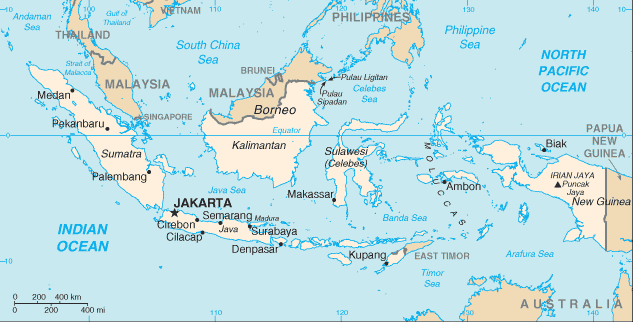
The Dutch began to
colonize Indonesia in the early 17th century; the islands were
occupied by Japan from 1942 to 1945. Indonesia declared its
independence after Japan's surrender, but it required four years
of intermittent negotiations, recurring hostilities, and UN
mediation before the Netherlands agreed to relinquish its
colony. Indonesia is the world's largest archipelagic state.
Current issues include: alleviating widespread poverty,
preventing terrorism, continuing the transition to
popularly-elected governments after four decades of
authoritarianism, implementing reforms of the banking sector,
addressing charges of cronyism and corruption, holding the
military and police accountable for human rights violations, and
resolving armed separatist movements in Aceh and Papua.
Geography
Location:
Southeastern Asia,
archipelago between the Indian Ocean and the Pacific Ocean
Geographic
coordinates:
5 00 S, 120 00 E
Map references:
Southeast Asia
Area:
total:
1,919,440 sq km land: 1,826,440 sq km water: 93,000 sq km
Area -
comparative:
slightly less than
three times the size of Texas
Land boundaries:
total: 2,830
km border countries: East Timor 228 km, Malaysia 1,782 km,
Papua New Guinea 820 km
occasional floods,
severe droughts, tsunamis, earthquakes, volcanoes, forest fires
Environment -
current issues:
deforestation;
water pollution from industrial wastes, sewage; air pollution in
urban areas; smoke and haze from forest fires
Environment -
international agreements:
party to:
Biodiversity, Climate Change, Climate Change-Kyoto Protocol,
Desertification, Endangered Species, Hazardous Wastes, Law of
the Sea, Ozone Layer Protection, Ship Pollution, Tropical Timber
83, Tropical Timber 94, Wetlands signed, but not ratified: Marine Life Conservation
Geography -
note:
archipelago of
17,508 islands (6,000 inhabited); straddles equator; strategic
location astride or along major sea lanes from Indian Ocean to
Pacific Ocean
total: 26.48
years male: 26.03 years female: 26.93 years (2005 est.)
Population
growth rate:
1.45% (2005 est.)
Birth rate:
20.71 births/1,000
population (2005 est.)
Death rate:
6.25 deaths/1,000
population (2005 est.)
Net migration
rate:
0 migrant(s)/1,000
population (2005 est.)
Sex ratio:
at birth:
1.05 male(s)/female under 15 years: 1.04 male(s)/female 15-64 years: 1 male(s)/female 65 years and over: 0.77 male(s)/female total population: 1 male(s)/female (2005 est.)
Infant mortality
rate:
total: 35.6
deaths/1,000 live births male: 40.72 deaths/1,000 live births female: 30.22 deaths/1,000 live births (2005 est.)
Life expectancy
at birth:
total
population: 69.57 years male: 67.13 years female: 72.13 years (2005 est.)
Muslim 88%,
Protestant 5%, Roman Catholic 3%, Hindu 2%, Buddhist 1%, other
1% (1998)
Languages:
Bahasa Indonesia
(official, modified form of Malay), English, Dutch, local
dialects, the most widely spoken of which is Javanese
Literacy:
definition:
age 15 and over can read and write total population: 87.9% male: 92.5% female: 83.4% (2002)
Government
Country name:
conventional
long form: Republic of Indonesia conventional short form: Indonesia local long form: Republik Indonesia local short form: Indonesia former: Netherlands East Indies; Dutch East Indies
Government type:
republic
Capital:
Jakarta
Administrative
divisions:
30 provinces (propinsi-propinsi,
singular - propinsi), 2 special regions* (daerah-daerah istimewa,
singular - daerah istimewa), and 1 special capital city
district** (daerah khusus ibukota); Aceh*, Bali, Banten,
Bengkulu, Gorontalo, Irian Jaya Barat, Jakarta Raya**, Jambi,
Jawa Barat, Jawa Tengah, Jawa Timur, Kalimantan Barat,
Kalimantan Selatan, Kalimantan Tengah, Kalimantan Timur,
Kepulauan Bangka Belitung, Kepulauan Riau, Lampung, Maluku,
Maluku Utara, Nusa Tenggara Barat, Nusa Tenggara Timur, Papua,
Riau, Sulawesi Barat, Sulawesi Selatan, Sulawesi Tengah,
Sulawesi Tenggara, Sulawesi Utara, Sumatera Barat, Sumatera
Selatan, Sumatera Utara, Yogyakarta*; note - with the
implementation of decentralization on 1 January 2001, the 357
districts or regencies became the key administrative units
responsible for providing most government services
Independence:
17 August 1945
(independence proclaimed); 27 December 1949 (Netherlands
recognizes Indonesian independence)
National
holiday:
Independence Day,
17 August (1945)
Constitution:
August 1945,
abrogated by Federal Constitution of 1949 and Provisional
Constitution of 1950, restored 5 July 1959
Legal system:
based on
Roman-Dutch law, substantially modified by indigenous concepts
and by new criminal procedures and election codes; has not
accepted compulsory ICJ jurisdiction
Suffrage:
17 years of age;
universal and married persons regardless of age
Executive
branch:
chief of state:
President Susilo Bambang YUDHOYONO (since 20 October 2004) and
Vice President Muhammad Yusuf KALLA (since 20 October 2004);
note - the president is both the chief of state and head of
government head of government: President Susilo Bambang YUDHOYONO
(since 20 October 2004) and Vice President Muhammad Yusuf KALLA
(since 20 October 2004); cabinet: Cabinet appointed by the president elections: president and vice president were elected for
five-year terms by direct vote of the citizenry; last held 20
September 2004 (next to be held in September 2009) election results: Susilo Bambang YUDHOYONO elected
president receiving 60.6% of vote; MEGAWATI Sukarnoputri
received 39.4%
Legislative
branch:
unicameral House of
Representatives or Dewan Perwakilan Rakyat (DPR) (550 seats;
members elected to serve five-year terms); House of Regional
Representatives (Dewan Perwakilan Daerah or DPD),
constitutionally mandated role includes providing legislative
input to DPR on issues affecting regions; People's Consultative
Assembly (Majelis Permusyawaratan Rakyat or MPR) has role in
inaugurating and impeaching President and in amending
constitution; consists of popularly-elected members in DPR and
DPD; MPR does not formulate national policy elections: last held 5 April 2004 (next to be held in
April 2009) election results: percent of vote by party - Golkar
21.6%, PDI-P 18.5%, PKB 10.6%, PPP 8.2%, PD 7.5%, PKS 7.3%, PAN
6.4%, others 19.9%; seats by party - Golkar 128, PDI-P 109, PPP
58, PD 55, PAN 53, PKB 52, PKS 45, others 50 note: because of election rules, the number of seats won
does not always follow the number of votes received by parties
Judicial branch:
Supreme Court or
Mahkamah Agung (justices appointed by the president from a list
of candidates approved by the legislature); a separate
Constitutional Court or Makhama Konstitusi was invested by the
president on 16 August 2003; in March 2004 the Supreme Court
assumed administrative and financial responsibility for the
lower court system from the Ministry of Justice and Human Rights
Political
parties and leaders:
Crescent Moon and
Star Party or PBB [Yusril Ihza MAHENDRA, chairman]; Democratic
Party or PD [Subur BUDHISANTOSO, chairman]; Functional Groups
Party or Golkar [Yusuf KALLA, chairman]; Indonesia Democratic
Party-Struggle or PDI-P [MEGAWATI Sukarnoputri, chairperson];
National Awakening Party or PKB [Alwi SHIHAB, chairman];
National Mandate Party or PAN [Amien RAIS, chairman]; Prosperous
Justice Party or PKS [MAHFUD, acting chairman]; United
Development Party or PPP [Hamzah HAZ, chairman]
two equal
horizontal bands of red (top) and white; similar to the flag of
Monaco, which is shorter; also similar to the flag of Poland,
which is white (top) and red
Economy
Economy -
overview:
Indonesia, a vast
polyglot nation, has restored financial stability and pursued
sober fiscal policies since the Asian financial crisis, but many
economic development problems remain, including high
unemployment, a fragile banking sector, endemic corruption,
inadequate infrastructure, a poor investment climate, and
unequal resource distribution among regions. Indonesia became a
net oil importer in 2004 due to declining production and lack of
new exploration investment. As a result, Jakarta is not reaping
the benefits of high world oil prices, and the cost of
subsidizing domestic fuel prices has placed an increasing strain
on the budget. Keys to future growth remain internal reform,
building up the confidence of international and domestic
investors, and strong global economic growth. In late December
2004, a major tsunami took over 237,000 lives in Indonesia and
caused massive destruction of property.
GDP:
purchasing power
parity - $827.4 billion (2004 est.)
oil and gas,
electrical appliances, plywood, textiles, rubber
Exports -
partners:
Japan 21.8%, US
13.5%, China 7.5%, Singapore 7.4%, South Korea 5.9%, Malaysia
4.9% (2004)
Imports:
$45.07 billion
f.o.b. (2004 est.)
Imports -
commodities:
machinery and
equipment, chemicals, fuels, foodstuffs
Imports -
partners:
Japan 19.3%, China
11%, Singapore 9.2%, Thailand 6.8%, Malaysia 6.5%, US 5.7%,
Australia 5%, Germany 4.2% (2004)
Reserves of
foreign exchange and gold:
$35.82 billion
(2004 est.)
Debt - external:
$141.5 billion
(2004 est.)
Currency (code):
Indonesian rupiah (IDR)
Currency code:
IDR
Exchange rates:
Indonesian rupiahs
per US dollar - 8,938.9 (2004), 8,577.1 (2003), 9,311.2 (2002),
10,260.8 (2001), 8,421.8 (2000)
Fiscal year:
calendar year; note
- previously was 1 April - 31 March, but starting with 2001, has
been changed to calendar year
Communications
Telephones -
main lines in use:
7.75 million (2002)
Telephones -
mobile cellular:
11.7 million (2002)
Telephone
system:
general
assessment: domestic service fair, international service
good domestic: interisland microwave system and HF radio
police net; domestic satellite communications system international: country code - 62; satellite earth
stations - 2 Intelsat (1 Indian Ocean and 1 Pacific Ocean)
Radio broadcast
stations:
AM 678, FM 43,
shortwave 82 (1998)
Radios:
31.5 million (1997)
Television
broadcast stations:
41 (1999)
Televisions:
13.75 million
(1997)
Internet country
code:
.id
Internet hosts:
62,036 (2003)
Internet Service
Providers (ISPs):
24 (2000)
Internet users:
8 million (2002)
Transportation
Railways:
total: 6,458
km narrow gauge: 5,961 km 1.067-m gauge (125 km
electrified); 497 km 0.750-m gauge (2004)
Highways:
total:
342,700 km paved: 158,670 km unpaved: 184,030 km (1999 est.)
Waterways:
21,579 km note: Sumatra 5,471 km, Java and Madura 820 km,
Kalimantan 10,460 km, Sulawesi (Celebes) 241 km, Irian Jaya
4,587 km (2004)
Pipelines:
condensate 850 km;
condensate/gas 128 km; gas 8,506 km; oil 7,472 km; oil/gas/water
66 km; refined products 1,329 km (2004)
Ports and
harbors:
Banjarmasin,
Belawan, Ciwandan, Krueg Geukueh, Palembang, Panjang, Sungai
Pakning, Tanjung Perak, Tanjung Priok
Merchant marine:
total: 728
ships (1,000 GRT or over) 3,192,847 GRT/4,319,739 DWT by type: bulk carrier 35, cargo 409, chemical tanker 19,
container 36, liquefied gas 7, livestock carrier 1, passenger
41, passenger/cargo 36, petroleum tanker 125, refrigerated cargo
2, roll on/roll off 13, specialized tanker 2, vehicle carrier 2
foreign-owned: 19 (France 1, Japan 3, Philippines 1,
Singapore 11, Switzerland 1, United Kingdom 2) registered in other countries: 113 (2005)
Airports:
667 (2004 est.)
Airports - with
paved runways:
total: 154
over 3,047 m: 4 2,438 to 3,047 m: 13 1,524 to 2,437 m: 44 914 to 1,523 m: 49 under 914 m: 44 (2004 est.)
Airports - with
unpaved runways:
total: 513
2,438 to 3,047 m: 1 1,524 to 2,437 m: 5 914 to 1,523 m: 27 under 914 m: 480 (2004 est.)
Heliports:
22 (2004 est.)
Military
Military
branches:
Indonesia Armed
Forces (TNI): Army (TNI-AD), Navy (TNI-AL, includes Marines,
Naval Air arm), Air Force (TNI-AU)
Military
manpower - military age and obligation:
18 years of age for
compulsory and voluntary military service; conscript service
obligation - 2 years (2002)
Military
manpower - availability:
males age 18-49:
60,543,028 (2005 est.)
Military
manpower - fit for military service:
males age 18-49:
48,687,234 (2005 est.)
Military
manpower - reaching military age annually:
males:
2,201,047 (2005 est.)
Military
expenditures - dollar figure:
$1.3 billion (2004)
Military
expenditures - percent of GDP:
3% (2004)
Transnational Issues
Disputes -
international:
East
Timor-Indonesia Boundary Committee continues to meet, survey and
delimit land boundary, but several sections of the boundary
remain unresolved; Indonesia and East Timor contest the
sovereignty of the uninhabited coral island of Palau Batek/Fatu
Sinai, which hinders a decision on a northern maritime boundary;
a 1997 treaty between Indonesia and Australia settled some parts
of their maritime boundary but outstanding issues remain; ICJ's
award of Sipadan and Ligitan islands to Malaysia in 2002 left
maritime boundary in the hydrocarbon-rich Celebes Sea in
dispute, culminating in hostile confrontations in March 2005
over concessions to the Ambalat oil block; the ICJ decision has
prompted Indonesia to assert claims to and to establish a
presence on its smaller outer islands; Indonesia and Singapore
pledged in 2005 to finalize their 1973 maritime boundary
agreement by defining unresolved areas north of Batam Island;
Indonesian secessionists, squatters, and illegal migrants create
repatriation problems for Papua New Guinea; piracy remains a
problem in the Malacca Strait
Refugees and
internally displaced persons::
IDPs:
535,000 (government offensives against rebels in Aceh; most IDPs
in Aceh, Central Kalimantan, Maluku, and Central Sulawesi
Provinces); 441,000 (resulting from 26 December 2004 tsunmai)
(2004)
Illicit drugs:
illicit producer of
cannabis largely for domestic use; possible growing role as
transshipment point for Golden Triangle heroin

 100+ Important Documents in United States History