Although ultimately a
victor in World Wars I and II, France suffered extensive losses
in its empire, wealth, manpower, and rank as a dominant
nation-state. Nevertheless, France today is one of the most
modern countries in the world and is a leader among European
nations. Since 1958, it has constructed a presidential democracy
resistant to the instabilities experienced in earlier
parliamentary democracies. In recent years, its reconciliation
and cooperation with Germany have proved central to the economic
integration of Europe, including the introduction of a common
exchange currency, the euro, in January 1999. At present, France
is at the forefront of efforts to develop the EU's military
capabilities to supplement progress toward an EU foreign policy.
Geography
Location:
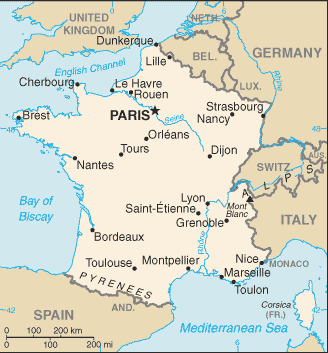
Western Europe, bordering
the Bay of Biscay and English Channel, between Belgium and
Spain, southeast of the UK; bordering the Mediterranean Sea,
between Italy and Spain
Geographic coordinates:
46 00 N, 2 00 E
Map
references:
Europe
Area:
total: 547,030 sq
km land: 545,630 sq km water: 1,400 sq km note: includes only metropolitan France; excludes the
overseas administrative divisions
Area -
comparative:
slightly less than twice
the size of Colorado
Land
boundaries:
total: 2,889 km border countries: Andorra 56.6 km, Belgium 620 km,
Germany 451 km, Italy 488 km, Luxembourg 73 km, Monaco 4.4 km,
Spain 623 km, Switzerland 573 km
Coastline:
3,427 km
Maritime claims:
territorial sea: 12
nm contiguous zone: 24 nm exclusive economic zone: 200 nm (does not apply to the
Mediterranean) continental shelf: 200-m depth or to the depth of
exploitation
Climate:
generally cool winters and
mild summers, but mild winters and hot summers along the
Mediterranean; occasional strong, cold, dry,
north-to-northwesterly wind known as mistral
Terrain:
mostly flat plains or
gently rolling hills in north and west; remainder is
mountainous, especially Pyrenees in south, Alps in east
Elevation extremes:
lowest point: Rhone
River delta -2 m highest point: Mont Blanc 4,807 m
Natural
resources:
coal, iron ore, bauxite,
zinc, uranium, antimony, arsenic, potash, feldspar, fluorospar,
gypsum, timber, fish
flooding; avalanches;
midwinter windstorms; drought; forest fires in south near the
Mediterranean
Environment - current issues:
some forest damage from
acid rain; air pollution from industrial and vehicle emissions;
water pollution from urban wastes, agricultural runoff
Environment - international agreements:
party to: Air
Pollution, Air Pollution-Nitrogen Oxides, Air
Pollution-Persistent Organic Pollutants, Air Pollution-Sulfur
85, Air Pollution-Sulfur 94, Air Pollution-Volatile Organic
Compounds, Antarctic-Environmental Protocol, Antarctic-Marine
Living Resources, Antarctic Seals, Antarctic Treaty,
Biodiversity, Climate Change, Climate Change-Kyoto Protocol,
Desertification, Endangered Species, Hazardous Wastes, Law of
the Sea, Marine Dumping, Marine Life Conservation, Ozone Layer
Protection, Ship Pollution, Tropical Timber 83, Tropical Timber
94, Wetlands, Whaling signed, but not ratified: none of the selected agreements
total: 38.85 years
male: 37.3 years female: 40.39 years (2005 est.)
Population growth rate:
0.37% (2005 est.)
Birth
rate:
12.15 births/1,000
population (2005 est.)
Death
rate:
9.08 deaths/1,000
population (2005 est.)
Net
migration rate:
0.66 migrant(s)/1,000
population (2005 est.)
Sex
ratio:
at birth: 1.05
male(s)/female under 15 years: 1.05 male(s)/female 15-64 years: 1 male(s)/female 65 years and over: 0.7 male(s)/female total population: 0.95 male(s)/female (2005 est.)
Infant
mortality rate:
total: 4.26
deaths/1,000 live births male: 4.76 deaths/1,000 live births female: 3.73 deaths/1,000 live births (2005 est.)
Life
expectancy at birth:
total population:
79.6 years male: 75.96 years female: 83.42 years (2005 est.)
Total
fertility rate:
1.85 children born/woman
(2005 est.)
HIV/AIDS - adult prevalence rate:
0.4% (2003 est.)
HIV/AIDS - people living with HIV/AIDS:
120,000 (2003 est.)
HIV/AIDS - deaths:
less than 1,000 (2003
est.)
Nationality:
noun: Frenchman(men),
Frenchwoman(women) adjective: French
Ethnic
groups:
Celtic and Latin with
Teutonic, Slavic, North African, Indochinese, Basque minorities
Religions:
Roman Catholic 83%-88%,
Protestant 2%, Jewish 1%, Muslim 5%-10%, unaffiliated 4%
Languages:
French 100%, rapidly
declining regional dialects and languages (Provencal, Breton,
Alsatian, Corsican, Catalan, Basque, Flemish)
Literacy:
definition: age 15
and over can read and write total population: 99% male: 99% female: 99% (1980 est.)
Government
Country
name:
conventional long form:
French Republic conventional short form: France local long form: Republique Francaise local short form: France
Government type:
republic
Capital:
Paris
Administrative divisions:
22 regions (regions,
singular - region); Alsace, Aquitaine, Auvergne, Basse-Normandie,
Bourgogne, Bretagne, Centre, Champagne-Ardenne, Corse, Franche-Comte,
Haute-Normandie, Ile-de-France, Languedoc-Roussillon, Limousin,
Lorraine, Midi-Pyrenees, Nord-Pas-de-Calais, Pays de la Loire,
Picardie, Poitou-Charentes, Provence-Alpes-Cote d'Azur, Rhone-Alpes
note: metropolitan France is divided into 22 regions
(including the "territorial collectivity" of Corse or Corsica)
and is subdivided into 96 departments; see separate entries for
the overseas departments (French Guiana, Guadeloupe, Martinique,
Reunion) and the overseas territorial collectivities (Mayotte,
Saint Pierre and Miquelon)
Dependent areas:
Bassas da India,
Clipperton Island, Europa Island, French Polynesia, French
Southern and Antarctic Lands, Glorioso Islands, Juan de Nova
Island, New Caledonia, Tromelin Island, Wallis and Futuna note: the US does not recognize claims to Antarctica
Independence:
486 (unified by Clovis)
National holiday:
Bastille Day, 14 July
(1789)
Constitution:
28 September 1958, amended
concerning election of president in 1962, amended to comply with
provisions of 1992 EC Maastricht Treaty, 1996 Amsterdam Treaty,
2000 Treaty of Nice; amended to tighten immigration laws in
1993; amended in 2000 to change the seven-year presidential term
to a five-year term
Legal
system:
civil law system with
indigenous concepts; review of administrative but not
legislative acts
Suffrage:
18 years of age; universal
Executive branch:
chief of state:
President Jacques CHIRAC (since 17 May 1995) head of government: Prime Minister Dominique DE VILLEPIN
(since 31 May 2005) cabinet: Council of Ministers appointed by the president
on the suggestion of the prime minister elections: president elected by popular vote for a
five-year term (changed from seven-year term in October 2000);
election last held 21 April and 5 May 2002 (next to be held,
first round April 2007, second round May 2007); prime minister
nominated by the National Assembly majority and appointed by the
president election results: Jacques CHIRAC reelected president;
percent of vote, second ballot - Jacques CHIRAC (RPR) 81.96%,
Jean-Marie LE PEN (FN) 18.04%
Legislative branch:
bicameral Parliament or
Parlement consists of the Senate or Senat (321 seats - 296 for
metropolitan France, 13 for overseas departments and
territories, and 12 for French nationals abroad; members are
indirectly elected by an electoral college to serve nine-year
terms; elected by thirds every three years); note - between now
and 2010, 25 new seats will be added to the Senate for a total
of 346 seats - 326 for metropolitan France and overseas
departments, 2 for New Caledonia, 2 for Mayotte, 1 for
Saint-Pierre and Miquelon, 3 for overseas territories, and 12
for French nationals abroad; members will be indirectly elected
by an electoral college to serve six-year terms, with one-half
the seats being renewed every three years; and the National
Assembly or Assemblee Nationale (577 seats; members are elected
by popular vote under a single-member majority system to serve
five-year terms) elections: Senate - last held 26 September 2004 (next to
be held September 2007); National Assembly - last held 8-16 June
2002 (next to be held not later than June 2007) election results: Senate - percent of vote by party -
NA%; seats by party - UMP 156, PS 97, UDF 33, PCF 23, RDSE 15,
other 7; National Assembly - percent of vote by party - NA%;
seats by party - UMP 355, PS 140, UDF 29, PCF 21, Radical Party
7, Greens 3, other 22
Judicial branch:
Supreme Court of Appeals
or Cour de Cassation (judges are appointed by the president from
nominations of the High Council of the Judiciary);
Constitutional Council or Conseil Constitutionnel (three members
appointed by the president, three appointed by the president of
the National Assembly, and three appointed by the president of
the Senate); Council of State or Conseil d'Etat
Political parties and leaders:
Citizen and Republican
Movement or MCR [Jean Pierre CHEVENEMENT]; Democratic and
European Social Rally or RDSE (mainly Radical Republican and
Socialist Parties, and PRG) [Jacques PELLETIER]; French
Communist Party or PCF [Marie-George BUFFET]; Left Radical Party
or PRG (previously Radical Socialist Party or PRS and the Left
Radical Movement or MRG) [Jean-Michel BAYLET]; Movement for
France or MPF [Philippe DE VILLIERS]; National Front or NF
[Jean-Marie LE PEN]; Rally for France or RPF [Charles PASQUA];
Socialist Party or PS [Francois HOLLANDE]; Greens [Yann WEHRLING,
national secretary]; Union for French Democracy or UDF [Francois
BAYROU]; Union for a Popular Movement or UMP (including RPR, DL,
and a part of UDF) [Nicolas SARKOZY]
Political pressure groups and leaders:
historically-Communist
labor union (Confederation Generale du Travail) or CGT,
approximately 700,000 members (claimed); left-leaning labor
union (Confederation Francaise Democratique du Travail) or CFDT,
approximately 889,000 members (claimed); independent labor union
(Confederation Generale du Travail - Force Ouvriere) or FO,
300,000 members (est.); independent white-collar union
(Confederation Generale des Cadres) or CGC, 196,000 members
(claimed); employers' union (Mouvement des Entreprises de
France) or MEDEF, 750,000 companies as members (claimed)
three equal vertical bands
of blue (hoist side), white, and red; known as the "Le drapeau
tricolore" (French Tricolor), the origin of the flag dates to
1790 and the French Revolution; the design and/or colors are
similar to a number of other flags, including those of Belgium,
Chad, Ireland, Cote d'Ivoire, Luxembourg, and Netherlands; the
official flag for all French dependent areas
Economy
Economy
- overview:
France is in the midst of
transition, from a well-to-do modern economy that has featured
extensive government ownership and intervention to one that
relies more on market mechanisms. The government has partially
or fully privatized many large companies, banks, and insurers.
It retains controlling stakes in several leading firms,
including Air France, France Telecom, Renault, and Thales, and
is dominant in some sectors, particularly power, public
transport, and defense industries. The telecommunications sector
is gradually being opened to competition. France's leaders
remain committed to a capitalism in which they maintain social
equity by means of laws, tax policies, and social spending that
reduce income disparity and the impact of free markets on public
health and welfare. The government has lowered income taxes and
introduced measures to boost employment and reform the pension
system. In addition, it is focusing on the problems of the high
cost of labor and labor market inflexibility resulting from the
35-hour workweek and restrictions on lay-offs. The tax burden
remains one of the highest in Europe (43.8% of GDP in 2003). The
lingering economic slowdown and inflexible budget items have
pushed the budget deficit above the eurozone's 3%-of-GDP limit.
Finance Minister Herve GAYMARD has promised that the 2005
deficit will fall below 3%.
GDP:
purchasing power parity -
$1.737 trillion (2004 est.)
machinery and
transportation equipment, aircraft, plastics, chemicals,
pharmaceutical products, iron and steel, beverages
Exports
- partners:
Germany 15%, Spain 9.4%,
UK 9.3%, Italy 9%, Belgium 7.2%, US 6.7% (2004)
Imports:
$419.7 billion f.o.b.
(2004 est.)
Imports
- commodities:
machinery and equipment,
vehicles, crude oil, aircraft, plastics, chemicals
Imports
- partners:
Germany 19.2%, Belgium
9.8%, Italy 8.8%, Spain 7.3%, UK 7%, Netherlands 6.7%, US 5.1%
(2004)
Reserves of foreign exchange and gold:
$70.76 billion (2003)
Debt -
external:
$NA
Economic aid - donor:
ODA, $5.4 billion (2002)
Currency (code):
euro (EUR) note: on 1 January 1999, the European Monetary Union
introduced the euro as a common currency to be used by financial
institutions of member countries; on 1 January 2002, the euro
became the sole currency for everyday transactions within the
member countries
Currency code:
EUR
Exchange rates:
euros per US dollar -
0.8054 (2004), 0.886 (2003), 1.0626 (2002), 1.1175 (2001),
1.0854 (2000)
Fiscal
year:
calendar year
Communications
Telephones - main lines in use:
33,905,400 (2003)
Telephones - mobile cellular:
41,683,100 (2003)
Telephone system:
general assessment:
highly developed domestic: extensive cable and microwave radio relay;
extensive introduction of fiber-optic cable; domestic satellite
system international: country code - 33; satellite earth
stations - 2 Intelsat (with total of 5 antennas - 2 for Indian
Ocean and 3 for Atlantic Ocean), NA Eutelsat, 1 Inmarsat
(Atlantic Ocean region); HF radiotelephone communications with
more than 20 countries
Radio
broadcast stations:
AM 41, FM about 3,500
(this figure is an approximation and includes many repeaters),
shortwave 2 (1998)
Radios:
55.3 million (1997)
Television broadcast stations:
584 (plus 9,676 repeaters)
(1995)
Televisions:
34.8 million (1997)
Internet country code:
.fr
Internet hosts:
2,396,761 (2004)
Internet Service Providers (ISPs):
62 (2000)
Internet users:
21.9 million (2003)
Transportation
Railways:
total: 29,519 km
standard gauge: 29,352 km 1.435-m gauge (14,481 km
electrified) narrow gauge: 167 km 1.000-m gauge (2004)
Highways:
total: 893,100 km
paved: 893,100 km (including 12,000 km of expressways)
unpaved: 0 km (2002)
Waterways:
8,500 km (1,686 km
accessible to craft of 3,000 metric tons) (2000)
Pipelines:
gas 14,232 km; oil 3,024
km; refined products 4,889 km (2004)
Ports
and harbors:
Bordeaux, Calais,
Dunkerque, La Pallice, Le Havre, Marseille, Nantes, Paris,
Rouen, Strasbourg
Merchant marine:
total: 56 ships
(1,000 GRT or over) 703,639 GRT/889,705 DWT by type: cargo 4, chemical tanker 6, liquefied gas 4,
passenger 3, passenger/cargo 30, petroleum tanker 8, roll
on/roll off 1 foreign-owned: 6 (Sweden 5, Switzerland 1) registered in other countries: 139 (2005)
Airports:
478 (2004 est.)
Airports - with paved runways:
total: 283 over 3,047 m: 13 2,438 to 3,047 m: 28 1,524 to 2,437 m: 95 914 to 1,523 m: 82 under 914 m: 65 (2004 est.)
Airports - with unpaved runways:
total: 195 1,524 to 2,437 m: 3 914 to 1,523 m: 72 under 914 m: 120 (2004 est.)
Heliports:
3 (2004 est.)
Military
Military branches:
Army (includes Marines,
Foreign Legion, Army Light Aviation), Navy (includes naval air),
Air Force (includes Air Defense), National Gendarmerie
Military manpower - military age and obligation:
17 years of age with
consent for voluntary military service (2001)
Military manpower - availability:
males age 17-49:
13,676,509 (2005 est.)
Military manpower - fit for military service:
males age 17-49:
11,262,661 (2005 est.)
Military manpower - reaching military age annually:
males: 389,204
(2005 est.)
Military expenditures - dollar figure:
$45,238.1 million (2003)
Military expenditures - percent of GDP:
2.6% (2003)
Transnational Issues
Disputes - international:
Madagascar claims Bassas
da India, Europa Island, Glorioso Islands, and Juan de Nova
Island; Comoros claims Mayotte; Mauritius claims Tromelin
Island; territorial dispute between Suriname and the French
overseas department of French Guiana; France asserts a
territorial claim in Antarctica (Adelie Land); France and
Vanuatu claim Matthew and Hunter Islands, east of New Caledonia
Illicit
drugs:
transshipment point for
and consumer of South American cocaine, Southwest Asian heroin,
and European synthetics

 100+ Important Documents in United States History