
Pray for Pope Francis
Scroll down for topics
 100+ Important Documents in United States History
Apostolic Fathers of the Church
Biographies & Writings of Notable Catholics
Catholic News Commentary by Michael Voris, S.T.B.

(Death, Heaven, Purgatory, Hell)
Links to Churches and Religions
Links to Newspapers, Radio and Television
Links to specialized Catholic News services
General Instruction of the Roman Missal
****
****
****
****
Rite of Christian Initiation for Adults

Visits to this site
| by Rush H. Limbaugh, Jr. "OUR LIVES, OUR FORTUNES, OUR SACRED HONOR" It was a glorious morning. The sun was shining and the wind was from the southeast. Up especially early, a tall, bony, redheaded young Virginian found time to buy a new thermometer, for which he paid three pounds, fifteen shillings. He also bought gloves for Martha, his wife, who was ill at home. Thomas Jefferson arrived early at the statehouse. The temperature was 72 and the horseflies weren't nearly so bad at that hour. It was a lovely room, very large, with gleaming white walls. The chairs were comfortable. Facing the single door were two brass fireplaces, but they would not be used today. The
moment the door was shut, and it was always kept locked, the room became
an oven. The tall windows were shut, so that loud quarreling voices
could not be heard by passersby. Small openings atop the windows allowed
a slight stir of air, and also a large number of horseflies. Jefferson
records that "the horseflies were dexterous in finding necks, and the
silk of stocking was as nothing to them." All discussion was punctuated
by the slap of hands on necks. 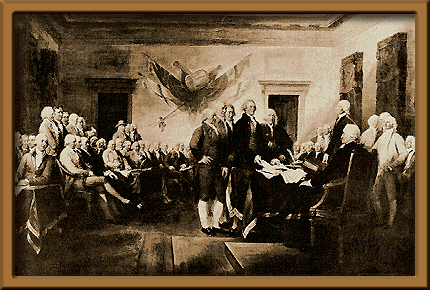 On the wall at the back, facing the President's desk, was a panoply--consisting of a drum, swords, and banners seized from Fort Ticonderoga the previous year. Ethan Allen and Benedict Arnold had captured the place, shouting that they were taking it "in the name if the Great Jehovah and the Continental Congress!" Now Congress got to work, promptly taking up an emergency measure about which there was discussion but no dissension. "Resolved: That an application be made to the Committee of Safety of Pennsylvania for a supply of flints for the troops at New York." Then Congress transformed itself into a committee of the whole, The Declaration of Independence was read aloud once more, and debate resumed. Though Jefferson was the best writer of all of them, he had been somewhat verbose. Congress hacked the excess away. They did a good job, as a side-by-side comparison of the rough draft and the final text shows. They cut the phrase "by a self-assumed power." "Climb" was replaced by "must read," then "must" was eliminated, then the whole sentence, and soon the whole paragraph was cut. Jefferson groaned as they continued what he later called "their depredations." "Inherent and inalienable rights" came out "certain unalienable rights," and to this day no one knows who suggested the elegant change. A total of 86 alterations were made. Almost 500 words were eliminated, leaving 1,337. At last, after three days of wrangling, the document was put to a vote. Here in this hall Patrick Henry had once thundered: "I am no longer a Virginian, Sir, but an American." But today the loud, sometimes bitter argument stilled, and without fanfare the vote was taken from north to south by colonies, as was the custom. On July 4, 1776, the Declaration of Independence was adopted. There were no trumpets blown. No one stood on his chair and cheered. The afternoon was waning and Congress had no thought of delaying the full calendar of routine business on its hands. For several hours they worked on many other problems before adjourning for the day. Much to lose... What kind of men were the 56 signers who adopted the Declaration of Independence and who, by their signing, committed an act of treason against the Crown? To each of you the names Franklin, Adams, Hancock, and Jefferson are almost as familiar as household words. Most of us, however, know nothing of the other signers. Who were they? What happened to them? I imagine that many of you are somewhat surprised at the names not there: George Washington, Alexander Hamilton, Patrick Henry. All were elsewhere. Ben Franklin was the only really old man. Eighteen were under 40; three were in their 20s. Of the 56, almost half--24--were judges and lawyers. Eleven were merchants, 9 were land-owners and farmers, and the remaining 12 were doctors, ministers, and politicians. With only a few exceptions, such as Samuel Adams of Massachusetts, these were men of substantial property. All but two had families. The vast majority were men of education and standing in their communities. They had economic security as few men had in the 18th century. Each had more to lose from revolution than he had to gain by it. John Hancock, one of the richest men in America, already had a price of 500 pounds on his head. He signed in enormous letters so "that his Majesty could now read his name without glasses and could now double the reward." Ben Franklin wryly noted: "Indeed we must all hang together, otherwise we shall most assuredly hang separately." Fat Benjamin Harrison of Virginia told tiny Elbridge Gerry of Massachusetts: "With me it will all be over in a minute, but you, you will be dancing on air an hour after I am gone." These men knew what they risked. The penalty for treason was death by hanging. And remember: a great British fleet was already at anchor in New York Harbor. They were sober men. There were no dreamy-eyed intellectuals or draft card burners here. They were far from hot-eyed fanatics, yammering for an explosion. They simply asked for the status quo. It was change they resisted. It was equality with the mother country they desired. It was taxation with representation they sought. They were all conservatives, yet they rebelled.
Richard Henry Lee, a delegate from Virginia, had introduced the resolution to adopt the Declaration of Independence in June of 1776. He was prophetic is his concluding remarks:
"Why then sir, why do we longer delay? Why still deliberate? Let this happy day give birth to an American Republic. Let her arise not to devastate and to conquer but to reestablish the reign of peace and law. The eyes of Europe are fixed upon us. She demands of us a living example of freedom that may exhibit a contrast in the felicity of the citizen to the ever increasing tyranny which desolates her polluted shores. She invites us to prepare an asylum where the unhappy may find solace, and the persecuted repose. If we are not this day wanting in our duty, the names of the American legislators of 1776 will be placed by posterity at the side of all of those whose memory has been and ever will be dear to virtuous men and good citizens." Though the resolution was formally adopted July 4, it was not until July 8 that two of the states authorized their delegates to sign, and it was not until August 2 that the signers met at Philadelphia to actually put their names to the Declaration.
"Most glorious service"... Even before the list was published, the British marked down every member of Congress suspected of having put his name to treason. All of them became the objects of vicious manhunts. Some were taken. Some, like Jefferson, had narrow escapes. All who had property or families near British strongholds suffered.
Phillips Livingstone had all his great holdings in New York confiscated and his family driven out of their home. Livingstone died in 1778 still working in Congress for the cause. Louis Morris, the fourth New York delegate, saw all his timber, crops, and livestock taken. For seven years he was barred from his home and family. John Hart
of Trenton, New Jersey, risked his life to return home to see his dying
wife. Hessian soldiers rode after him, and he escaped in the woods.
While his wife lay on her deathbed, the soldiers ruined his farm and
wrecked his homestead. Hart, 65, slept in caves and woods as he was
hunted across the countryside. When at long last, emaciated by hardship,
he was able to sneak home, he found his wife had already been buried,
and his 13 children taken away. He never saw them again. He died a
broken man in 1779, without ever finding his family. Dr. John Witherspoon, signer, was president of the College of New Jersey, later called Princeton. The British occupied the town of Princeton, and billeted troops in the college. They trampled and burned the finest college library in the country. Judge Richard Stockton, another New Jersey delegate signer, had rushed back to his estate in an effort to evacuate his wife and children. The family found refuge with friends, but a sympathizer betrayed them. Judge Stockton was pulled from bed in the night and brutally beaten by the arresting soldiers. Thrown into a common jail, he was deliberately starved. Congress finally arranged for Stockton's parole, but his health was ruined. The judge was released as an invalid, when he could no longer harm the British cause. He returned home to find his estate looted and did not live to see the triumph of the revolution. His family was forced to live off charity. Robert
Morris, merchant prince of Philadelphia, delegate and signer, met
Washington's appeals and pleas for money year after year. He made and
raised arms and provisions which made it possible for Washington to
cross the Delaware at Trenton. In the process he lost 150 ships at sea,
bleeding his own fortune and credit almost dry. George Clymer,
Pennsylvania signer, escaped with his family from their home, but their
property was completely destroyed by the British in the Germantown and
Brandywine campaigns.
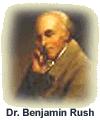
Dr. Benjamin Rush, also from Pennsylvania, was forced to flee to Maryland. As a heroic surgeon with the army, Rush had several narrow escapes. John Morton, a Tory in his views previous to the debate, lived in a strongly loyalist area of Pennsylvania. When he came out for independence, most of his neighbors and even some of his relatives ostracized him. He was a sensitive and troubled man, and many believed this action killed him. When he died in 1777, his last words to his tormentors were: "Tell them that they will live to see the hour when they shall acknowledge it [the signing] to have been the most glorious service that I rendered to my country." William
Ellery, Rhode Island delegate, saw his property and home burned to the
ground.
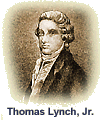
Thomas Lynch, Jr., South Carolina delegate, had his health broken from privation and exposures while serving as a company commander in the military. His doctors ordered him to seek a cure in the West Indies and on the voyage he and his young bride were drowned at sea. Edward Rutledge, Arthur Middleton, and Thomas Heyward, Jr., the other three South Carolina signers, were taken by the British in the siege of Charleston. They were carried as prisoners of war to St. Augustine, Florida, where they were singled out for indignities. They were exchanged at the end of the war, the British in the meantime having completely devastated their large land holdings and estates. Thomas Nelson, signer of Virginia, was at the front in command of the Virginia military forces. With British General Charles Cornwallis in Yorktown, fire from 70 heavy American guns began to destroy Yorktown piece by piece. Lord Cornwallis and his staff moved their headquarters into Nelson's palatial home. While American cannonballs were making a shambles of the town, the house of Governor Nelson remained untouched. Nelson turned in rage to the American gunners and asked, "Why do you spare my home?" They replied, "Sir, out of respect to you." Nelson cried, "Give me the cannon!" and fired on his magnificent home himself, smashing it to bits. But Nelson's sacrifice was not quite over. He had raised $2 million for the Revolutionary cause by pledging his own estates. When the loans came due, a newer peacetime Congress refused to honor them, and Nelson's property was forfeited. He was never reimbursed. He died, impoverished, a few years later at the age of 50. Lives, fortunes, honor... Of those 56 who signed the Declaration of Independence, nine died of wounds or hardships during the war. Five were captured and imprisoned, in each case with brutal treatment. Several lost wives, sons or entire families. One lost his 13 children. Two wives were brutally treated. All were at one time or another the victims of manhunts and driven from their homes. Twelve signers had their homes completely burned. Seventeen lost everything they owned. Yet not one defected or went back on his pledged word. Their honor, and the nation they sacrificed so much to create, is still intact.
The 56 signers of the Declaration of Independence proved by their every deed that they made no idle boast when they composed the most magnificent curtain line in history. "And for the support of this Declaration with a firm reliance on the protection of divine providence, we mutually pledge to each other our lives, our fortunes and our sacred honor." |
 It
was principle, not property, that had brought these men to Philadelphia.
Two of them became presidents of the United States. Seven of them became
state governors. One died in office as vice president of the United
States. Several would go on to be U.S. Senators. One, the richest man in
America, in 1828 founded the Baltimore and Ohio Railroad. One, a
delegate from Philadelphia, was the only real poet, musician and
philosopher of the signers (it was he, Francis Hopkinson--not Betsy
Ross--who designed the United States flag).
It
was principle, not property, that had brought these men to Philadelphia.
Two of them became presidents of the United States. Seven of them became
state governors. One died in office as vice president of the United
States. Several would go on to be U.S. Senators. One, the richest man in
America, in 1828 founded the Baltimore and Ohio Railroad. One, a
delegate from Philadelphia, was the only real poet, musician and
philosopher of the signers (it was he, Francis Hopkinson--not Betsy
Ross--who designed the United States flag). 
 William
Ellery, delegate from Rhode Island, was curious to see the signers'
faces as they committed this supreme act of personal courage. He saw
some men sign quickly, "but in no face was he able to discern real
fear." Stephen Hopkins, Ellery's colleague from Rhode Island, was a man
past 60. As he signed with a shaking pen, he declared: "My hand
trembles, but my heart does not."
William
Ellery, delegate from Rhode Island, was curious to see the signers'
faces as they committed this supreme act of personal courage. He saw
some men sign quickly, "but in no face was he able to discern real
fear." Stephen Hopkins, Ellery's colleague from Rhode Island, was a man
past 60. As he signed with a shaking pen, he declared: "My hand
trembles, but my heart does not." 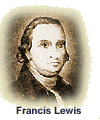 Francis
Lewis, New York delegate, saw his home plundered and his estates, in
what is now Harlem, completely destroyed by British soldiers. Mrs. Lewis
was captured and treated with great brutality. Though she was later
exchanged for two British prisoners through the efforts of Congress, she
died from the effects of her abuse.
Francis
Lewis, New York delegate, saw his home plundered and his estates, in
what is now Harlem, completely destroyed by British soldiers. Mrs. Lewis
was captured and treated with great brutality. Though she was later
exchanged for two British prisoners through the efforts of Congress, she
died from the effects of her abuse. 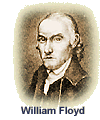 William
Floyd, another New York delegate, was able to escape with his wife and
children across Long Island Sound to Connecticut, where they lived as
refugees without income for seven years. When they came home, they found
a devastated ruin.
William
Floyd, another New York delegate, was able to escape with his wife and
children across Long Island Sound to Connecticut, where they lived as
refugees without income for seven years. When they came home, they found
a devastated ruin. 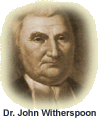
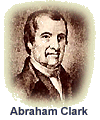 And,
finally, there is the New Jersey signer, Abraham Clark. He gave two sons
to the officer corps in the Revolutionary Army. They were captured and
sent to the infamous British prison hulk afloat in New York harbor known
as the hell ship "Jersey," where 11,000 American captives were to die.
The younger Clarks were treated with a special brutality because of
their father. One was put in solitary and given no food. With the end
almost in sight, with the war almost won, no one could have blamed
Abraham Clark for acceding to the British request when they offered him
his sons' lives if he would recant and come out for the King and
parliament. The utter despair in this man's heart, the anguish in his
very soul, must reach out to each one of us down through 200 years with
his answer: "No."
And,
finally, there is the New Jersey signer, Abraham Clark. He gave two sons
to the officer corps in the Revolutionary Army. They were captured and
sent to the infamous British prison hulk afloat in New York harbor known
as the hell ship "Jersey," where 11,000 American captives were to die.
The younger Clarks were treated with a special brutality because of
their father. One was put in solitary and given no food. With the end
almost in sight, with the war almost won, no one could have blamed
Abraham Clark for acceding to the British request when they offered him
his sons' lives if he would recant and come out for the King and
parliament. The utter despair in this man's heart, the anguish in his
very soul, must reach out to each one of us down through 200 years with
his answer: "No."