Victor R Claveau, MJ
Baptism, eucharist, and Confirmation are called the sacraments of initiation. The one I now write about is the eucharist, which we believe to be the actual Body and Blood of our Savior, doing so by relating a true story that took place a few years ago.
I was asked to take over a religion class for a day at a Protestant high school. I met with the pastor, his wife, and four other members of the faculty. It was not long before we got down to basics. I offered to answer any and all questions they had concerning Catholicism. The pastor had been sitting directly opposite me. His wife (I’ll call her Jane) was sitting on a large pillow on the floor next to him. she sat up straight and said, “You seem well educated. Do you honestly believe that just because a priest says a few words over the bread and wine that they become the Body and Blood of Jesus? I answered, “Certainly, I would give my life rather than deny this reality.” Jane said, “Please explain.”
I thought for a moment and began my answer with the question, “Who created the universe?” The question surprised Jane and, after a brief hesitation, she answered, “God did.” I then asked how God created, and she answered, “He spoke.” “Yes,” I said, “God said, ‘Let there be light,’ and there was light. There was a Bible on the table before me. I picked it up, turned to the first chapter of Genesis, and recited additional passages that demonstrated that when God spoke during the creation narrative, whatever He said came to pass.
Then, to hammer home my point further, I referred to Isaiah 55:11: “So shall my word be that goes forth from my mouth; it shall not return to me empty, but it shall accomplish that which I purpose, and prosper in the thing for which I sent it.” “Do you agree,” I said, “that when God declares something into being that it actually comes to pass?” “Yes, of course,” Jane answered. “Do you believe that Jesus is a divine person, in others words, God.” Jane nodded assent.
“Then,” I continued, “whatever Jesus declared would have to come to pass as well. When He told the woman caught in adultery that her sins were forgiven, were they not forgiven? Did He not have the power to raise people from the dead and cure many illnesses by the mere power of his word? “Certainly,” she answered. “Well, then, at the last supper when he held bread in His sacred hands and declared ‘Take, eat; this is my Body’ (Mt 26:26), what, or should I say, “whom” was he holding in his hands? Jane seemed to be a bit shocked and, after a pregnant pause, answered, ‘himself, he had to be holding His own Body.’” I went on, to illustrate further: “and when Jesus took the cup and had given thanks, He gave it to them, saying, ‘Drink of it, all of you; for this is my Blood’ (Mt 26:28), What was he holding in his hands?” Jane answered, “His Blood.” “Exactly,” I said, “It could be no less.”
Jane and her husband appeared stunned. although this is one of the greatest mysteries in Christianity, it is really quite simple. Jesus changed bread and wine into His sacred Body and Blood, and in Luke’s Gospel, Jesus instructed his apostles to do the same by saying, “Do this in remembrance of me” (22:19). What did Jesus mean by the word “this”? He had just changed bread and wine into his Body and Blood. Isn’t it obvious that Jesus meant for the apostles to change bread and wine into his Body and Blood and gave them the power to do it? Catholics believe that this was the moment when Jesus established the ministerial priesthood. the logic of my explanation was obvious, and there was silence in the room. as we had been in conversation for almost three hours, I thought it best to end on that note and took leave of these good people.
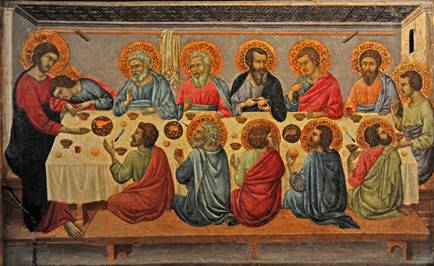
The Last Supper by Ugolino da siena (Ugolino di nerio), c. 1325–30
First published in The Catholic Response September/October 2022.