©2025 Victor R. Claveau, MJ
“In a place where there are no men, try to be a man!” -Hillel the Elder, (Avot 2:6). [i]
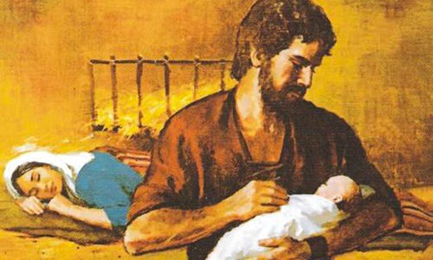
The model earthly example of fatherhood has of course been St. Joseph who is often thought of as the prime Patron Saint for fathers.
St. Joseph’s guardianship of the Holy Family, however, has not been restricted to a general protection of those entrusted to his charge. The Litany of St. Joseph, papal declaration, and popular acclamation have made his, among many other accolades, the patron of:
- those in authority, because he, who was least in holiness at Nazareth, was placed over our Lord and our Lady, and he used his authority in the most detached manner possible, respecting its divine source and not abusing it for selfish personal aggrandizement as if it grew out of some intrinsic right in itself;
- Patron of fathers, because of Joseph’s fatherhood is the most sublime fatherhood ever given to any human being, and he is the worthiest of all fathers;
- Patron of husbands, because Joseph was married to the most perfect of all women, and since he had been chosen by God for this position, too, he is evidently the most perfect of husband of the human race.
The Gospel narratives tell us the St. Joseph was the father of Jesus in a unique sense that was not biological. He was listed in the genealogies (Mt. 1 and Lk. 3) as one of the legal ancestors of Jesus and therefore he had parental and paternal authority.
God brought the Holy Family of Joseph and Mary into existence so that Jesus could be brought into the world within this family, and be reared, educated, and loved there. Jesus was miraculously conceived by the Holy Spirit and born of the Blessed Virgin when she was already Joseph’s wife. By the bonds of marriage any children she had within her marriage belonged to Joseph her husband. St. Joseph certainly had a fatherly relationship to Jesus.
Chosen by the Father to be the guardian of his Divine Son, it was Saint Joseph who decided to take Mary and Jesus to Egypt and then later on to Galilee. It was he who decided to settle his family in Nazareth (Mt. 2:14. 22-23). Joseph made these decisions as head of the household and Mary did not hesitate to recognize him as the “man of the house.”
St. Joseph’s conformity to God’s will was a bloodless martyrdom of self so complete that it is difficult to grasp. Yet, to his friends he was only “Joseph the carpenter.”
Many persons are surprised to hear of a virtue called “emulation.” It is the desire urging us to imitate, to equal, and possibly to surpass the good qualities of others. Emulation is particularly valuable in urging us to use others’ good qualities as a stimulus to our own shortcomings. We can always go in spirit to St. Joseph as our masculine model and endeavor to emulate him.
A father is one who gives to another by generation his own substance, so that the two have the same specific inseparable human nature. In fatherhood there are two bonds; one obviously physical and the other moral. The moral bond implies certain duties, and obligations on the part of both the father and child.
“The Child is father of the Man” is a line from the poem “My Heart Leaps Up” by William Wordsworth (1770 –1850).
My heart leaps up when I behold
A rainbow in the sky:
So was it when my life began;
So is it now I am a man;
So be it when I shall grow old,
Or let me die!
The Child is father of the Man;
And I could wish my days to be
Bound each to each by natural piety.
Wordsworth’s premise is that our childhoods shape our adulthood. Phycologists use the term ‘formative years’ to refer to the period of a person’s life during which key psychological and social milestones are achieved, typically encompassing infancy to adolescence. This stage is pivotal in shaping an individual’s personality, behavior, and cognitive abilities.
Every father is responsible for the salvation of his wife and children and will one day stand before the Master to give an accounting. Fathers are stewards of souls.
It is the father’s responsibility to set the tone for his family. There should be an atmosphere of peace and tranquility, and yet lively communication. The father considers the opinions of his family, but decides according to his own view. He must treat his family with kindness and humility, and in doing so, lead them to God. He must train himself to be gentle and patient and to receive his children with warmth. He must, at all times, be ready to answer the child’s questions, even about matters that seem to have little consequence. A child afraid to ask questions cannot learn. No question should be rejected out-of-hand as stupid or foolish. No child should feel embarrassed or discouraged by feeling he could not ask whatever he pleased. The father should put aside everything in order to attentively listen and answer a child’s questions.
One of the most important responsibilities of fatherhood is to religiously educate his children. A good father is one who is a bold student of the Faith.
Many Catholic families home-school their children, perhaps to shield them from negative secular influences and/or to ensure a proper Catholic education. Usually, it is the mother that undertakes this overall responsibility. However, the religious education should be the responsibility of the father. An hours’ instruction, once or twice per week may be all that is necessary. He can inspire and educate by reading the lives of the saints and Gospel stories to his younger children and having fruitful discussions with his pubescent teenage sons (Mom can instruct the daughters).
A father leads by example showing love and strength. Above all, he must demonstrate religious submission in all things to the will of God; setting an example of moral manliness by being resolute and at the same time being patience and gentle. He must demonstrate strength of character and humility; never lying, cheating, stealing, or using foul language; never criticizing, always encouraging. He must teach his children to be patriots and to love their country.
It is said that “Man is tallest when he is on his knees before God.” It is the father’s responsibility to lead prayers of thanksgiving before and after meals. Fish on Friday’s is a small sacrifice which demonstrates gratitude to God for the blessings received and helps us to grow spiritually through self-denial. Small gestures can have lasting value.
It is also his responsibility to lead the evening prayers and a weekly Rosary. Monthly confession should be the norm for all who have reached the age of reason. The father should show his love and spiritual authority by blessing his family with the Sign of the Cross on their foreheads at day’s end.
He must teach his children proper respect for God’s house. A child as young as two years can be taught to genuflect and make the sign of the cross. He must also foster an understanding of Holy Mass and the reality of our eucharistic Lord.
He must treat his wife with the same respect and dignity he would to the Blessed Mother; demonstrating what a loving marital relationship should be. When a man treats his wife as his queen, she will treat him as her king.
Most importantly, he must reverence Christ as Lord and always be prepared to make a defense to anyone who calls him to account for the hope that is in him, yet do it with gentleness and reverence (1 Pet. 3:15). “According to the painstaking is the reward” is a famous Talmudic saying. The reward is great when a father can be justly proud of his adult children.
[i] Hillel (died c. 10 CE) was one of the greatest rabbis of the Jewish tradition. sage and scholar associated with the development of the Mishnah and the Talmud and the founder of the House of Hillel (Beit Hillel) school of tannaim (teachers).