
For conspicuous gallantry and intrepidity at the risk of life, above and beyond the call of duty, in action involving actual conflict with an opposing armed force.
Presented by the President in the Name of the Congress, it is the highest honor that can be bestowed upon any American. The men who wear it call themselves “recipients” (not winners), for what they received it for was not a contest…it was a time of terror and death where their valor was tested, then recognized by a grateful Nation. All of them feel that they didn’t win The Medal…they RECEIVED it. Frequently called “The Congressional Medal of Honor”, its true title is simply: MEDAL OF HONOR
The 3 Present Day Variations of the Medal of Honor
The Army Medal Of Honor
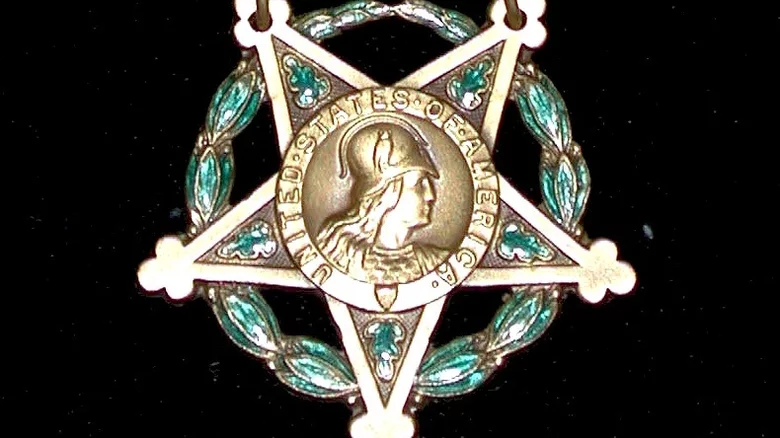
The Army’s Medal of Honor (depicted above) dates back to 1862, according to History, the first recipients being a group of six Union soldiers who penetrated deep into enemy territory during the Civil War and destroyed bridges and railroad tracks between Chattanooga and Atlanta.
The current iteration of the medallion is described by the Smithsonian as “A gold five pointed star, each point tipped with trefoils, one and a half inches wide, surrounded by a green laurel wreath and suspended from a gold bar inscribed ‘VALOR’, surmounted by an eagle.” According to a website dedicated to the medals, the Army’s medallion contains a circle of laurel leaves, added in 1904, to serve as a symbol of victory. The helmeted figure in the middle is Minerva, the Roman goddess of wisdom and war, the words “United States of America” surrounding her. Green, leaf-like clusters in each of the five points of the star represent strength.
The Air Force Medal of Honor
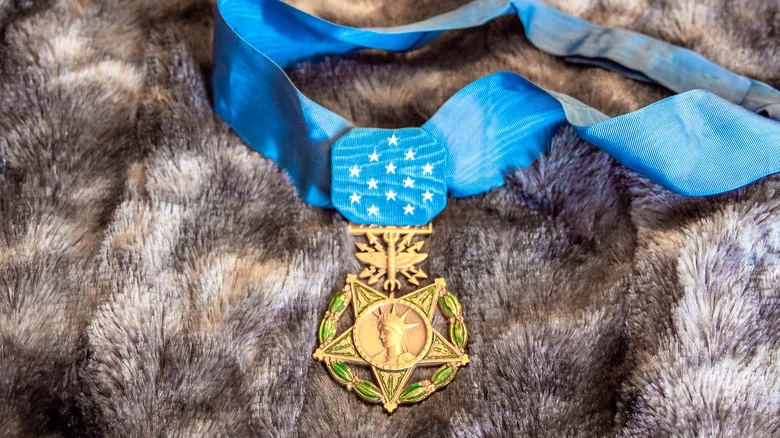
The Air Force Medal of Honor (pictured above) is younger than its Navy/Marine Corps/Coast Guard and Army counterparts, having been established in 1965, according to Medal of Honor Convention. The first recipient was Major Bernard Fisher, who received it in 1967 for heroism during the Vietnam War.
The Navy, Marine Corps, and Coast Guard Medal
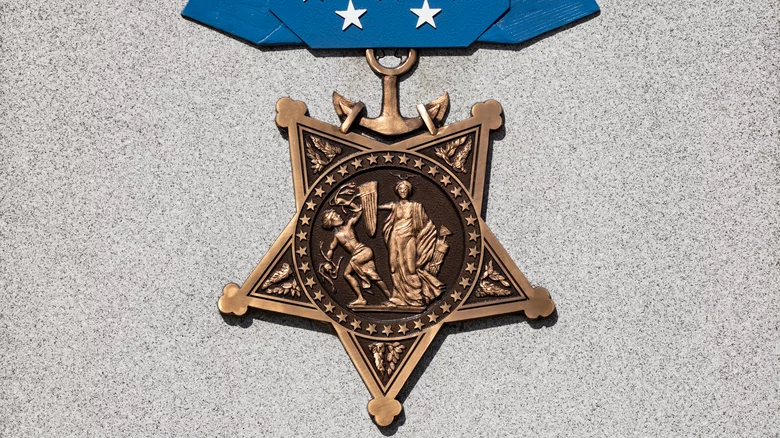
The Navy Medal of Honor (pictured above) is the oldest of the three medals, according to Medal of Honor Convention, established in 1861 and, at first, available only to enlisted men but later extended to officers as well (per the Naval History and Heritage Command). According to a website dedicated to the Medal of Honor, the first recipient was Robert Benton, who earned the medal through heroism during the Civil War.
The Navy’s version, also used by the Marine Corps and the Coast Guard, is fundamentally different from its counterparts in that it lacks the word “VALOR,” and in that its pendant hangs from an anchor. According to another Medal of Honor website, the goddess Minerva appears again, this time fighting a man clutching snakes, with an owl, representing wisdom, perched on her helmet. In her left hand are a bundle of rods and an ax blade, symbolizing authority; in her right, a shield, representing the union of the states. The states are also represented by the 34 stars, representing the number of stars on the flag/states of the union in 1862. Like its Army and Air Force counterparts, the Navy medal also includes leaves in each of the five points of its star, representing victory and strength.
The first military decoration formally authorized by the American government to be worn as a badge of honor, the Medal of Honor was created by an act of Congress in December 1861. On December 9, Iowa Senator James W. Grimes introduced S. No. 82 in the United States Senate, a bill designed to “promote the efficiency of the Navy” by authorizing the production and distribution of “medals of honor”. On December 21st the bill was passed, authorizing 200 such medals be produced “which shall be bestowed upon such petty officers, seamen, landsmen and marines as shall distinguish themselves by their gallantry in action and other seamanlike qualities during the present war (Civil War).” President Lincoln signed the bill and the (Navy) Medal of Honor was born.
Two months later on February 17, 1862 Massachusetts Senator Henry Wilson introduced a similar bill, this one to authorize “the President to distribute medals to privates in the Army of the United States who shall distinguish themselves in battle.” Over the following months wording changed slightly as the bill made its way through Congress. When President Abraham Lincoln signed S.J.R. No. 82 on July 12, 1862, the Army Medal of Honor was born. It read in part
Resolved by the Senate and House of Representatives of the United States of America in Congress assembled, That the President of the United States be, and he is hereby, authorized to cause two thousand “medals of honor” to be prepared with suitable emblematic devices, and to direct that the same be presented, in the name of the Congress, to such noncommissioned officers and privates as shall most distinguish themselves by their gallantry in action, and other soldier-like qualities, during the present insurrection (Civil War).
With this simple and rather obscure act Congress created a unique award that would achieve prominence in American history like few others. The table below will acquaint you with a chronological time line of key events in the history of the Medal of Honor.
| 3 MAR 1847 | Congress authorizes a “certificate of merit” be presented by the President when a “private soldier distinguishes himself in the service”, along with additional pay of $2 per month. |
| 9 DEC 1861 | Iowa Senator James W. Grimes, chairman of the Senate Naval Committee, introduces S. No.82 in Congress to create a medal of honor to promote the efficiency of the Navy. |
| 21 DEC 1861 | President Abraham Lincoln approves the Congressional action to provide for 200 Navy Medals of Honor. |
| 17 FEB 1862 | Massachusetts Senator Henry Wilson introduces a bill in Congress to provide for an Army Medal of Honor for “privates in the Army of the United States who shall distinguish themselves in battle.” |
| 12 JUL 1862 | President Lincoln approves the legislation authorizing the preparation of 2,000 Medals of Honor to “be presented, in the name of the Congress, to such non-commissioned officers and privates as shall most distinguish themselves by their gallantry in action, and other soldier-like qualities.” Already 88 soldiers have performed heroic actions that will be ultimately awarded Medals of Honor. |
| 3 MAR 1863 | The Act of 3 March 1863 extended the presentations of the Army Medal of Honor to officers, as well as non-commissioned officers and privates. (The Navy medal continued to be reserved for enlisted personnel ONLY.) |
| 23 APR 1890 | The MEDAL OF HONOR LEGION is established to protect the integrity of the Medal. |
| 2 MAY 1896 | Congress approved legislation authorizing “a rosette or knot to be worn in lieu of the medal, and a ribbon to be worn with the medal.” (20 Stat. 473) |
| 10 NOV 1896 | For the first time a change is made in the design of the Medal of Honor. The change is only in the suspension ribbon and affects only the Army’s Medal of Honor. |
| 26 JUN 1897 | With more than 700 Civil War soldiers applying for Medals of Honor since 1890, President William McKinley had directed the Army to establish new policies regarding Medal of Honor applications and awards. Published on this date the new regulations: …Established that Medals of Honor could only be awarded for “gallantry and intrepidity” above and beyond that of one’s fellow soldiers, …Required that a submission for the Medal of Honor be made by a person other than the veteran who had performed the heroic deed, …Required the testimony, under oath, of one or more eyewitnesses to the heroic deed. …Set a time limit of one year for any person to be submitted for the Medal of Honor for an act occurring after 26 June 1897. |
| 1 FEB 1898 | The Army issues proper instruction for display of the Medal of Honor suspended from a ribbon hung around the neck of the recipient. (For the next half century Army Medals of Honor were sometimes displayed in this fashion, at other times pinned to the tunic of a soldier’s uniform.) |
| 23 APR 1904 | Congress authorizes a distinctive new design for the Army Medal of Honor, the brainchild of General George Gillespie who had received the Medal of Honor during the Civil War. The new “Gillespie Medal” retains the star shape but surrounds it with a green laurel. The Medal is suspended from a newly designed blue ribbon bearing 13 stars from a bar on which is printed the word “VALOR”. Upon authorizing the new Medal of Honor design, Congress requires Medal recipients to return their original Medals to be replaced with the new. |
| 27 FEB 1907 | Recipients of the earlier designs for the Medal of Honor have shown reluctance to return their “old” medals for the new “Gillespie” medals because of the sentimental value their original award holds for them. In response Congress authorizes them to be issued the new design without turning in their original Medals and instructs that those who had previously turned in their Medals have them returned to them. The legislation specifies, however, that both Medals (original and Gillespie) cannot be worn at the same time. |
| 1913 | The Navy changes the ribbon from which their Medal of Honor is suspended to a blue ribbon with 13 white stars, similar to the design of the ribbon patented with Gillespie’s Medal of Honor for the Army. Other slight changes in design are also made. |
| 3 MAR 1915 | Authorized the President to present “a suitable Medal of Honor to be awarded to any officer of the Navy, Marine Corps, or Coast Guard who shall have distinguished himself in battle or displayed extraordinary heroism in the line of his profession.” Previously the award was reserved for enlisted personnel ONLY, but this act made it available to officers as well. (38 Stat. 928, 931) |
| 27 APR 1916 | Congress passes legislation to establish “The Army and Navy Medal of Honor Roll” and authorizes a $10 monthly pension for Medal recipients over age 65. |
| 3 JUN 1916 | “A board to consist of five general officers on the retired list of the Army shall be convened…for the purpose of investigating and reporting upon past awards or issue of the so-called congressional medal of honor.” |
| 16 OCT 1916 | The BOARD OF GENERALS authorized in the previous legislation convened under Lt. General Nelson Miles, a Medal recipient from the Civil War. General Miles had taken an active role in promoting legislation to protect the Medal as commander of the Medal of Honor Legion and approached the work of his committee with determination and dedication. Every award of the Army Medal of Honor since the Civil War was reviewed. The recipients were anonymous to the board, represented only by a number. |
| 23 JUN 1917 | Commander Willis Winter Bradley, Jr. aboard the U.S.S. Pittsburgh becomes the first Medal of Honor recipient of World War I. In all 119 soldiers, sailors, marines, and for the first time AIRMEN performed heroism meriting their Nation’s highest award over the following two years. Only 4 such awards were actually presented during the period of the war; the remainder came as a result of a review of World War I awards of the Distinguished Service Cross at the request of General John J. Pershing. The last presentation of a World War I Medal of Honor would not occur until the closing decade of the century. |
| 9 JUL 1918 | The Medal of Honor was born in 1862, but it was the act of 9 July 1918 that defined the future of the award, while further eliminated the Certificate of Merit while establishing the new “Pyramid of Honor” providing for lesser awards (The Distinguished Service Cross, The Distinguished Service Medal, and the Silver Star). A key difference between the levels of awards was spelled out, “That the President is authorized to present, in the name of the Congress, a medal of honor only to each person who, while an officer or enlisted man of the Army, shall hereafter, in action involving actual conflict with an enemy, distinguish himself conspicuously by gallantry and intrepidity at the risk of his life above and beyond the call of duty.” The lesser awards were authorized for presentation by the President, “BUT NOT IN THE NAME OF CONGRESS.” The act of July 9th further established time limits to avoid problems like those encountered with Civil War veterans seeking the award. Recommendations for Medals of Honor had to be made within 2 years of the act of heroism for which it was to be awarded, and the Medal was to be presented within 3 years. The act of July 9th was further clarified in September, then again in February 1919, to stipulate that no person could receive more than ONE Medal of Honor. Previously there had been 19 DOUBLE AWARDS of the Medal, but hereafter, while there were provisions for second and consecutive awards of lesser medals to be made and noted with appropriate ribbon devices, no more than ONE Medal of Honor could be awarded. |
| 7 AUG 1942 | The TIFFANY CROSS established for non-combat naval heroism in 1942 had proven unpopular, perhaps because it so closely resembled the German Iron Cross. It was also poorly regulated and documented. The Act of August 7th restored the earlier provisions of the Navy Medal of Honor for non-combat heroism and eliminated the Tiffany Cross and the two-medal system. |
| 20 JUL 1950 | General William F. Dean and George Dalton Libby earn the first Medals of Honor of the Korean War. Libby was killed in action and General Dean was taken as a Prisoner of War. |
| 10 AUG 1956 | Legislation is authorized providing members of the United States Air Force with their own, distinctive design for an Air Force Medal of Honor separate from that of the Navy and Army. |
| 14 AUG 1958 | The Medal of Honor Society is absorbed into the Congressionally Chartered CONGRESSIONAL MEDAL OF HONOR SOCIETY OF THE UNITED STATES OF AMERICA under Title 38, USC. |
| 25 JUL 1963 | Congress amended Titles 10 and 14 of the US Code establishing criteria and guidelines for award of the Medal of Honor: …It would be awarded for action against an enemy of the United States, …while engaged in military operations involving conflict with an opposing foreign force, or …while serving with friendly forces (such as was the case with the UN forces in Korea) in an armed conflict against an opposing armed force in which the United States is not a belligerent party. |
| 13 OCT 1964 | Changes in Medal of Honor legislation provided for a $100 per month pension for Medal of Honor recipients over the age of 50. |
| 1965 | The AIR FORCE introduces the design for their distinctive Air Force Medal of Honor, similar in design to that of the Army Medal of Honor only larger and displaying the head of the Statue of Liberty and other design changes. Each branch of service, Army, Navy/Marines/Coast Guard, and Air Force now has its own medal design. All three branches display the Medal suspended below a neck ribbon. |