©2026 Victor R. Claveau, MJ
The history of Christianity in the Philippines is one of remarkable fidelity to Jesus Christ, deep devotion to the Blessed Virgin Mary, and steadfast adherence to the Catholic faith amid persecution, poverty, social upheaval, and cultural transformation. Since the arrival of Catholic missionaries in the sixteenth century, the Filipino people have embraced the Gospel with extraordinary zeal. Today, the Philippines stands as the largest Catholic nation in Asia and one of the strongest centers of Catholic life in the world. The sanctity that has flourished in the Philippine Church demonstrates that holiness is not limited by race, social class, occupation, or historical circumstance. The Filipino saints and blessed serve as living witnesses to the universal call to holiness proclaimed by Christ.
The Catholic Church teaches that all the baptized are called to become saints. As the Second Vatican Council declared, “all the faithful of Christ of whatever rank or status are called to the fullness of the Christian life and to the perfection of charity.”¹ Filipino saints exemplify this universal vocation. Their lives reveal courage in martyrdom, fidelity in religious life, zeal in missionary service, dedication to family, and heroic charity toward the poor. Their witness continues to inspire Catholics throughout the world and particularly the faithful of the Philippines.
The saints are not merely historical figures. According to Catholic doctrine, they are members of the Communion of Saints, united with Christ in heaven and interceding for the Church on earth.² Their examples demonstrate how divine grace transforms ordinary human lives into instruments of God’s glory. The Filipino saints, blessed, and martyrs testify that holiness is attainable in every culture and every age.
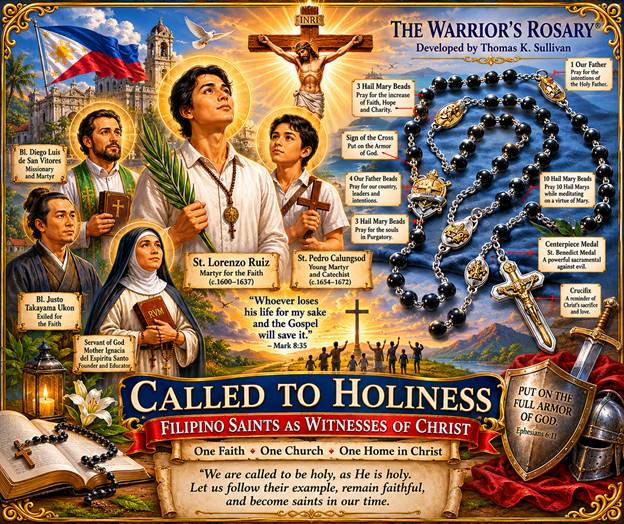
Among the saints associated with the Philippines, the first canonized martyr is Saint Lorenzo Ruiz, whose life stands as a powerful testimony to courage under persecution. Born in Binondo, Manila, around 1600, Lorenzo was the son of a Chinese father and a Filipino mother. Educated by the Dominican Fathers, he became a devoted Catholic, husband, father, and member of the Confraternity of the Holy Rosary.³
In 1636, Lorenzo joined a group of Dominican missionaries traveling to Japan, where Christianity was violently persecuted. Upon arrival, he and his companions were arrested by Japanese authorities and pressured to renounce their faith. Subjected to brutal torture, Lorenzo steadfastly refused to abandon Christ. His famous declaration remains one of the most inspiring testimonies in Catholic history:
“I am a Catholic and wholeheartedly do accept death for God. Had I a thousand lives, all these to Him shall I offer.”⁴
After enduring prolonged suffering, Lorenzo was executed on September 29, 1637, in Nagasaki. His martyrdom fulfilled Christ’s teaching that whoever loses his life for the sake of the Gospel will save it (Mk 8:35). Pope Saint John Paul II beatified Lorenzo in Manila on February 18, 1981, and canonized him in Rome on October 18, 1987.⁵ He became the first Filipino saint and remains a patron of Filipino Catholics throughout the world.
The canonization of Saint Lorenzo Ruiz was a moment of profound significance for the Philippine Church. It affirmed that the seeds of faith planted by missionaries had produced genuine holiness among the Filipino people. Lorenzo’s witness demonstrates that sanctity can flourish in the life of a layman, husband, father, and ordinary worker. His life serves as a reminder that every Catholic is called to heroic fidelity.
Another saint closely connected to the Philippines is Saint Pedro Calungsod. Born around 1654 in the Visayas region of the Philippines, Pedro was a young catechist who joined Jesuit missionaries serving in the Mariana Islands.⁶ Although still a teenager, Pedro exhibited exceptional dedication to evangelization and Christian instruction.
Working alongside the Jesuit missionary Father Diego Luis de San Vitores, Pedro helped spread the Gospel among the Chamorro people of Guam. Their missionary work encountered opposition from local leaders and enemies of Christianity who falsely accused missionaries of harming native children through baptism. In 1672, Pedro and Father Diego were attacked while baptizing an infant. Rather than flee, Pedro remained beside the missionary priest and willingly faced death. Both were killed for their faith on April 2, 1672.⁷
Pedro’s martyrdom illustrates Christ’s command to bear witness to the Gospel regardless of cost. Though young in age, he demonstrated mature Christian virtue and courage. Pope Benedict XVI canonized Pedro Calungsod on October 21, 2012.⁸ His canonization highlighted the vital role of young people in the mission of the Church and confirmed that holiness is not measured by years but by fidelity to God’s grace.
The Philippine Church also venerates numerous blessed and servants of God whose causes for canonization continue to advance. Among these is Blessed Diego Luis de San Vitores, the missionary companion of Pedro Calungsod. His zeal for evangelization and willingness to die for Christ exemplify the missionary spirit that has shaped the Catholic history of the Philippines.
Another significant figure is Blessed Iñigo de Azevedo and his companions, several of whom ministered in territories connected to the broader missionary expansion that eventually reached the Philippines. Their witness reminds Catholics that the evangelization of Asia was sustained by countless missionaries who sacrificed comfort, security, and often their lives for the Gospel.
Particularly beloved among Filipino Catholics is Blessed Justo Takayama Ukon. A Japanese Christian nobleman exiled because of his faith, he arrived in Manila in 1614.⁹ Although he died only forty days after reaching the Philippines, his courageous endurance during persecution made him a revered figure in Philippine Catholic history. Beatified in 2017, he serves as a symbol of Christian perseverance amid suffering.
The Philippines has also produced numerous candidates for sainthood whose heroic virtue continues to inspire the faithful. One of the most notable is Venerable Teofilo Camomot, Archbishop of Cagayan de Oro and founder of the Daughters of Saint Teresa. Known for humility, charity, and devotion to the poor, he spent his life serving those most in need. Reports of miraculous occurrences associated with his ministry have contributed to widespread devotion among Filipino Catholics.¹⁰
Another beloved candidate is Venerable Alfredo Obviar, Bishop of Lucena and founder of the Missionary Catechists of Saint Therese. His life was marked by pastoral zeal, simplicity, and profound concern for catechetical formation. His dedication reflects the Church’s mission to teach and sanctify the faithful.
Servant of God Darío Hernández, Servant of God Mother Ignacia del Espíritu Santo, and Servant of God Francisco de Paula Victor are among other Filipino Catholics whose causes continue to advance. Mother Ignacia, in particular, holds a unique place in Philippine history as the founder of the Religious of the Virgin Mary, the first indigenous religious congregation for women in the Philippines.¹¹ Her example demonstrates the vital role Filipino women have played in the life and growth of the Church.
The lives of Filipino saints also reveal the profound connection between holiness and devotion to the Blessed Virgin Mary. Filipino Catholic spirituality has long been characterized by Marian devotion expressed through the Rosary, novenas, processions, and consecration to the Mother of God. Saint Lorenzo Ruiz belonged to the Confraternity of the Holy Rosary, while countless Filipino martyrs and missionaries drew strength from Mary’s maternal protection. This devotion reflects the Church’s teaching that Mary leads believers more perfectly to Christ.¹²
Furthermore, the Filipino saints demonstrate the inseparable relationship between faith and charity. Their holiness was not limited to prayer but was manifested in concrete acts of service, sacrifice, and love. Saint Pedro Calungsod devoted himself to catechesis and evangelization. Saint Lorenzo Ruiz surrendered his life rather than betray Christ. Mother Ignacia served God through religious formation and education. Their lives embody Saint James’ teaching that faith without works is dead (Jas 2:17).
The witness of these saints carries particular significance in the modern world. Contemporary society often promotes materialism, secularism, and moral relativism. The Filipino saints offer a different vision rooted in truth, virtue, sacrifice, and eternal life. They remind believers that true happiness is found not in worldly success but in faithful discipleship.
The Catechism teaches that the saints continually intercede for the Church and contribute to its holiness.¹³ Filipino Catholics therefore honor these holy men and women not merely as historical heroes but as active participants in the life of the Church. Their prayers strengthen the faithful, their examples encourage perseverance, and their lives point toward the ultimate destiny of every Christian: eternal union with God.
The story of Filipino sanctity is ultimately the story of God’s grace at work in human lives. From the martyrdom of Saint Lorenzo Ruiz and Saint Pedro Calungsod to the heroic virtue of Mother Ignacia and other candidates for canonization, the Philippine Church has produced remarkable witnesses to Christ. Their lives affirm the universal truth proclaimed by Scripture: God calls people from every nation, tribe, people, and language into His kingdom (Rev 7:9).
The Filipino saints stand as enduring testimonies that holiness transcends culture, language, and geography. They teach that fidelity to Christ may require sacrifice, courage, and perseverance, yet it leads ultimately to eternal glory. In honoring these saints, Catholics recognize the triumph of divine grace and are inspired to pursue their own vocation to holiness with renewed faith, hope, and love.
Footnotes
- Second Vatican Council, Lumen Gentium, no. 40 (1964).
- Catechism of the Catholic Church (2nd ed.), nos. 946–962.
- Congregation for the Causes of Saints, Positio Super Martyrio of Lorenzo Ruiz and Companions (Vatican City, 1979).
- Testimony recorded during the martyrdom proceedings of Lorenzo Ruiz, Nagasaki, 1637.
- Pope John Paul II, Homily for the Canonization of Lorenzo Ruiz and Companions, October 18, 1987.
- Archdiocese of Cebu Historical Commission, Pedro Calungsod: Life and Martyrdom.
- Jesuit Archives, Guam Mission Records, 1672.
- Pope Benedict XVI, Canonization Homily, October 21, 2012.
- Justo Takayama Ukon, Beatification Documentation, Vatican Congregation for the Causes of Saints.
- Archdiocese of Cebu, Cause for Canonization of Teofilo Camomot.
- Religious of the Virgin Mary Archives, Historical Documents on Mother Ignacia del Espíritu Santo.
- Catechism of the Catholic Church, nos. 971, 2673–2679.
- Catechism of the Catholic Church, nos. 956, 2683.
Bibliography
- Catechism of the Catholic Church. 2nd Edition. Vatican City: Libreria Editrice Vaticana, 1997.
- Second Vatican Council. Lumen Gentium. Dogmatic Constitution on the Church. Vatican City, 1964.
- Archdiocese of Cebu Historical Commission. Pedro Calungsod: Life and Martyrdom. Cebu City.
- Congregation for the Causes of Saints. Positio Super Martyrio of Lorenzo Ruiz and Companions. Vatican City.
- Jesuit Archives. Guam Mission Records, 1668–1672.
- Religious of the Virgin Mary Archives. Historical Documents of Mother Ignacia del Espíritu Santo.
- Pope John Paul II. Homily at the Canonization of Saint Lorenzo Ruiz and Companions. Rome, October 18, 1987.
- Pope Benedict XVI. Homily at the Canonization of Saint Pedro Calungsod. Rome, October 21, 2012.
- Butler, Alban. Lives of the Saints. Revised Edition. New York: P.J. Kenedy & Sons.
- Del Castillo, Benjamin. The Saints and Martyrs of the Philippines. Manila: Catholic Truth Society.
- Philippine Catholic Bishops’ Conference. Witnesses of Faith: Filipino Saints and Martyrs. Manila: CBCP Publishing.